Mining
Cave-ins have always been a serious danger in mines. As the depth increases, the pressure on the walls and ceiling of the mine tunnel becomes enormous. Engineers have worked to design new methods of reinforcing tunnels so they will not collapse. Using just paper as a reinforcement material, can you design a good, safe tunnel? Try this as a contest among several groups of students.
Materials
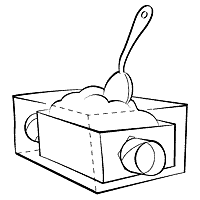
Two cardboard boxes, one small enough to fit inside the other with considerable room to spare, but deep enough to hold several inches of sand. The small box should have a hole cut at the base in two opposite sides, large enough for the experimental tunnels to slide through (see diagram).
Several pounds of wet sand
a big spoon, scoop, or measuring cup
Several sheets of regular white paper or construction paper
Tape
1. Place the smaller box, with the open top facing up, inside the larger box. (The larger box is just there to catch spilled sand.)
2. Design a tunnel, using only paper with enough tape to hold it together. Start with something simple like a long, narrow box or tube.
3. Place the tunnel through the holes in the small box. (The tunnel must be long enough to fit through both holes with an inch or so protruding from each side.)
4. Pour wet sand into the small box in measured quantities (scoops or cups), covering the tunnel. Record how much sand is required to make the tunnel collapse. (You will have to look through the tunnel from one end to determine when it collapses.)
5. Design some reinforcements or cross braces for your tunnel, still using just paper. You might try folding, twisting, tightly rolling, or braiding pieces of paper to obtain supports with different strength characteristics.
6. Repeat steps 3 and 4 to test your design again.
Newton's Apple, http://ericir.syr.edu/Projects/Newton/index.html
Gold Mining
Materials:
Pie Pan
Dirt
Copper BBs (available in a sporting goods or discount store)
Glass beads (approximately 5 mm, available in an art supply store)
Water
Colander
Procedure:
In a pie pan, mix dirt, a few small copper BBs with a handful of glass beads of about the same diameter. Add two or three cups of water. Over a colander, swish the mixture in a circle, sloshing some over the side each time.
Ask students: Do the glass beads or the copper BBs rinse out more easily with the water? Why is this happening?
Newton's Apple, http://ericir.syr.edu/Projects/Newton/index.html