-
Brain Scans Show Deaf Subjects 'Hear' Vibrations
(6/12/01)
- Journal of Consciousness Studies 8 (12) (6/12/01)
- The Turing Test: 50 Years Later (6/12/01)
- International Journal of Psychophysiology No 42 (2) (6/12/01)
- Sensations's ghost. The non-sensory "fringe" of consciousness (3/11/01)
- New issue: Consciousness & Cognition (3/11/01)
- Subliminal sights educate brain (3/11/01)
- Reversible lesions to study attention (3/11/01)
- New books on consciousness (3/11/01)
- New issue: Trends in Cognitive Science 5 (11) (3/11/01)
- New issue: Trends in Cognitive Science 5 (10) (3/11/01)
- Conscious vs unconscious memory dissociation revisited (3/11/01)
- Brain scans of intensely pleasurable responses to music (3/11/01)
- Pain Resources (1/11/01)
- Intensely pleasurable music and the brain (1/11/01)
- Neural circuitry for circadian regulation of sleep-wake cycles (1/11/01)
- also: browse the archive
Brain Scans Show Deaf Subjects 'Hear' Vibrations
 Deaf people use the region of the brain associated with hearing to sense vibrations, a new study shows. "These findings illustrate how altered experience can affect brain organization," says investigator Dean Shibata of the University of Washington. He presented his results yesterday at the annual meeting of the Radiological Society of North America.
Scientific American
[top of page]
Journal of Consciousness Studies 8 (12)
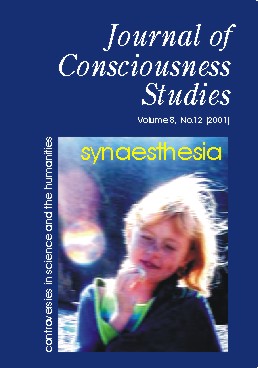 V.S. Ramachandran and E.M. Hubbard - Synaesthesia: A Window Into Perception, Thought and Language
We investigated grapheme-colour synaesthesia and found that: (1) The induced colours led to perceptual grouping and pop-out, (2) a grapheme rendered invisible through 'crowding' or lateral masking induced synaesthetic colours -- a form of blindsight -- and (3) peripherally presented graphemes did not induce colours even when they were clearly visible. Taken collectively, these and other experiments prove conclusively that synaesthesia is a genuine perceptual phenomenon, not an effect based on memory associations from childhood or on vague metaphorical speech. We identify different subtypes of number-colour synaesthesia and propose that they are caused by hyperconnectivity between colour and number areas at different stages in processing; lower synaesthetes may have cross-wiring (or cross-activation) within the fusiform gyrus, whereas higher synaesthetes may have cross-activation in the angular gyrus. This hyperconnectivity might be caused by a genetic mutation that causes defective pruning of connections between brain maps. The mutation may further be expressed selectively (due to transcription factors) in the fusiform or angular gyri, and this may explain the existence of different forms of synaesthesia. If expressed very diffusely, there may be extensive cross-wiring between brain regions that represent abstract concepts, which would explain the link between creativity, metaphor and synaesthesia (and the higher incidence of synaesthesia among artists and poets). Also, hyperconnectivity between the sensory cortex and amygdala would explain the heightened aversion synaesthetes experience when seeing numbers printed in the 'wrong' colour. Lastly, kindling (induced hyperconnectivity in the temporal lobes of temporal lobe epilepsy [TLE] patients) may explain the purported higher incidence of synaesthesia in these patients. We conclude with a synaesthesia-based theory of the evolution of language.
[top of page]
The Turing Test: 50 Years Later
 Saygin, Ayse Pinar, Cicekli, Ilyas and Akman, Varol
Minds and Machines (2000) 10(4):463-518
The Turing Test is one of the most disputed topics in artificial intelligence, philosophy of mind, and cognitive science. This paper is a review of the past 50 years of the Turing Test. Philosophical debates, practical developments and repercussions in related disciplines are all covered. We discuss Turing's ideas in detail and present the important comments that have been made on them. Within this context, behaviorism, conscioussness, the `other minds' problem, and similar topics in philosophy of mind are discussed. We also cover the sociological and psychological aspects of the Turing Test. Finally, we look at the current situation and analyze programs that have been developed with the aim of passing the Turing Test. We conclude that the Turing Test has been, and will continue to be, an influential and controversial topic.
[top of page]
International Journal of Psychophysiology 42 (2)
 New perspectives in EEG/MEG brain mapping and PET/fMRI neuroimaging of human pain
Andrew C.N. Chen
pp 53-65
With the maturation of EEG/MEG brain mapping and PET/fMRI neuroimaging in the 1990s, greater understanding of pain processing in the brain now elucidates and may even challenge the classical theory of pain mechanisms. This review scans across the cultural diversity of pain expression and modulation in man. It outlines the difficulties in defining and studying human pain. It then focuses on methods of studying the brain in experimental and clinical pain, the cohesive results of brain mapping and neuroimaging of noxious perception, the implication of pain research in understanding human consciousness and the relevance to clinical care as well as to the basic science of human psychophysiology. Non-invasive brain studies in man start to unveil the age-old puzzles of pain-illusion, hypnosis and placebo in pain modulation. The neurophysiological and neurohemodynamic brain measures of experimental pain can now largely satisfy the psychophysiologist's dream, unimaginable only a few years ago, of modelling the body�brain, brain�mind, mind�matter duality in an inter-linking 3-P triad: physics (stimulus energy); physiology (brain activities); and psyche (perception). For neuropsychophysiology greater challenges lie ahead: (a) how to integrate a cohesive theory of human pain in the brain; (b) what levels of analyses are necessary and sufficient; (c) what constitutes the structural organisation of the pain matrix; (d) what are the modes of processing among and across the sites of these structures; and (e) how can neural computation of these processes in the brain be carried out? We may envision that modular identification and delineation of the arousal�attention, emotion�motivation and perception�cognition neural networks of pain processing in the brain will also lead to deeper understanding of the human mind. Two foreseeable impacts on clinical sciences and basic theories from brain mapping/neuroimaging are the plausible central origin in persistent pain and integration of sensory�motor function in pain perception.
Abstract: BioMedNet
Event-related markers of unconscious processes
Howard Shevrin
pp 115-124
A series of studies is reviewed strongly suggesting that event-related potentials (ERPs) may provide markers for unconscious processes. In one study it was shown that, although smaller in amplitude by a least a factor of four, ERPs to subliminal stimuli have a similar component structure to ERPs to supraliminal stimuli. In another study, it was shown that an oddball P300 could be obtained for subliminal stimuli. In two additional studies, it was shown that aversive conditioning could be established unconsciously. The implications for our understanding of the role of unconscious processes in phobias and post-traumatic stress disorders are discussed, as well as more general implications for memory formation.
BioMedNet
[top of page]
Sensations's ghost. The non-sensory "fringe" of consciousness
 Bruce Mangan
PSYCHE 7 (18)
Non-sensory experiences represent almost all context information in consciousness. They condition most aspects of conscious cognition including voluntary retrieval, perception, monitoring, problem solving, emotion, evaluation, meaning recognition. Many peculiar aspects of non-sensory qualia (e.g., they resist being 'grasped' by an act of attention) are explained as adaptations shaped by the cognitive functions they serve. The most important nonsensory experience is coherence or "rightness." Rightness represents degrees of context fit among contents in consciousness, and between conscious and non-conscious processes. Rightness (not familiarity) is the feeling-of-knowing in implicit cognition. The experience of rightness suggests that neural mechanisms "compute" signals indicating the global dynamics of network integration.
PSYCHE
[top of page]
New issue: Consciousness & Cognition, 10 (3)
 Selected articles:
Confidence and Accuracy of Near-Threshold Discrimination Responses
Craig Kunimoto, Jeff Miller, Harold Pashler
This article reports four subliminal perception experiments using the relationship between confidence and accuracy to assess awareness. Subjects discriminated among stimuli and indicated their confidence in each discrimination response. Subjects were classified as being aware of the stimuli if their confidence judgments predicted accuracy and as being unaware if they did not. In the first experiment, confidence predicted accuracy even at stimulus durations so brief that subjects claimed to be performing at chance. This finding indicates that subjects's claims that they are "just guessing" should not be accepted as sufficient evidence that they are completely unaware of the stimuli. Experiments 2-4 tested directly for subliminal perception by comparing the minimum exposure duration needed for better than chance discrimination performance against the minimum needed for confidence to predict accuracy. The latter durations were slightly but significantly longer, suggesting that under certain circumstances people can make perceptual discriminations even though the information that was used to make those discriminations is not consciously available.
The Central Role of the Parietal Lobes in Consciousness
J. G. Taylor
There are now various approaches to understand where and how in the brain consciousness arises from neural activity, none of which is universally accepted. Difficulties among these approaches are reviewed, and a missing ingredient is proposed here to help adjudicate between them, that of "perspectivalness." In addition to a suitable temporal duration and information content of the relevant bound brain activity, this extra component is posited as being a further important ingredient for the creation of consciousness from neural activity. It guides the development of what is termed the "Central Representation," which is supposed to be present in all mammals and extended in humans to support self-consciousness as well as phenomenal consciousness. Experimental evidence and a theoretical framework for the existence of the central representation are presented, which relates the extra component to specific buffer working memory sites in the inferior parietal lobes, acting as attentional coordinators on the spatial maps making up the central representation. The article closes with a discussion of various open questions.
[top of page]
Subliminal sights educate brain

Helen Pearson
Nature ScienceUpdate
You must pay attention to learn, teachers say. Not necessarily, US psychologists now argue: sights we are unaware of can have a lasting impact on our brains.
Subliminal training can improve our ability to see moving dots, Takeo Watanabe and his co-workers at Boston University, Massachusetts, have found. "Without noticing, we are unconsciously learning," Watanabe says. Repeated exposure to objects we are oblivious to "could have a tremendous effect on our brains", he says.
Nature ScienceUpdate
[top of page]
Reversible lesions to study attention
 Lianna Orlando
Trends in Neurosciences, 2001, 24:11:635
Patients with unilateral cortical lesions are often inattentive to objects presented contralaterally to their lesion. Interestingly, some such patients do not demonstrate this hemispatial neglect unless an ipsilateral object is competing for attention, and this sign is called visual extinction. One theory of neglect and extinction calls for mutual inhibition between the cortical hemispheres: when one cortex is damaged, the other is disinhibited, and activation of the disinhibited cortex by competing stimuli can further inhibit the damaged hemisphere to cause extinction. Researchers from Harvard and Boston University Medical Schools have tested this theory using a remarkable technique called repetitive transcranial magnetic stimulation (rTMS) to produce transient parietal lobe lesions in normal subjects. In addition to impaired contralateral visual attention, which was exacerbated by competing stimuli in the opposite hemifield, attention to ipsilateral stimuli was enhanced compared with normal attention, lending support to the model of interhemispheric competition.
[top of page]
New issue: Trends in Cognitive Science 5 (11)
 Selected articles:
Feeling for touch
Mark Wexler
When we touch an object, how and where do we locate the sensation? Two recent studies by Yamamoto and Kitazawa have shed light on this problem. In the first , the authors used a temporal order task to probe localization of haptic sensations: brief vibrations were applied in rapid succession to both hands, and subjects had to judge the temporal order of the stimuli. With the hands extended normally, subjects were very accurate (they made few errors, even for between-stimulus intervals of 100 ms). But with the hands crossed (so that the right hand was to the left of the midline and vice versa), performance dropped significantly (intervals of about 1 s were required for accurate judgments). As subjects could always accurately judge which hand received the stimulus, the authors conclude that haptic sensations are first localized in space (rather than relative to the part of the body where they occur) before they can be ordered in time. In a second study, subjects held a drumstick in each hand and Yamamoto and Kitazawa applied the vibrations to the tips of the drumsticks. Crossing the drumsticks (but not the hands) had the same effect as crossing the hands in the previous study, whereas crossing the drumsticks and the hands re-established the accuracy of the uncrossed condition. Thus, it appears that we localize touch sensations at their source (e.g. at the tip of a tool) rather than at the skin.
A quantum approach to visual consciousness
Nancy J. Woolf and Stuart R. Hameroff
Trends in Cognitive Sciences, 2001, 5:11:472-478
A theoretical approach relying on quantum computation in microtubules within neurons can potentially resolve the enigmatic features of visual consciousness, but raises other questions. For example, how can delicate quantum states, which in the technological realm demand extreme cold and isolation to avoid environmental 'decoherence', manage to survive in the warm, wet brain? And if such states could survive within neuronal cell interiors, how could quantum states grow to encompass the whole brain? We present a physiological model for visual consciousness that can accommodate brain-wide quantum computation according to the Penrose�Hameroff 'Orch OR' model. In this view, visual consciousness occurs as a series of several-hundred-millisecond epochs, each comprising 'crescendo sequences' of quantum computations occurring at ~40 Hz.
[top of page]
New books on consciousness
 John Benjamins Publishing would like to announce the publication of the following volumes in the field of Consciousness Studies:
My Double Unveiled. The dissipative quantum model of brain. By Giuseppe Vitiello
Face Recognition. Cognitive and computational processes. By Sam S. Rakover and Baruch Cahlon
John Benjamins Publishing
[top of page]
Trends in Cognitive Science 5 (10)
 Selected articles:
Binocular rivalry and visual awareness
Timothy J. Andrews
Physiological studies of binocular rivalry have provided important clues to the relationship between neural activity in the brain and visual awareness. However, uncertainty about these insights has been raised by a recent study showing that the events underlying binocular rivalry occur earlier in the visual pathway than was previously thought.
****
Unmasking the neural correlates of conscious perception
Edith Kaan
Which brain areas are involved in consciousness? One way to assess this issue is to investigate brain activity to consciously and unconsciously perceived words, using a phenomenon called 'masking'. When a word is presented briefly and is immediately preceded or followed by other stimuli ('masked'), it is often not detected, but is still processed to some degree, as has been shown by behavioral studies. It is therefore interesting for the question of consciousness to see which brain areas are activated by such unconsciously perceived words, and in what sense the activation differs from that in conscious perception.
****
Radical embodiment: neural dynamics and consciousness
Evan Thompson and Francisco J. Varela
We propose a new approach to the neuroscience of consciousness, growing out of the 'enactive' viewpoint in cognitive science. This approach aims to map the neural substrates of consciousness at the level of large-scale, emergent and transient dynamical patterns of brain activity (rather than at the level of particular circuits or classes of neurons), and it suggests that the processes crucial for consciousness cut across the brain�body�world divisions, rather than being brain-bound neural events. Whereas standard approaches to the neural correlates of consciousness have assumed a one-way causal-explanatory relationship between internal neural representational systems and the contents of consciousness, our approach allows for theories and hypotheses about the two-way or reciprocal relationship between embodied conscious states and local neuronal activity.
[top of page]
A Comparison of Forgetting for Conscious and Automatic Memory Processes in Word Fragment Completion Tasks
 Differential forgetting rates have been used as one argument for separable memory systems for implicit and explicit memory. In a previous study (McBride & Dosher, 1997), however, stem completion performance showed similar forgetting rates for both implicit and explicit instructions. The current study evaluated forgetting for implicit and explicit word-fragment completion. In Experiment 1, forgetting rates were compared for implicit and explicit task performance. Forgetting rates did not differ significantly between the two tasks. In Experiment 2, conscious and automatic memory estimates derived from multinomial models for process dissociation were compared. Forgetting rates for conscious and automatic memory processes did not differ significantly when estimated by a Jacoby equation-based model or by a guessing-elaborated model. Results indicate that forgetting is similar for conscious and automatic memory processes when measured with a fragment completion task for delays up to 45 min.
J. Memory and Language
[top of page]
Intensely pleasurable responses to music correlate with activity in brain regions implicated in reward and emotion
 Proc.Nat.Acad.Sci.USA, vol. 98 (20), 11818-11823
We used positron emission tomography to study neural mechanisms underlying intensely pleasant emotional responses to music. Cerebral blood flow changes were measured in response to subject-selected music that elicited the highly pleasurable experience of "shivers-down-the-spine" or "chills." Subjective reports of chills were accompanied by changes in heart rate, electromyogram, and respiration. As intensity of these chills increased, cerebral blood flow increases and decreases were observed in brain regions thought to be involved in reward/motivation, emotion, and arousal, including ventral striatum, midbrain, amygdala, orbitofrontal cortex, and ventral medial prefrontal cortex.
These brain structures are known to be active in response to other euphoria-inducing stimuli, such as food, sex, and drugs of abuse. This finding links music with biologically relevant, survival-related stimuli via their common recruitment of brain circuitry involved in pleasure and reward.
PNAS
[top of page]
Pain Resources

In the recent Webscan on HMS Beagle, Cindy Siewert localizes some of the web resources for the present knowledge on pain and related issues. Some of the features are links to brain scans of subjects in both chronic and acute pain.

In the recent Webscan on HMS Beagle, Cindy Siewert localizes some of the web resources for the present knowledge on pain and related issues. Some of the features are links to brain scans of subjects in both chronic and acute pain. "Pain - like few other things - unites all humans. We all suffer from it, at least now and then, regardless of age, ethnicity, gender, nationality, race, or sexual orientation. Nevertheless, all of us experience pain in solitude, and communicating the actual experience is notoriously difficult. What one person considers a simple touch might be felt as painful by another. Pain can even be felt in parts of the body that no longer exist, as is clear from the perception of aches in phantom limbs, which are "invisible" limbs that often appear following amputation. According to The Pain Web, over 1,200 online sites - containing over 3 million pages - address the topic of pain. Consequently, this WebScan just scratches the surface of available resources."
BioMedNet WebScan
[top of page]
The neural circuitry for circadian regulation of sleep-wake cycles
 An unknown aspect of behavioral state regulation is how the circadian oscillator of the suprachiasmatic nucleus (SCN) regulates sleep and waking. In this report, we describe the necessary elements for a circuit that provides circadian regulation of arousal. Transsynaptic retrograde tracing revealed a prominent indirect projection from the SCN to the noradrenergic nucleus locus coeruleus (LC), a brain arousal system. Double-labeling experiments revealed several possible links between the SCN and the LC, including the dorsomedial (DMH) and paraventricular hypothalamic nuclei (PVN), as well as medial and ventrolateral pre-optic areas. Lesion studies confirmed that the DMH is a substantial relay in this circuit. Next, neurophysiology experiments revealed circadian variations in LC impulse activity. Lesions of the DMH eliminated these circadian changes in LC activity, confirming the functionality of the SCN�DMH�LC circuit. These results reveal mechanisms for regulation of circadian and sleep�waking functions.
BioMedNet - Peter V. Nguyen
Nature Neuroscience - Aston-Jones G. et al. A neural circuit for circadian regulation of arousal
[top of page]