News story Tilt after-effect from invisible patterns - What you don�t see now will affect what you see next  Vision is not perfect. The human eye is only receptive to certain wavelengths. And, due to the relatively low temporal resolution of the eyes, you cannot see the flickering images on the TV screen. So, what you see right now is only a fragment of the total visual scene. But what if you were told that what you did not see previously has an impact on what you see now? Would you believe it? Vision is not perfect. The human eye is only receptive to certain wavelengths. And, due to the relatively low temporal resolution of the eyes, you cannot see the flickering images on the TV screen. So, what you see right now is only a fragment of the total visual scene. But what if you were told that what you did not see previously has an impact on what you see now? Would you believe it? In a recent article in Nature (411), Sheng He from the University of Minnesota and Donald MacLeod of the University of California at San Diego, describes an effect where previously presented
stimu li that have not been perceived consciously, still has an effect on what their subjects saw next. The researchers based their study on a phenomenon called �tilt after-effect�. Basically, we get temporarily insensitive to faint test patterns that resemble the pre-exposed pattern (i.e. gratings of the same orientation). Moreover, if the test pattern is slightly tilted relative to the pre-exposed one, this tilt may be perceptually exaggerated - we experience the tilt after-effect. li that have not been perceived consciously, still has an effect on what their subjects saw next. The researchers based their study on a phenomenon called �tilt after-effect�. Basically, we get temporarily insensitive to faint test patterns that resemble the pre-exposed pattern (i.e. gratings of the same orientation). Moreover, if the test pattern is slightly tilted relative to the pre-exposed one, this tilt may be perceptually exaggerated - we experience the tilt after-effect. In their study, He and MacLeod show that the visual after-effect occur even if the pre-exposed grating is too fine to be consciously detected. In the pre-exposure trial, subjects were presented fine gratings that were so high in spatial frequency that it was perceptually indistinguishable from a uniform field. That is, the lines in a grating were too thin and densely packed that the subject could not see other than a uniform gray field. Another central feature of the stimulus grating was that it was slightly tilted relative to the target stimulus. 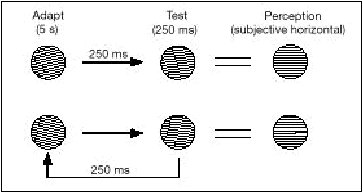 Reprinted with permission When subjects were presented the target stimulus - a line grating where the lines could be distinguished consciously - they claimed to perceive the lines as slightly tilted relative to the actual line orientations. Furthermore, the researchers demonstrated that the tilt after-effect depended upon the relation of the test pattern�s tilt to the unseen orientation of the pre-exposed pattern. It is well documented that the cortex is necessary for the analysis of line orientation. Based on this fact, He and MacLeod claims that even unseen fine line gratings is processed in the cortex, and thus generate the after-effects as seen. So, even nonconscious perception must show a significant cortical activation. What does this say about conscious vision? Activation of
orientation- selective units at the stage of cortical pattern adaption is not sufficient for perceptual awareness of the pattern orientation. He and MacLeod find it difficult to point at any mechanism for the added requirement, but propose that - to be represented in conscious experience - it must be based upon a process where information is relayed from primary visual areas to another region of the brain. perception must show a significant cortical activation. What does this say about conscious vision? Activation of
orientation- selective units at the stage of cortical pattern adaption is not sufficient for perceptual awareness of the pattern orientation. He and MacLeod find it difficult to point at any mechanism for the added requirement, but propose that - to be represented in conscious experience - it must be based upon a process where information is relayed from primary visual areas to another region of the brain. TR Further Reading Sheng He�s homepage Donald MacLeod�s homepage Keywords:Tilt after-effect, unconscious perception, semantic priming, line gratings, cortical activation References Crick, F. & Koch, K. (1995). Are we aware of neural activity in primary visual cortex? Nature, 375, 121-123.
He, S. & MacLeod, D.I.A. (2001). Orientation-selective adaption and tilt after-effect from invisible patterns. Nature 411, 473-476.
|