ArticleCortical substrate for unconscious processing
- A case against Zeki & Bartels theory of �microconsciousness�?
 Thomas Zo�ga Rams�y Department of Psychology Copenhagen University, Denmark [email protected]
Copyright � T.Z.Rams�y Science & Consciousness Review 1, 2001
 Printer ready page
THIS ARTICLE IS STILL ONLY A DRAFT - FINAL VERSION WILL BE UPLOADED SOON
In their 1999 article, Zeki and Bartels of the University College London postulated their theory of �microconsciousness� - a theory of visual consciousness. Here they claimed that visual consciousness resides as distributed and isolated networks in the cortical visual areas, and that it is based upon the binding of processes that are specialized, parallel and distributed throughout the visual cortex. But binding is post-conscious - the conscious experience of a visual scene is more fragmented, they claim.
Zeki and Bartels point to evidence that, in normal subjects, different features of a visual stimulus are experienced at different times. That is, when attributes of a visual stimulus, e.g. its color and motion, are presented at the same time, they are not necessarily perceived at the same time. Color is in fact often perceived before motion. Hence, Zeki and Bartels argue for the autonomy of these two processing systems and, by extention, for autonomy of other processing systems as well.
Now, two independent studies pose rather conclusive evidence agaist the theory of microconsciousness.
First case - The brain basis of visual extinction
Visual extinction is a rather common phenomenon after unilateral brain injury, particularly when posterior-parietal cortex is damaged. In this neurological condition patients can detect isolated visual stimuli on either side of their visual field, yet they often miss contralesional - typically left - stimuli during bilateral stimulation.
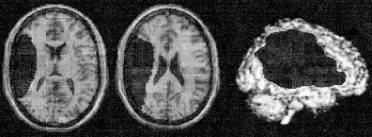
Reprinted with permission
TR Further Reading
Keywords: Visual awareness; microconsciousness; binding problem; parietal damage; neglect syndrome; visual extinction
References
Driver et al. (2001). Functional Magnetic Resonance Imaging and Evoked Potential Correlates of Conscious and Unconscious Vision in Parietal Extinction Patients. NeuroImage 14, S68-S75.
S. Zeki & A. Bartel (1999). Toward a Theory of Visual Consciousness. Consciousness & Cognition 8, 225-259