Article
Seeing sounds, hearing tastes
-
Synesthesia in brain and mind
 Thomas Zo�ga Rams�y
Department of Psychology
Copenhagen University, Denmark
[email protected]
Copyright � Thomas Zo�ga Rams�y, 2001
Science & Consciousness Review 1 (1) 2001
 Printer ready version
In 1915, the Russian composer Alexander
Scriabin had his �Prometheus� played for the first time. The
orchestral piece was originally written for orchestra, piano, pipe organ, choir and
light organ --- literally
an organ that creates light. You may ask what a light organ is, and you would be perfectly right if you guessed that there is no such thing. So why did
Scriabin compose a piece of music for a fictive instrument? The answer lies in the concept of �synesthesia�: the perceptual crossover between senses.
Scriabin probably did not believe that one could ever play what he had composed for the light organ - he simply did not know of any other way
to describe his conception of the music when the �Prometheus� was played. Although it is still debated whether
Scriabin was a "true" synesthete, the Prometheus is
often regarded as one of many examples of the phenomenon.
Many others have claimed to be so-called
synesthetes, among them Wassily Kandinsky, Vladimir Nabokov, Richard Feynman and Nikola Tesla. Nabokov, for example, had a quite specific form of �coloured hearing�, where the sounds of each of the letters of the alphabet evoked specific hues. As a child, he also sometimes complained that the numbers and letters on his block were �wrong�. His mother - also a synesthete - understood and sympathized.
The cross-modality of perception
Synesthesia
stems from the Greek syn-aisthesis ("together-perception"), and is used for terming the phenomenon where a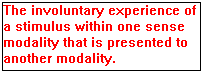 person has involuntary physical experience of a cross-modal experience. This means that stimulating a given sense produces an experience in another sense modality. The most common example is the �coloured hearing� cases, where a person experience colours when listening to a particular sound. The
synesthesias are often quite specific and stable, so that separate instruments might evoke different visual sensations, e.g. their hues and forms.
person has involuntary physical experience of a cross-modal experience. This means that stimulating a given sense produces an experience in another sense modality. The most common example is the �coloured hearing� cases, where a person experience colours when listening to a particular sound. The
synesthesias are often quite specific and stable, so that separate instruments might evoke different visual sensations, e.g. their hues and forms.
How many
people experience synestesia? Initially, this is rather difficult to answer, since it depends on how one choose to define the phenomenon. On the one hand, one could use a broad definition, including weaker associations like coupling the vocal �a� to seeing a red colour. Using what might initially seem a conservative definition, estimates are still quite high, ranging among children from 40-50%, to 10-20% among adults. On the other hand, others claim that the phenomenon is much more rare, at a rate at only 1 in 25.000 people.
Unprecedented work has been done by Sean Day, who catalogued 19 different kinds of
synesthesia based upon 175 case histories.
Numbers and letters evoking colours
(69%) | (in 121 of 175 cases) | |
Units of time triggering colours | 42 | (24%) |
Spoken sounds calling up colours | 24 | (14%) |
General sound evoking colours | 23 | (13%) |
Musical sounds calling up colours | 21 | (12%) |
Musical notes setting off colours | 16 | (9%) |
Pain evoking colours | 6 | (3.4%) |
Odours triggering colours | 5 | (3%) |
Personalities evoking colours | 5 | (3%) |
Tastes evoking colours | 5 | (3%) |
Sound evoking taste | 3 | (2%) |
Sound evoking touch | 3 | (2%) |
Vision evoking taste | 3 | (2%) |
Touch evoking taste | 2 | (1%) |
Sound evoking odour | 1 | (0.6%) |
Temperature evoking colours | 1 | (0.6%) |
Taste evoking touch | 1 | (0.6%) |
Touch evoking smell | 1 | (0.6%) |
Vision evoking touch | 1 | (0.6%) |
Reproduced with permission, Discover 20 (12) �-- December 1999
Theories on
synesthesia
Despite different assessments on the prevalence of
synesthesia, one fact is less disputed; the phenomenon is much more prevalent in children than adults. But why is this the case? Some speculate that it reflects a general cognitive development. The famous
imagery researcher Alan Paivio has claimed that children process information mainly by means of iconic representations, while adults process information in an abstract manner - in the form of symbolic representations. Building further on this, Marks has stated that cognitive development come in three stages, from purely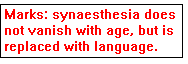 sensory representation of perceptual information, through a joint sensory/verbal representation, to pure verbal representation. According to Marks,
synesthesia does not vanish with age, but merely looses its reflexive, sensory character, and is more and more expressed through language. Support for this thought has been found in studies showing that adults have weak cross-modal associations, but that they are weak or come to expression through verbal analogies and metaphors, and not as �living�
images, as found in true synesthetes.
sensory representation of perceptual information, through a joint sensory/verbal representation, to pure verbal representation. According to Marks,
synesthesia does not vanish with age, but merely looses its reflexive, sensory character, and is more and more expressed through language. Support for this thought has been found in studies showing that adults have weak cross-modal associations, but that they are weak or come to expression through verbal analogies and metaphors, and not as �living�
images, as found in true synesthetes.
In general, there are two major lines of thought pertaining to
Synesthesia. First, there is the theory of synesthetic metaphors, which claims that
Synesthesia is the result of a person�s vivid imagination. In this view, people that claim to experience
synesthesia take metaphors, like �I see what you are getting at� and �that colour is very loud�, too literally. In the same line of thought, the theory of linguistic
synesthesia claims that synesthesia is generated through semantic processes and fashioned by time and cultural elements. One central thesis stemming from this view is the expectation of cultural differences. That is, if
synesthesia is moulded from linguistic acts and cultural influences, any cultures should possibly reveal differences in the kinds of
synesthesias that are expressed among individuals. Although scientific investigation in this matter has been rather sparse, it now seems that there are few cultural variations in
synesthesia.
Cytowic's
theory
The other type of theory on
synesthesia is often described as �more scientific�, and follows theories from physics and neurological disorders, as well as the study of effects of psychoactive drugs. One of the foremost contemporary writers on
synesthesia, Richard E. Cytowic, has proposed a theory of its neural basis. Important to his work is his definition of the phenomenon, which is comprised of several pieces, for example that
synesthesia is:
neither voluntary or controllable by the subject, or constant - it is usually triggered by some stimulus
�projected� - perceived to take place in the area immediately surrounding the subject
�durable and generic� - associations between the senses will be constant over time and will also be relatively abstract
One of Cytowic�s surprising claims is that
synesthesia is not a result of cortical activity. This is in direct opposition to theories of the brain basis for normal conscious sensation. In general, most such theories assume not only a cortical substrate per se, such as the primary sensory modalities, but also argue for the necessary role of extensive processing in the frontal areas of the cortex. Contrary to this, Cytowic cites several pieces of evidence that
synesthesia is accompanied by increased limbic activity - that is, activity in structures �below� the cortex, often seen as more primitive structures. At the same time, cortical activity is decreased.
sensation. In general, most such theories assume not only a cortical substrate per se, such as the primary sensory modalities, but also argue for the necessary role of extensive processing in the frontal areas of the cortex. Contrary to this, Cytowic cites several pieces of evidence that
synesthesia is accompanied by increased limbic activity - that is, activity in structures �below� the cortex, often seen as more primitive structures. At the same time, cortical activity is decreased.
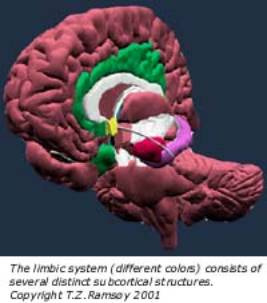 The main reason for Cytowic�s claim is based on an opposition to what he identifies as the Western notion of a dichotomy between reason and emotion, and the resulting models where cortex is placed as being of higher order than the more �primitive� and �lower� areas, such as the limbic system. By
citing Ommaya, a critic of current brain modeling, Cytowic claims
that the corticocentric view of the brain ignores the fact that
"we are irrational creatures by design, and that emotion, not
reason, may play the decisive role both in how we think and
act". The relationship between cortex and the limbic
structures are not one of hierarchy and doninance, but rather of
complex reciprocal communication and interdependence. Thus, if we
are to accept Cytowic's theory of synesthesia, we also are forced
to accept his notion of brain design and functioning.
The main reason for Cytowic�s claim is based on an opposition to what he identifies as the Western notion of a dichotomy between reason and emotion, and the resulting models where cortex is placed as being of higher order than the more �primitive� and �lower� areas, such as the limbic system. By
citing Ommaya, a critic of current brain modeling, Cytowic claims
that the corticocentric view of the brain ignores the fact that
"we are irrational creatures by design, and that emotion, not
reason, may play the decisive role both in how we think and
act". The relationship between cortex and the limbic
structures are not one of hierarchy and doninance, but rather of
complex reciprocal communication and interdependence. Thus, if we
are to accept Cytowic's theory of synesthesia, we also are forced
to accept his notion of brain design and functioning.
Burt
and Smith-Laittan's theory
Cytowic's
theory has not gone unchallenged. Burt and
Smith-Laittan from Cambridge University base their theory on a
rather more traditional, modular brain theory. They suggest
that, due to some genetic factors, synesthesia may arise from an
abnormal differentiationbetween visual and auditory pathways. That
is, during normal development, each brain area that pertains to a
certain sense is specialized and hence differentiated from other
senses. Not so with synesthetes, where the brain circuitries for,
say, the visual and the auditory pathways are still significantly
more "intermingled", which in turn functions as the
basis for the abnormal sensory integration. Another consequence
from this view is that it would seem that infants all alike are
experiencing Synesthesia.
In
terms of a theory for the brain basis for consciousness, Burt and
Smith-Laittan's theory poses that the senses are hardwired from
birth into certain cortical (and thalamic) areas. In infancy, the brain consists of a multiplicity
and ambundance of neurons and connections. During development of
an individual, however, neurons specializes, creating modules,
nodes and other functional units. Neurons that cannot adapt and
make significant connections, die. So, over time it would seem
that conscious perception within a given sense is more and more
isolated from other senses, and that the integration of senses is
a more effortful and time consuming process. For the synesthetes,
however, it would seem that their brains are not that specialized
and "sensory isolated". For future research, it will be
interesting to see whether there are further perceptual
differences between normal sensation and Synesthesia.
thalamic) areas. In infancy, the brain consists of a multiplicity
and ambundance of neurons and connections. During development of
an individual, however, neurons specializes, creating modules,
nodes and other functional units. Neurons that cannot adapt and
make significant connections, die. So, over time it would seem
that conscious perception within a given sense is more and more
isolated from other senses, and that the integration of senses is
a more effortful and time consuming process. For the synesthetes,
however, it would seem that their brains are not that specialized
and "sensory isolated". For future research, it will be
interesting to see whether there are further perceptual
differences between normal sensation and Synesthesia.
Summary
Like
so many brain phenomena, synesthesia seems like hard to believe
--- unless you are a synesthete. But decades of scientific studies have shown
that it is real. A better understanding may shed light on normal
conscious perception, and perhaps even on the minds of highly
creative people like Scriabin. If many
children are natural synesthetes, we may also learn more about the
conscious world of childhood. Surprising conditions always reveal
unexpected insights into the brain, its development, and the human
condition.
TZR
Links
Lingua Franca (2001) volume 11, no. 6
PSYCHE symposium on
Synesthesia
(go down on page)
->
Smilek &
Dixon: "Towards a synergistic understanding of synesthesia"
What does one mean by a cross-modal association?
Cytowic homepage
Dean A. Day homepage
Synesthesia
and the synesthetic experience (MIT)
Online
Synesthesia Experiment
Doctor Hugo � Museums of the Mind
Keywords :
Synesthesia, cross-modal experience, cross-modal association, secondary sensations, LSD, brain theory
Selected References
Cytowic, R.E. (1995). Synesthesia: phenomenology and neuropsychology. A review of current knowledge. PSYCHE, 2 (10)
McGrath, M.M. (1998). Tangled Wires: Conceptualising neurological and cultural explanations of
Synesthesia
Marks, L.E. (1975). On coloured hearing
Synesthesia: Cross-modal translations of sensory dimensions. Psychological Bulletin, 82, 303-331.
Paivio, A. (1971). Imagery and verbal processes. New York: Holt, Rinehart & Winston.
Svartdal, F. & Fossland, B. (1988).
Synesthesia. A review and discussion. Nordisk Psykologi, 40, 48-63.