
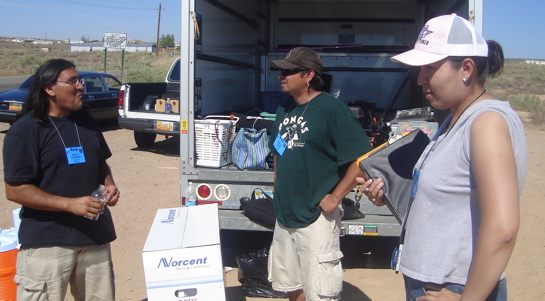
When ITE's James Lujan put out a call for a Native American crew, he didn't expect such an enthusiastic response, but that's exactly what he got, as appromixately fifteen novice and experienced American Indian filmmakers came together to work on one of seven short films to be produced by the 7th Annual Duke City Shootout.
Each summer, the founders of the Duke City Shootout select a handful of short screenplays to produce for its annual weeklong filmmaking festival. The main difference at this year's festival is that for the first time a crew was comprised primarily of Native American filmmakers.
"This was an exciting opportunity to bring Native American filmmakers together to work on a production in a professional-level environment," says James Lujan, Planner for Southern California Indian Center, Inc., and InterTribal Entertainment. Lujan, who received his training at the world-renowned Masters of Fine Arts Program at the University of Southern California School of Cinema-Television, and later ran his own film training program, the Taos Filmmakers Initiative, from 2000-2004, served as the mentor for the Native Crew.
Says Lujan, "With the increasing number of films shooting in New Mexico because of the State's incentives, there is a corresponding demand for experienced crews, so this presents an important opportunity for training and employment in a high growth industry." Given the high unemployment rate for American Indians, Lujan sees this as a logical solution for both parties, and gives credit to Shootout founders Anthony DellaFlora and Grubb Graebner for also recognizing this opportunity. Lujan was a participant in the Duke City Shootout's first annual festival in 2000 when it was known as "Flicks on 66."
With this partnership with a New Mexico organization, Lujan sees this as an important step in forming national alliances to benefit Native filmmakers all over he country.