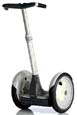
 The Segway HT is a two wheeled,
battery powered, one-person vehicle that is self-balancing
(when a rider is on it)
and it was invented by
Dean Kamen.
It has handlebars and you ride it while standing on a platform that is about eight inches off the ground.
The handlebars can be adjusted to different heights for the comfort of the rider.
Learning to ride the Segway is supposed to be very easy.
Lean forward and you move forward. Straighten up and
you stop. Lean back, and you move back. You guide the Segway using the movable grip
on the left handle bar. Rotate it down (clockwise) and you turn to the right. Rotate it up (counterclockwise) and you turn to the
left. This is similar to turning a steering wheel on a car. Some requirements for riding the
Segway are:
The Segway HT is a two wheeled,
battery powered, one-person vehicle that is self-balancing
(when a rider is on it)
and it was invented by
Dean Kamen.
It has handlebars and you ride it while standing on a platform that is about eight inches off the ground.
The handlebars can be adjusted to different heights for the comfort of the rider.
Learning to ride the Segway is supposed to be very easy.
Lean forward and you move forward. Straighten up and
you stop. Lean back, and you move back. You guide the Segway using the movable grip
on the left handle bar. Rotate it down (clockwise) and you turn to the right. Rotate it up (counterclockwise) and you turn to the
left. This is similar to turning a steering wheel on a car. Some requirements for riding the
Segway are:
1. You must weight at least 100 pounds and no more then 250 pounds.
2. You must be able to step up and down from an eight inch platform with no assistance.
3. You must have full use of your left hand.
Each Segway comes with three different keys that controls
their speed and turning rate. A black key for beginners is the slowest, a yellow
key for the middle speed and a red key for the fastest speed.
There are three models of the Segway that are currently (Dec. 2003)
available.
They are:
1. i series - This model can travel about 10 miles on a single charge.
The maximum weight it
can carry including rider and cargo is 260 pounds. It is also designed to go over many different
kinds of terrain. It weighs 83 pounds and has a top speed of 12.5 mph.
2. p series - This model is the smallest, lightest, and slowest of the Segway models.
It weighs 70 pounds and has a top speed of 10 mph. It is designed for smooth surfaces like you
would find in the city and will go about 8 miles on a single charge.
3. e series - This model is the heaviest at 95 pounds and is designed to carry up
to 75
pounds in three cargo bags, one on the front and one on each side. It has a maximum
carrying capacity (rider+cargo) of 260 pounds, a top speed of 12.5 mph and is the only Segway
model that has
an "electronic parking stand" that allows it to balance by itself without a rider on it. The
distance it can go on a single charge is about 10 miles. All three models of the Segway have a
power assist mode which is used to move the Segway when the rider isn't on it. The power
assist mode makes going up and down stairs easier.