Pz.Kpfw. VI, Tiger
Tiger I (Early Production Model)
1/16th Scale
Kit contents
|
|
Tamiya Pz.Kpfw. VI, Tiger Tiger I (Early Production Model) 1/16th Scale Kit contents |
|
| |
|
Tamiya
has released the most advanced 1/16th scale R/C tank in history with
thier new kit, the Panzerkampfwagen VI, Tiger I. The kit arrived in the United States in absolutely pristine shape from HobbyLinc Japan via a special shipping agreement HLJ has with the United Parcel Service. Shipping to other countries is handled differently and explained on HLJ's site. If it sounds like I'm plugging them, forgive me. I have ordered and received four large scale tanks from them and not a dent. Impressive! Upon removing the shipping paper and box, you are greeted with a suitcase-sized, jet-black box with a ghostly picture of the Tiger I on it. There is even a suitcase handle and the black part is a jacket that slips off. 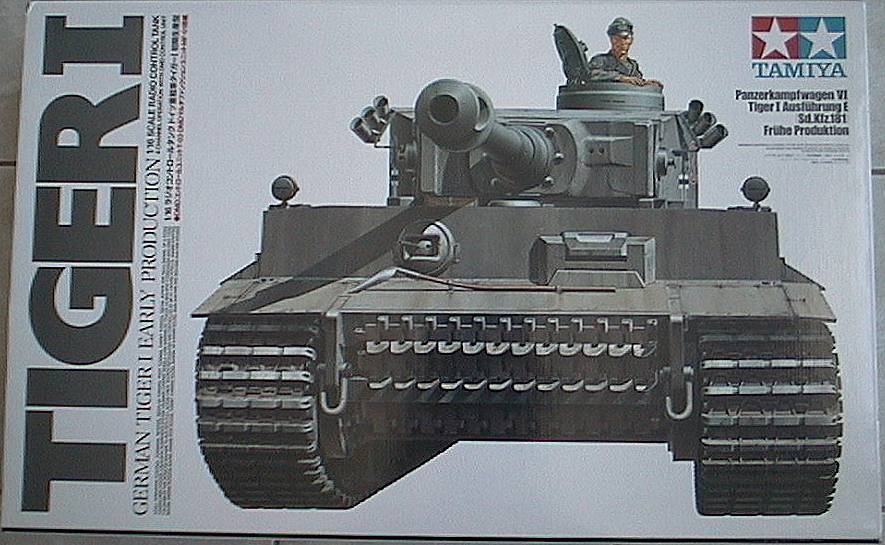 The box measures a huge 29x18x7 inches (73x46x18 cm) 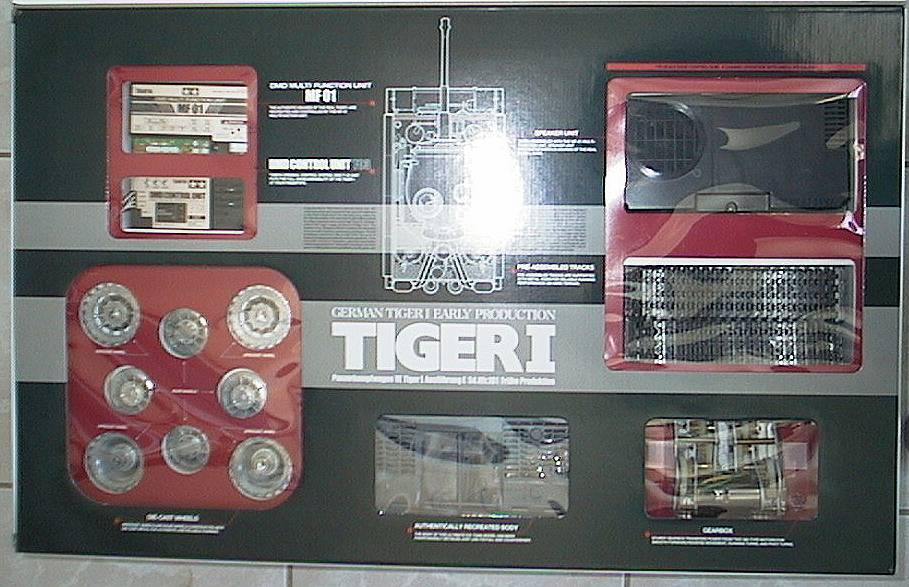 Cellophane windows show off the kit's premium features |
The flap itself is jammed with photos, drawings and text explaining the virtues of
this mechanical marvel. Everything about this kit is first class,
even the packaging!
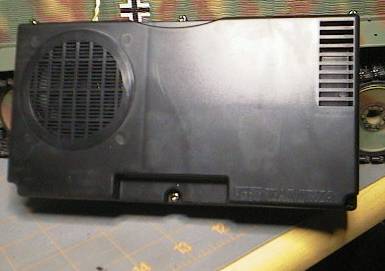
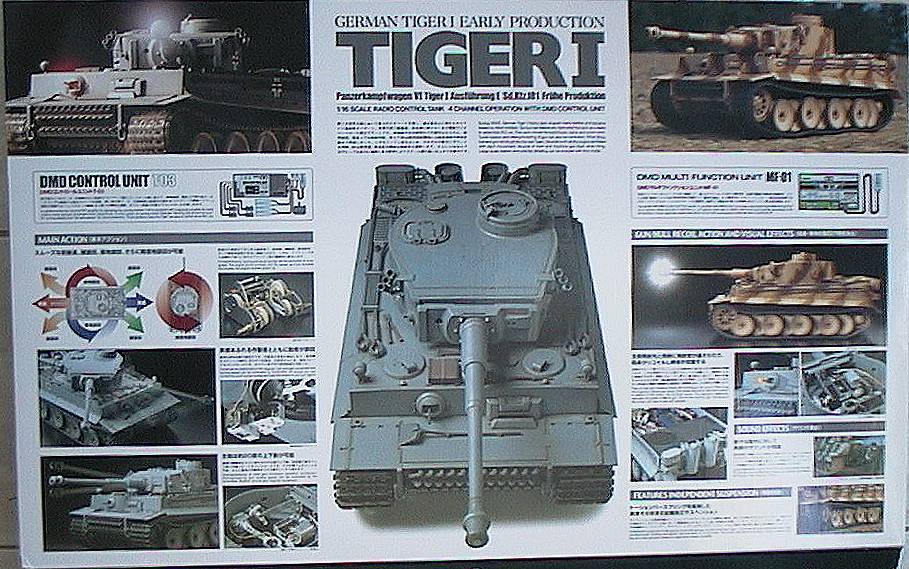 The packaging is impressive--well deserved for this work of art! 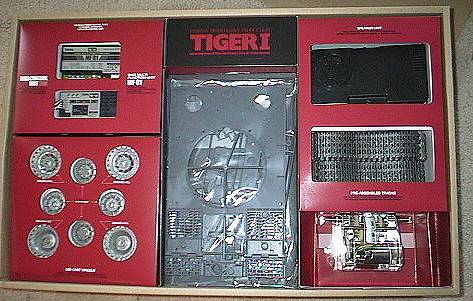 Top left shows the Multifunction unit and motor speed controller. Top right is the sound unit. It must have a Bose ® brand speaker in it--great frequency response. I found there was absolutely nothing to complain about. Read on to see the other kit features in categorical order.
|
| What's in the box? | ||||||||
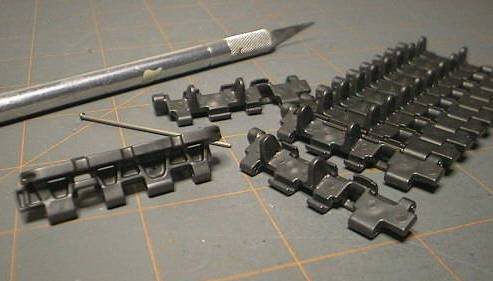
| Track Links | Pre-assembled. Two separate pieces, a link and long, nail-like pin. I ended up with ten spare links. |
 |
||||||
| Bogeys |
Plastic with rubber tire, like Tamiya's Sherman. Idler bogey has a
screw-type track tensioning system. Each bogey set has
a polished steel axle and two brass inserts that should last a lifetime. There are no track return rollers on the Tiger I. |
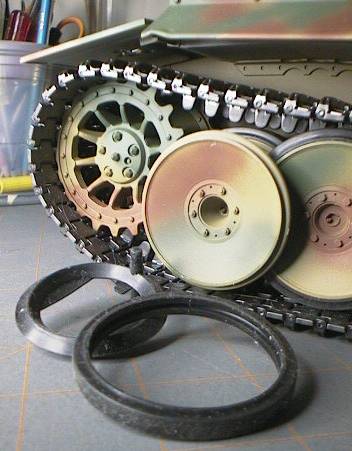 The odd thing on the left of the removed tire is the sprue
|
||||||
| Sprockets | Cast metal (pewter?) | See the picture above for sprocket details | ||||||
| Torsion bar suspension | Each suspension arm is held in place by a long metal bracket which is secured to the hull lengthwise with two machine screws. Inside the hull, the suspension arm has a slot that engages one end of the long rectangular torsion bar. The torsion bar is secured at the other end in the other bracket. All very effective, strong and clean--and PROVEN. Tamiya has used this suspension system on the Tiger II, Leopard and Ghepard so they've got the engineering down pat! |
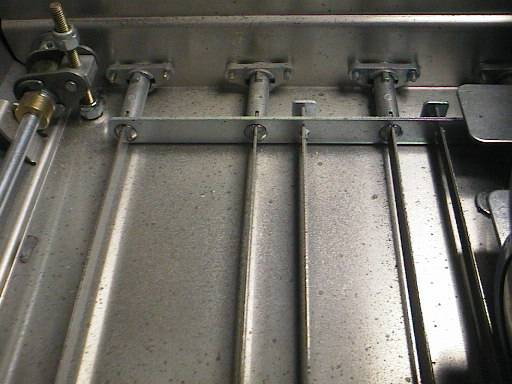 The Tiger I's suspension system is a thing of beauty. |
||||||
| Chassis | Precision stamped 1/16" aluminum. Pre-drilled and tapped mounting holes for the dual gear boxes, suspension brackets and bushings. | |||||||
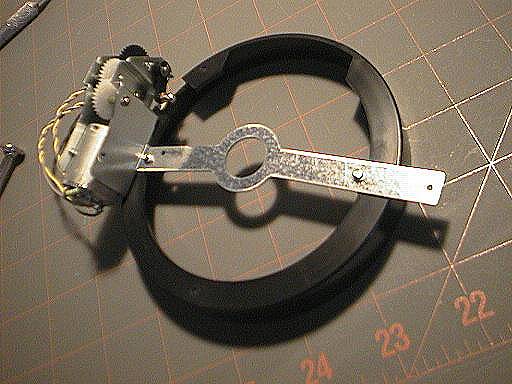
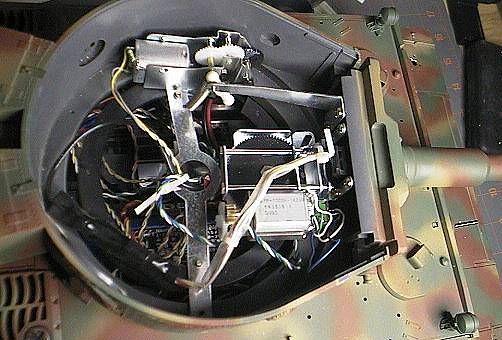
| Turret |
All hatches are positionable with the rear escape hatch even hinged.
The commander's cupola has a little seat that you glue on to hold the
commander figure (bust only) up. Gun elevation and barrel recoil units are contained here.
|
 |
||||||
| Hull |
Upper hull is multi-piece with separate track skirts. Hull attaches
to chassis with screws. Details are crisp and
excellent. A mesh tube is provided for the Fiefel air breathers to
connect to the intake manifold. Picture show radiator grilles. The part between the grills was sand-cast in real life and you can see the surface detail has been reflected accurately. Driver and bow-gunners hatches are separate pieces, although you really wouldn't want them open.
|
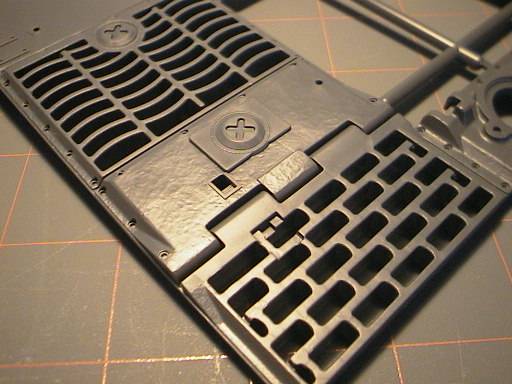
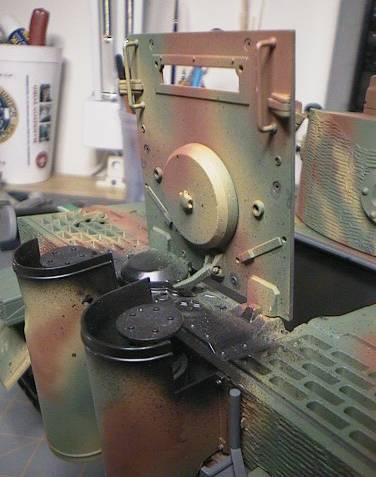 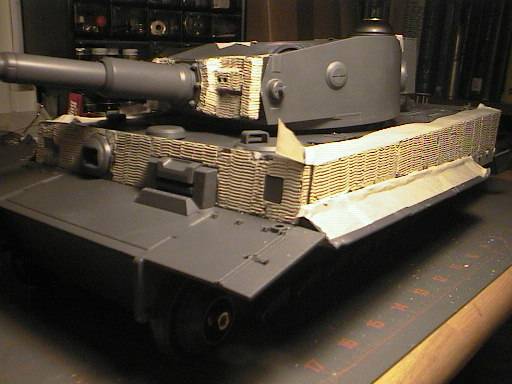 Pictures showing the "sand-cast" detail in the radiator area; the opening
engine hatch, and the application of zimmermit anti-magnetic mine
paste.
Pictures showing the "sand-cast" detail in the radiator area; the opening
engine hatch, and the application of zimmermit anti-magnetic mine
paste.
|
||||||
| Figure (tank commander) |
The Commander figure is bust-only, but very nicely executed. I scraped off the Wehrmacht crest from his service cap and substituted the "totenkopf" (death-head, or skull and crossbones) of the Waffen SS. It was a trick to make that symbol, but as I wanted my Tiger to be a member of the 1st SS Panzer Division (Liebstandarte), it was necessary. |
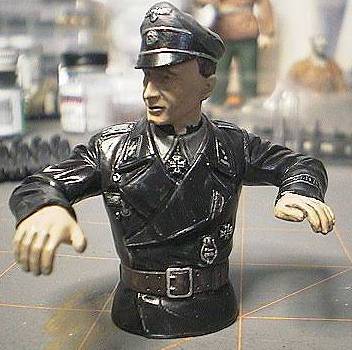
|
||||||
| Gear Boxes | Twin, separate gear drives with 380 motors. Brass and teflon gears. All turning axles have bushing bearings. Gearbox is heavy-duty 3/32" stamped aluminum plate. Gearboxes mount to lower hull with three brass standoff screws, each. |
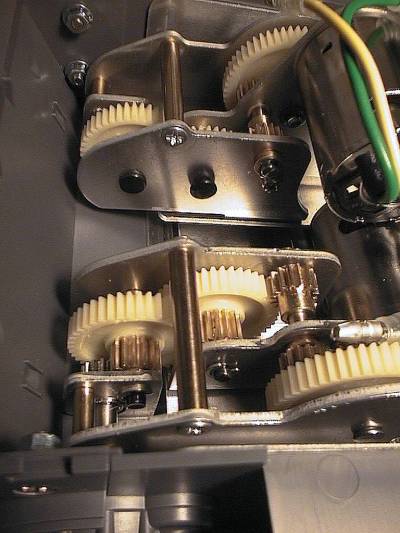 Dual 380 motor gearboxes with ballbearings on the output shaft. |
||||||
| Motor Controller |
Dual, integrated, digital motor control. Requires two channel radio
with one channel for each track. The unit come with a BEC (Battery
Eliminator Circuit) which means that a separate battery for the
radio receiver is not needed (the propulsion battery pack supplies
the juice). The unit is equipped with several MOSFETs (solid-state). The Multi-function unit has a wiring harness that hooks into the T-03 motor controller. I presume this is to communicate when throttle is advanced, turret is rotated, and the gun is elevated and fired. That way, the sound unit can make the appropriate sound. A really cool feature of the sound is the startup and shutdown sequence. If you turn on the transmitter first and then the receiver, the startup gives a lengthy "cold start" sequence. If you turn off the transmitter, a shutdown sound happens. If you turn on the transmitter after the receiver, the system "assumes" the engine is warm and cranks right up! |
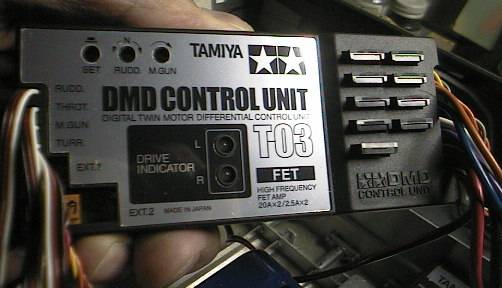 The DMD unit interfaces into the Multi-Function unit.
|
||||||
| Radio Control Unit | Full Kit only comes with a Futaba Attack 4-channel radio control transmitter and receiver. Since the T-03 motor controller also acts as a battery-eliminator circuit, there is no need for a receiver battery, but you will need to buy eight (8) AA batteries for the transmitter. The good news is, if you already own a Futaba radio, the transmitter charger will work with this radio if you get nickel-cadmium batteries for it. A charging jack is built in. |
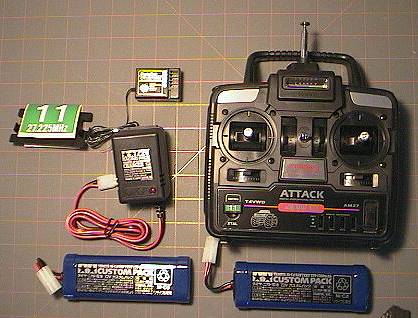 The charger shown is for the six-cell R/C car battery packs. The radio will need eight AA nicads.
Summary
|
This is an outstanding model! It assembles quickly and the quality is
superb. The DMD motor controller, with it's solid state circuitry can
allow for runtimes as long as an hour (or more) with stop and start
driving habits. | The only minor drawback operationally is the duration of the battery for the sound and gun strobe. I replaced the 1300mah battery for that circuit with an 1800mah Tower Hobbies brand battery so I could shoot the cannon and drive the tank. Imagine, the drive battery actually lasts longer than the strobe battery if you drive like a real tank in an urban setting--lots of stopping and slow movement--and you are trigger happy, like I am. At about $1000.00 (USD shipped from HLJ), this is an outstanding value and its durable design features will give years of pleasure. Hopefully, Tamiya will expand the line and rerelease their Leopard and Ghepard tanks. | ||||
| BACK |
visitor number: |