
Phil's Wall
As a lifelong flatlander, I had never given much thought to vertical pursuits. Now while its true I always loved mountains, and enjoyed visiting family in Utah, I understood very little about rock climbing. Philip had grown up in El Paso- a place that to a non-geographer might sound flat. However, Phil corrected me on this gross misconception, because the eastern edge of the rocky mountains cuts right through the town which is situated at elevations well over four thousand feet. He had grown up near the climbing Mecca known as Hueco Tanks, a state park containing some of the greatest rock climbing in the world. When Philip first told me about the wall he was going to build in his basement, I tried to maintain an open mind. While others scoffed at his plans I was genuinely intrigued. Because of this interest, in the winter of '98 I became the first guest to 'Phil's Wall.'
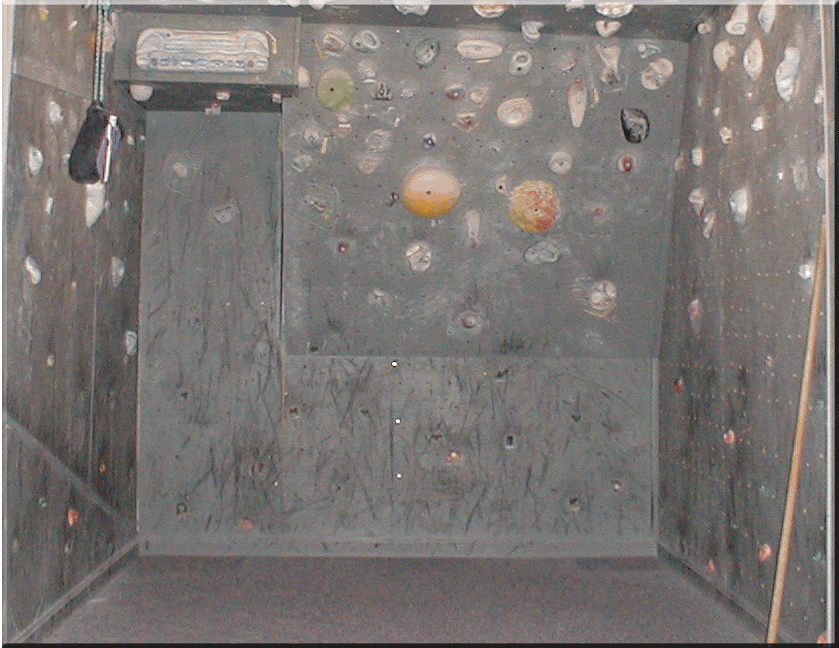
January isn't a prime month for rock climbing in most of the northern states, consequently indoor gym climbing is considered a viable alternative. In the Midwest however, indoor gym climbing is rock climbing, January or July. Phil's wall was made of a two by four structure, covered by a very thick plywood. Systematically drilled and pounded into the plywood were T-nuts, into which one could screw handholds into the wall. Most handholds are made of dense plastic, are produced in almost any shapes imaginable and have a rough texture, which give them a slightly rocky feel.
I soon learned when I first visited the wall that is was not a toy, and it had not been created for show. It had one sole purpose, and that purpose was training. The concept 'Routes', however, was something that came very slow for me- I will explain. To a novice, rock climbing means climbing up, getting from the bottom of a steep cliff to the top. This, however, is not so. The climb up a craggy face of a mountain is not the easiest way to the top. Granted, with modern technology someone could fly a helicopter or take a ski lift to the top, but you also might reach the summit a much more simple way- you often can hike the gradual slope that is on the other side of the mountain, opposite to the rocky cliff the climber would scale. Now that we understand that rock climbing is not about scaling a cliff, more complex natures of climbing can be understood.
Phil's wall was only 8 or 9 feet high, the height of an ordinary basement, but the wall also included a ceiling, an over hanging section and dozens of feet of lateral climbing area. At Phil's wall, you could not climb up; most of the movement was primarily side-to-side. Phil taught that the essence of climbing is its experience and its challenge. It is very Similar to running: People don?t run a marathon to get from pint a to point b, and neither is running the fastest or most logical way to get somewhere. Climbing is the same.
Back to routes. When I first climbed on the wall I climbed everywhere, I touched every hold, went side to side, up and down, it was fun, but it had very little purpose.
 It was November or December when my newfound acquaintance entertained me with his machinations of a training facility in his basement. Little did I know then the impact his plans would have on the next few years of my life. Although Philip was strong, he was no ordinary athlete; He didn't lift weights, throw baseballs, footballs or kick soccer balls. His passion was climbing.