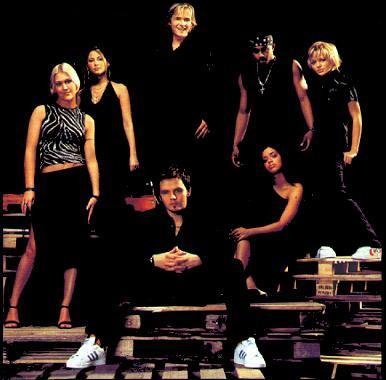
| Taken from the Daily Mail (Saturday 19th May 2001) ROBO-POPS Tomorrow these seven young people will once again top the pop charts. In fact, we can reveal their success owes nothing to creativity but everything to the most ruthless and cynical marketing operation in the history of music For those over the age of 10, today's date, Saturday, May 19, 2001, will probably have no particular significance. If you are an average 9 year old girl however, it's the day you've been waiting for since 1998. Parents, if you have cheques, prepare to write them now. Cleancut British teen sensations S Club 7, who have shifted 9 million albums and singles to date and whose latest offerin will knock Geri Halliwell off the No 1 slot tomorrow are about to begin their first ever live tour. It's 3 years since the group was formed by pop svengali Simon Fuller (the man who gave us the Spice Girls), and while many may find it off that a band can go on to have 2 best selling albums and four No1 singles without ever playing live, on Planet S Club there is nothing unusual about this at all. In fact, it was all carefully planned this way. Welcome to the 21st century world of pop - and the consummate creation of an artifice. The old fashioned idea of making music - friends getting together and writing songs, honing their craft through live performance - is now seen as dreadfully passe. Today's chart toppers don't even bother to refer to themselves as a pop group, but describe themselves, with no sense of irony, as 'youth multimedia concepts'. Of course there have been manufactured bands for as long as there has been music. But here it's been taken to another level. For while it suits S Club 7's management to push an image of the seven as everyday kids who like to hang out, sing and dance together - like The Monkees before them - the reality is that for this pop group singing live comes a poor fifth to the multi-million pound television series, internet website, the movie and the sponsorship deals. The group is totally manufactured. An estimated �1 million alone was spent selecting the lucky 7 from the 10,000 applicants who responded to advertisements. Creating a group like this means sales not only of records but of an entire lifestyle to the target audience of 6 - 10 year olds. As a result, their parents will swiftly be relieved of �20 for a concert ticketm �5 for a programme, �15 for a T-Shirt, �13.99 for a singing doll and �15.99 for an album before you can say pester power. An in hooking these teeny supporters, no detail is too small to be overlooked for S Club 7, who performed live for the first time on Wednesday for a select group of the media and fans. The set for this event looked like a West End show. The gimmicks - fireworks, model cars and go-karts zooming round - were targeted firmly at their child audience. All the 'spontaneous' asides were carefully scripted. (Oop's it's not that bit yet, giggled Hannah, when one of them messed up their lines.) Meanwhile, almost every song had a reference to the band name (Ain't no party like an S Club party, Don't stop movin' to the S Club beat), while the backing singers wore 'S Club rocks' T-Shirts and the group themselves had American football jackets with their name and the number 7 on the back. Not that this constant subliminal advertising bothers a true fan like Lucy Soulier, a 9 year old from Rugby, happily mimicking their dance moves. 'Ever since I first heard them, I thought they were the best' she squeals. 'In the playground we all do the S Club routines every breaktime, and my favourite thing to do at home is dress up as Rachel in a cropped top, jeans and high-heeled silver sandals. They rock!' Simon Fuller says he started planning the S Club concept the day he split from the Spice Girls in November 1997, taking with him a �15 million payoff. He was already regarded as the man who had taken pop to a whole ne level of marketing with the Spice tie-ines nvolving everything from the deodorant to lollipops. However compared to S Club 7 this was peanuts. From the start, it was decided that a whole aspirationl lifestyle would be built up around the band, starting with a television series. The programmes would be based in America to make it appear trendy and so that it would appeal to an international audience. It would be penned by Kim Fuller, Simon's brother and the writer of Spice World: The Movie. 'S Club 7 were deigned to be like your best friend, someone you could imagine living next door' says Corinna Shaffer, editor of Top Of The Pops magazine. 'Or given that the fans are so young, your older brothers and sisters who are hanging out having a good laugh. They were not seens as perfect but fun, ordinary people who were capable of making mistakes.' Yet even before the band was cast, a timetable had been laid out (4 years to achieve 4 TV series, 4 albums, 6 TV Specials, 3 tours and 1 movie) and the name had been chosen. According to Fuller's company, 'S' was chosen because it is the 19th letter of the alphabet - and the company is called 19 management. It was also left deliberately vague so that it could stand for 'special' or 'success'. 'Club' was chosen to promote the idea that the fas could be part of a gang. They were even given a mwkish slogan - Everybody is Somebody - copying the success of the Spices' Girl Power! brand. A full year was allotted to recruit the 7 members of the band, aged between 18 and 24. The idea of having 7 (unlike 5 and then 4 spice girls) meant that there would be less focus on individual personalities who could dominate the group. Perhaps Fuller was remembering his clashes with mouthy Mel B and Geri Halliwell in the Spices. Also, a larger band size meant that he could design a group with specific complementary abilities and personalities, and even racial types. So there is Jo O'Meara, the mouthy Essex girl who can actually sing, Rachel Stevens, the sexy Jennifer Aniston lookalike to appeal teenage boys, Tina Barrett, the Latinesque dancer, Jon Lee, the cute sensitive one, Bradley McIntosh, the funky black rapper and court jester, Hannah Spearitt, the Baby Spice lookalike who's a bit of a flirt and Paul Cattermole, the rock 'n' roll rebel with the pierced ear. Between them, they have no A-levels and the only instrument they say they can play is the spoons. It took 10,000 auditions to bring the number down to this final seven. (Put in context, Popstars phenomenon Hear'Say were originally selected from 1,000 auditions. Like the Spice Girls, ads were placed in The Stage newspaper, and Fuller also sent out talent scouts to scour theatre schools, holiday camps, amateur productions and restaurants for new band members. All bar Rachel had had some sort of stage school experience although only Jon had an established track record in showbusiness (appearing briefly in Eastenders and playing the lead in Olvier! at the London Palladium.) So they were the competent actors, singers and dancers at least, even if not exceptional. (Today's tour meant they had to be given a month's intense voice coaching and personal training to get their fitness up.) But then to be exceptional was never the point. The stage show consists of funky mes (no unsavoury crotch-grabbing a la Michael Jackson) and routines that are simple enough for kids to copy in the playground. The songs too - usually with some aspirational message about following your dream of appreciating your best friend - are simple and catchy enough for their young fans to pick up. After a year's preparation and filming, S Club 7 burst on the scene in April 1999 with their TV series Miami 7, which told the story of a naive young band who travel to Miami to seek fame and fortune, with lots of amusing adventures and songs along the way. To get positive coverage, the management bypassed the national press, who were seen as 'cynically unhelpful' about Fuller's wonderful new creation and wooed the teen media - Top Of The Pops magazine, Smash Hits, TV Hits - with a trip to Miami. ' It was very carefully planned to get them on boar' says Charlotte Hickson, public relations director. 'The launch of S Club 7 was always seen as a slow burn - so that people could think they were disconvering S Club for themselves, rather than feeling they were being overloaded with hype.' Delighted at their exclusive success, the teen magazines gave rave write ups and Miami 7 quickly acquired viewing figures of 3.5 million. When the group finally got round to launching their first single, Bring It All Back at the end of the series in June 1999, it went straight to No 1, selling 600,000 copies. Their first series was quickly followed by another, called LA7 (the band go to Los Angeles, have more amusing adventures and sing evenmore songs), plus a succession of one-off special, including 7 GO Wild, where the band travel round the world visiting some rather startled favourite endangered species. To date, the series and the music were seen as only two 'building blocks' in the overall culture. For when the series isn;t on TV, or a single isn't in the charts, how do you keep your group in the public eye? The answer was through the internet and sponsorship - which is also where the real money lies. Around �6 million is thought to have been spent creating www.sclub.com. There was no traditional fan club, so to be an official 'S Clubber' you have to log on to the website which takes your name, age and part of the country you come from (building useful data about the fan base). Today there are 120,000 regular users receiving e-mails and text messages giving updates and gossip on the group and it receives 2 million hits per month. Meanwhile for a mere �15 you can 'click and create' your own S Club 7 T-Shirt online, choosing a colour, style and logo and have it delivered for free 5 days later. Other merchandise that has been developed includes S Club singing dolls, key rings, mouse mats, pencil cases and stationary. Multi-million sponsorship deals were negioted with corporations such as Pepsi, Cdbury, Hasbro and BT. As a result of the �3 million Ppesi deal, S Club faces will be appearing on 15 million cans of the fizzy drink. Cadbury's deal says Charlotte Hickson, who manages the group's PR, means 'you'll be seeing the bands faces on 101 million Dairy Milk and Fruit'n'Nut bars very soon'. The problem is that even with such a carefully planned schedule, human nature can intrude. Many predicted that sex would cause trouble-even though the group has has an 'unofficial' tule banning them from relationships with other members. In fact it was that other stalwart of the rock 'n' roll lifestyle - drugs - that nearly brought the whole carefully constructed edifice crashing down on March 21 this year. Bradley, Jon and Paul were spotted by a policeman smoking cannabis in a back street off Leicester Square and arrested. They were let off with a caution and immediately released a statement saying they were 'gutted' that they had let their fans down. But Quaker Oats pulled out of a prospective sponsorship deal over Sugar Puffs and the Labour Party also discarded the idea of using the single Reach as an election anthem. Cadbury and BT stayed on board but were said to be 'disappointed' at the tarnishing of the band's queaky clean image. It rather overshadowed the next development in the S Club portfolio - a movie backed by Hollywood giant Columbia Tristar to be filmed next year. 'Spliff Club 7' as the scandal was inevitably dubbed was not the first sign of trouble however. Last December, the group threatened to split up after a succession of 18 hour days, being forced to travel economy back from a promotional tour of Spain and the discovery that a lucrative BT deal for the S Club concept had netted the band members nothing more than a free mobile with 30 minutes of free talk time. Their record group Polydor acted quickly to stave off rebelion by writing �100,000 cheques for each of them as an early Christmas present. The group's individual members are now sid to be worth �750,000 each - money enough perhaps, but still only a minute percentage that the concept will have made their managers. No one will speak publically about contracts and percentages at 19 management, but Simon Fuller is now reported to be worth more than �30 million. Yet this week, like the good troupers they are, the perkier-than-thou stars were publicly proclaiming their enthusiasm for the British tour (Amazing said Jo, Fantastic said Rachel, A real laugh said Bradley) - alhough the signs of strain were creeping in. 'We're working an average 18 hour day' said exhausted Paul. 'And a lot of that isn't performing or writing, it's doing the promotion'. While still proclaiming his dedication to the band, he shrugges when asked whether the band would still be together in 5 years. 'We may be together in 10 years, but I doubt it' Maybe we'll stay together, maybe we won't. All i know is when we do split up. I'm going to take a lot of time off and rest my body.' I hate to tell him but in the S Club timetable there's still 2 albums, 1 series, 1 TV Special, 2 tours and 1 movie to finish - all within 2 years. When there's sponsorship deals to be signed and a lifestyle to promote, there's no peace for the youth multimedia concept. |
 |