The Determinants of R&D in Canadian Software: The Industrial Economics Paradigm Revisited
Jorge Niosi and Emmanuel Chéron
Professors
Department of Administrative Science
Université du Québec à Montréal
Canada
Tel. (514) 987-3000 # 7897
Fax (514) 987-0422
E-mail: [email protected]
March 1998
This paper has been presented to the
International Conferenceon the Management of Technology
held in Orlando, FL, February 16-20, 1998
Please do not quote or reproduce
Abstract
This research follows past research in industrial economics on the determinants of R & D effort in manufacturing industries. In Canada, size, type of industry, diversification and country of control were isolated as determinants of R & D effort in previous research. We present results from a large survey of 2278 firms in the Canadian software industry conducted in early 1997. In contrast to previous Canadian research in the manufacturing industries, larger firm size and wider product diversification were not found to be associated with R & D effort as measured by the proportion of employees devoted to R & D. Results of a multivariate analysis isolated firm specialization and firm location in the province of Quebec as the two most important determinants of R & D effort in the case of the Canadian software industry. Thus a different paradigm seems to apply in the case of Canadian software firms where industrial concentration is low and R & D efforts are not related to firm size and diversification.
Key words: R & D effort, industrial economics, Canadian software industry
The software industry is probably the fastest-growing segment of the industrialized economies in the 1990s. Its growth rate varies between 10% and 20% per year, and there is no slowdown to be seen in the near future. Also, this industry is a science-based one, together with biotechnology, aerospace and advanced materials. Finally, this is an industry where turnover is particularly high, with hundreds of firms entering and exiting the industry every year in each advanced nation (Cusumano, 1991; Mowery, 1996).
The Canadian software industry is particularly active: thousands of firms have been founded in the 1980s and 1990s in all the spectrum of the business sector. This paper presents a first portrait of the industry, together with an analysis of the determinants of R&D. The first section brings a discussion of R&D determinants in general and in science-based industries in particular. The second section introduces a portrait of the industry. The third one presents data on the determinants of R&D in the Canadian software industry. A conclusion recalls the main results of the study.
I. THE DETERMINANTS OF R&D
The literature on the determinants of R&D is particularly large. Some factors have been well isolated. They include firm size, industry, firm diversification, industrial concentration and country of control.
The idea that the size of firms is positively correlated with their research and development (R&D) effort goes back to Schumpeter (1942). Only large firms would have the resources necessary to undertake risky and uncertain R&D projects. This hypothesis argues that a) the percentage of firms undertaking research increases steadily with the size of the firm. This variable is called the propensity to conduct R&D; and b) that the research effort of firms (as measured by total R&D expenditures on sales or by R&D personnel on total personnel) also increases with their size. This is the R&D intensity of firms. In other terms, larger firms are more likely to conduct R&D and, those that do perform R&D are also more likely to make a stronger effort than smaller ones. Economies of scale in R&D are the core of the Schumpeterian argument. Some authors found a linear relationship between size and R&D efforts (Soete, 1979), while others suggested that large size favours R&D activities only up to a certain level of size. With some caveats, Scherer's earlier works (1965, 1970) confirmed the importance of size as a determinant of R&D intensity. The very large firms would spend proportionately less than the medium-to-large ones (Scherer, 1965, 1984). In other terms, relative effort increases with size up to a certain point and then declines (Kamien and Schwartz, 1982). The development of the three new generic technologies in the 1980s and early 1990s has probably changed the relationship between size and R&D intensity. Small firms entering the electronics (both hardware and software) industry, but also biotechnology for human health and new advanced materials are much more research-intensive than large electronics, pharmaceutical and traditional materials' firms. Audretsch's theory on market structure probably applies: large number of young firms are usually found in R&D-intensive industries and small-firm innovation is high in these activities (Audretsch, 1995:120).
Industrial concentration also favours R&D activities. This is another Schumpeterian hypothesis. Oligopolistic or monopolistic firms enjoy higher profits, and have more resources to devote to R&D. Also, innovation is risky, and only relatively stable market positions would induce firms to innovate, as they increase appropriability. Schumpeter did not make a clear-cut difference between large size and oligopolistic structure. Villard did (1958); he suggested that a competitive oligopoly should be the type of market structure more conducive to innovation, whatever the size of the dominant firms. Oligopoly is positively correlated with higher profits. These profits can be reinvested in R&D activities. Within niches, oligopolies are usually found, and they can be populated by SMEs. Later, Scherer (1984) and Kraft (1989) confirmed the positive relationship between industrial concentration and R&D effort.
Industry is also a well-known determinant of R&D. In his seminal article, Villard (1958) demonstrated that three industrial groups (aircraft, electrical equipment and machinery) accounted for 60 percent of US expenditures. Using a US database on over 8000 innovations, Acs and Audretsch (1988, 1990, 1991) found a relationship between industry and size, on the one hand, and innovativeness on the other. Large firms are comparatively more innovative in capital-intensive, concentrated, highly-unionized industries producing differentiated goods, like the tobacco, the paper or the transportation equipment industries. Small firms are proportionally more innovative in industries with a high R&D/sales ratio, using more skilled labour, and containing a large proportion of large firms; the electronics, instruments, machinery and chemical industries are among these. More recently, Cohen and Kepler (1992) find that intra-industry variation is large enough to suggest that unobservable, random processes take place within industries. Rumelt (1984) found that inter-industry variation was very large and suggested that company strategy and competence are factors explaining that variation.
Diversification is also a key determinant of R&D expenditures. Nelson (1959) argued that only diversified firms, with broad technology basis are interested in supporting basic research programs, while more specialized firms will find more profitable to develop only products and processes closely related to their knowledge stock. Diversification, thus, is a positive determinant of the size of R&D activities. Later, Grabowski (1968) empirically confirmed the positive relationship between diversification and R&D intensity (measured through R&D expenditures on sales), in a study of three US manufacturing industries: chemical, drug and petroleum. Scherer (1970, 1984) found less evidence of this relationship.
Foreign control is another important variable determining R&D efforts. For some authors (Ronstadt, 1984), foreign-owned research laboratories are mostly technology-transfer devices; their main function is only to adapt parent-company technology to subsidiaries operating abroad. As such, the R&D intensity of foreign-owned companies should be lower than that of domestically-owned firms. More recently, other authors have suggested that in high-technology activities, such as pharmaceuticals, electronics, advanced materials or aerospace, foreign laboratories are used for recruiting foreign highly-skilled, seldom-mobile labour force, and for increasing the interaction with critical users (Taggart, 1991). For Taggart, foreign-controlled subsidiaries can be as R&D-intensive as locally-controlled firms.
Canadian determinants: In Canada, some of these determinants were also isolated, but again, opinions differed as to their relative importance.
Size always appeared as a major determinant of R&D activities. Chand (1981) found that among firms that performed R&D in 1975, the large ones (with sales over $50 M) represented 25 percent of the performers, but 70 percent of the total R&D manufacturing expenditures. Conversely, small firms (with sales under $10 M) were 46 percent of the performers, but they represented only 10 percent of the expenditures. This relationship has been confirmed year after year by Statistics Canada survey of R&D. However, smaller firms that conduct R&D devoted a larger percentage of their sales to R&D than medium- or large-size corporations. This finding runs contrary to what other authors (including Kamien and Schwartz, and Scherer for the US) had found. Chand believes this finding is unique to the Canadian economy, but he offers no explanation for that pattern.
Industry was isolated as a major determinant of the propensity to conduct R&D. With 1975 data, Bones (1979) showed that seven manufacturing industries (accounting for 40 percent of the manufacturing value added) made up 85 percent of manufacturing R&D. These industries were aircraft and parts, electrical products, petroleum, machinery, chemicals, primary metals and pulp and paper. Chand (1982) confirmed the status of industry as a major determinant of R&D expenditures. He found, also with 1975 data, that six among the same industries identified by Bones, were research-intensive. (He excluded all wood-based products, including pulp and paper, and substituted the more inclusive transportation equipment for aircraft). In these research-intensive industries, a larger proportion of firms conducted R&D compared to the non-research-intensive sector. Later, Statistics Canada (1991) data showed that a few industries, including telecommunications equipment, aircraft manufacturing and a few other high-technology manufacturing industries were responsible for over 50% of Canadian Business Expenditure on R&D (BERD). More recently, Gault (1997) found that service industries, including software, engineering and scientific services, are becoming major players in Canadian R&D.
Country of control was early pointed in Canada as a major determinant of R&D expenditures. For one, foreign-controlled firms are concentrated in research-intensive activities. But opinions vary on how well do foreign subsidiaries perform compared to Canadian-controlled firms. For both Safarian (1966) and Watkins (1968) they do as well, or better, than domestic corporations. In 1971, however, Cordell (1971) related the poor overall record of Canadian industrial R&D with foreign control. Also, Bones (1979) found that, in six of the seven research-intensive industries, foreign-controlled firms had a lower R&D-to-sales ratio than Canadian-controlled corporations. Nevertheless, foreign subsidiaries compensated their lower research expenditures with more payments (in royalties and scientific and research services) to their parent companies abroad. Chand (1982) confirmed the relationship between Canadian control and higher R&D intensity. And a study commissioned by the Economic Council of Canada (1983) went in the same direction, and suggested that the different results probably reflect real changes in the 1970s: foreign-controlled subsidiaries would have reduced their R&D effort in Canada.
As to firm diversification, Bones (1979) suggests that foreign subsidiaries are more diversified than Canadian-controlled corporations. Diversification would have at least two effects on the R&D programs. On the one hand, these diversified subsidiaries would produce too little sales to support specialized R&D programs. On the other, subsidiaries would mostly conduct adaptive research for the domestic market, a thesis in line with Ronstadt's. This finding contradicts Nelson's thesis, and is more in line with Scherer's findings about diversification and R&D efforts.
Studies on the relationship between industrial concentration and R&D activities in Canada have been scattered and inconclusive. No strong study find any major relationship between industrial concentration (or the specific position of firms within concentrated industries) and the R&D effort. In the Canadian context, the main Schumpeterian hypothesis remains to be tested (Economic Council, 1983).
II. THE CANADIAN SOFTWARE INDUSTRY
Statistics Canada provided a first estimation of the size of the industry. In 1995, the latest figures indicated that the software development and computer services industry was composed of some 15300 firms, generating over C$11 billion in revenue, an increase of 10% relative to 1994. The Statistics Canada 1995 estimate, however includes not only software producers, but also professional services (of which systems and technical consulting, facilities management, contract programming and customized software development represented 37% of total industry revenues), data processing services (20%) and packaged software development (17%). Small firms, with revenues under C$250000 represented 82% of the firms in the industry, but only 10% of total revenues. Conversely, large firms, with revenues over C$10 M, earned 60% of total industry revenues in 1995 (Statistics Canada, 1998).
Our study was conducted in early 1997. A preliminary database was built with over 5000 software and computer services firms, as well as hardware manufacturers across Canada. Due to the large numbers of very small firms operating in the industry, it is virtually impossible to know the exact size of the population. Some bias may exist, a problem that is frequent in studies on SMEs (Kleinknecht, 1987).
Firms were selected if they produced and sold software in the market, and software represented over 5% of their total revenues. A questionnaire was prepared and a telephone survey was conducted resulting in 2278 usable responses that were processed. Tables 1 to 4 summarize the geographical distribution, diversification patterns, revenues and employment of the respondents (see Tables 1 to 4). Table 1 shows that Ontario and Quebec concentrate some 73% of the industry, with BC representing another 9% followed by the Prairies (11%) and the Maritimes (6,2%). The diversification patterns appears in Table 2: nearly a quarter of the responding firms have no revenue attributable to software sales: these are mostly hardware manufacturers and consulting firms. Table 3 shows the domestic revenue distribution. We found 154 companies with total revenues over C$ 10M (a figure close to the 130 firms that Statistics Canada found in 1995) some of which are mostly hardware, consulting and systems integrators. Our figures may underestimate the numbers of the smaller software producers, particularly in the 0-250K revenue brake. Finally, Table 4 shows the employee distribution: nearly 50% of the responding firms have up to 10 employees and 84% of them have up to 50 employees. This table confirms the vast predominance of SMEs upon Canadian software producers.
Table 1
Provincial distribution of Canadian software companies
|
Province |
Frequency |
Percentage |
Cumulative % |
|
Ontario |
1056 |
46.4 |
46.4 |
|
Quebec |
612 |
26.9 |
73.3 |
|
British Columbia |
206 |
9.0 |
82.3 |
|
Alberta |
190 |
8.3 |
90.6 |
|
New Brunswick |
69 |
3.0 |
93.6 |
|
Nova Scotia |
50 |
2.2 |
95.8 |
|
Manitoba |
32 |
1.4 |
97.2 |
|
Saskatchewan |
27 |
1.2 |
98.4 |
|
Newfoundland |
22 |
1.0 |
99.4 |
|
Other |
14 |
0.5 |
100.0 |
|
Total |
2278 |
Table 2: Diversification patterns. Sales attributable to software
|
Percentage of sales in software |
Frequency |
Percentage |
Cumulative percentage |
Valid percentage |
|
0% |
425 |
18.7 |
18.7 |
24.5 |
|
1-10% |
146 |
6.3 |
25.0 |
8.6 |
|
11-20% |
116 |
5.0 |
30.0 |
6.8 |
|
21-30% |
96 |
4.2 |
34.2 |
5.5 |
|
31-40% |
67 |
3.0 |
37.2 |
3.9 |
|
41-50% |
150 |
6.6 |
43.8 |
8.7 |
|
51-60% |
73 |
3.4 |
47.2 |
4.7 |
|
61-70% |
66 |
2.9 |
50.1 |
3.8 |
|
71-80% |
117 |
5.2 |
55.3 |
6.8 |
|
81-90% |
80 |
3.5 |
58.8 |
4.6 |
|
91-100% |
390 |
17.0 |
74.1 |
22.6 |
|
Missing |
545 |
23.9 |
100.0 |
-- |
|
Total |
2278 |
100 |
-- |
100 |
Table 3: Domestic Revenue
|
Revenue |
Frequency |
Percentage |
Valid percentage |
Cumulative percentage |
|
>$1 M |
767 |
33.7 |
51.1 |
51.2 |
|
$1M-10M |
578 |
25.4 |
38.6 |
89.7 |
|
Over $10 M |
154 |
6.8 |
10.3 |
100 |
|
Valid cases |
1499 |
65.9 |
100 |
-- |
|
Missing |
779 |
34.2 |
-- |
-- |
|
Total |
2278 |
100 |
-- |
-- |
Table 4: Employees in Canada
|
Employees |
Frequency |
Percentage |
Valid percentage |
Cumulative percentage |
|
0-10 |
1104 |
48.4 |
49.5 |
49.5 |
|
11-50 |
779 |
34.2 |
34.9 |
84.4 |
|
51-100 |
166 |
7.3 |
7.5 |
91.9 |
|
101-500 |
145 |
6.4 |
6.6 |
98.5 |
|
Over 500 |
36 |
1.6 |
1.5 |
100 |
|
Missing |
48 |
2.1 |
-- |
-- |
|
Total |
2278 |
100 |
-- |
-- |
III R&D IN SOFTWARE
Our model had two dependent variables: the propensity to conduct R&D (PROPRD, a dichotomy with two levels; "yes" and "no", for firms that conduct or do not conduct R&D) and the R&D intensity or R&D effort, measured usually by the R&D expenditures on sales or the R&D employment on total employment (RDEFFO, a metric variable, used this later indicator of effort). The model also had several independent variables: the size of firms (SIZEFI, a metric variable measured through total employment), industry (INDUST, a nominal variable), firm diversification (DIVERS, a metric variable measured through the different products and services that each company sold), and government incentives for R&D (GOVINC, the use of public incentives). Finally, country of control is a dichotomy (COUNCO, Canadian or foreign).
The industrial economics hypothesis, thus, read as follows:
- PROPRD increases directly with SIZEFI, DIVERS AND GOVINC
- PROPRD varies with INDUST, COUNCO
- RDEFFO increases with SIZEFI, DIVERS, GOVINC
- RDEFFO varies with INDUST, COUNCO.
These are the hypothesis we have tested.
Diversification. The relationship between diversification and both R&D propensity and R&D intensity was tested and the industrial economics hypothesis was rejected. In our sample, the specialized software producers (those with 50% and over of their revenues in software) are those with the highest propensity to conduct R&D, in spite of the fact that they are smaller than the diversified firms and the software manufacturers (Tables 5 and 6). Dedicated software firms are also those with the highest proportion of employees devoted to R&D, according to a cluster analysis (Table 7), compared to more diversified ones1
Table 5: Size (domestic employment) and diversification
|
Diversification |
Average nb. of employees |
Standard deviation |
Number of cases |
|
<50% of sales in software |
91.4 |
781.9 |
987 |
|
=>50% of sales in software |
31.9 |
126.7 |
717 |
|
Within groups total |
66.3 |
600.7 |
1704 |
Degree of Freedom=1; F=4.0677; Sign.=0.0439
Table 6: Diversification and R&D propensity
|
Diversification |
Conducts R&D Yes No |
Total |
|
|
<50% of sales in software |
462 |
291 |
753 |
|
=>50% of sales in software |
450 |
123 |
573 |
|
Total |
912 |
414 |
1326 |
Cases=1326; Median=50; Chi-square=43.9251; Sign.=0.0000
Table 7: Proportion of R&D employees on total employment by major activity
|
Major activity (clusters) |
Average % of R&D employees |
Standard deviation |
Cases |
|
Other |
17.3 |
22.3 |
40 |
|
Consulting |
18.3 |
23.1 |
276 |
|
Systems integrator |
20.4 |
24.4 |
136 |
|
Multimedia |
19.6 |
24.3 |
69 |
|
Telecomm. hardware |
22.1 |
24.3 |
74 |
|
PCs. printers. etc. |
8.8 |
15.1 |
62 |
|
Hardware engineering |
22.8 |
23.4 |
64 |
|
Software special. application |
36.4 |
28.0 |
383 |
|
Software (not for specialized applicat.) |
31.1 |
28.6 |
118 |
|
Total |
25.5 |
26.6 |
1222 |
Missing cases=1056; Degrees of Freedom=8; F=17.9; Sign.=0.0000
Country of control plays a role, but a minor one in explaining the propensity to conduct R&D: overall, foreign-controlled firms have a smaller propensity to conduct R&D than domestic firms (Table 8). Also, the proportion of employees that conduct R&D in foreign firms is lower than in Canadian-owned firms (Table 9). These findings tend to confirm Ronstadt analysis of foreign R&D.
Table 8: Country of control and propensity to conduct R&D
|
Country of control |
Not R&D performers |
R&D performers |
Total |
|
Domestic |
427 |
879 |
1306 |
|
Foreign |
33 |
32 |
65 |
|
Total |
460 |
911 |
1371 |
Missing observations: 907
Pearson value: 9.07246; df= 1; Sign.=0.00259; Phi=0.08135
Table 9: Country of control and proportion of R&D employees on total employment
|
Country of control |
Proportion of R&D employees Over the median Under the median |
Cases |
|
|
Domestic |
661 |
645 |
1306 |
|
Foreign |
23 |
42 |
65 |
|
Total |
684 |
687 |
1371 |
Missing cases=907; Median=18.18; Chi-square=5.1504; Sign.=0.0232
Size is usually a major determinant of R&D . The propensity to conduct R&D increases with size (Table 10). Firms over the median (with 12 employees and more) are more likely to conduct R&D than very small firms with up to 11 employees. This particular traditional hypothesis of industrial economics is thus confirmed.
The proportion of employees devoted to R&D, however, has a meager relationship with the size of the firm, nonetheless, and it is a negative one. But size has an interesting relationship with country of control and industry: when the population of firms is divided by size and country of control, it appears that the propensity to conduct R&D is particularly low in very small foreign firms (Tables 11a and 11b). Larger firms, mostly conducting R&D appeared to be in the production of software for specific applications, while smaller foreign firms without R&D were concentrating most of their sales in hardware manufacturing and consulting.
Table 10: Size of firms and propensity to conduct R&D
|
Employees |
No R&D |
R&D performers |
Total |
|
<=11 |
265 |
360 |
633 |
|
>11 |
195 |
544 |
739 |
|
Total |
460 |
912 |
1372 |
Missing cases=906; Pearson value=36.64632; df=1; Sign.=0.00000; Phi=0.16343
Tables 11a and 11b: Size of firms. country of control and propensity to conduct R&D
Table 11a: Firms under 12 employees
|
Country of control |
No R&D |
R&D performers |
Total |
|
Canada |
249 |
363 |
612 |
|
Foreign |
16 |
4 |
20 |
|
Total |
265 |
367 |
632 |
Pearson value=12.29348; df=1; Sign.=0.00045; Phi=0.13
Table 11b: Firms with 12 employees and over
|
Country of control |
No R&D |
R&D performers |
Total |
|
Canada |
178 |
516 |
694 |
|
Foreign |
17 |
28 |
45 |
|
Total |
195 |
544 |
739 |
Pearson value=3.20080; df=1; Sign.=0.07360; Phi=0.06581
Table 12: Size of firms and request for government support
|
Employees in Canada |
Request for public support Yes No |
Total |
|
|
<=10 |
259 |
524 |
773 |
|
>10 |
326 |
442 |
768 |
|
Total |
585 |
966 |
1551 |
Cases=1551; Median=10; Chi-square=14.0943; Sign.=0.0002
Finally, there was a relationship between size and government incentives: very small firms tend to use government incentives less often than larger firms. Again, the sample was divided according to the median employment (11 employees). Firms larger than the median had more often requested government support than smaller ones (Table 12). The most important explanations for this difference was that requesting government support took much time for very small firms, and that these lacked information. Similarly larger firms over 11 employees used much more often public R&D facilities than the very small firms (Table 13).
Table 13: Size of firms and use of public R&D facility
|
Employees in Canada |
Used public R&D facilities Yes No |
Total |
|
|
<=10 |
78 |
705 |
783 |
|
>10 |
155 |
615 |
770 |
|
Total |
223 |
1320 |
1553 |
Cases=1553; Median=10; Chi-square=30.6838; Sign.=0.0000
The provincial differences: Ontario vs. Quebec
We created a location variable (PROLOC) to understand the differences - if any - between the two major provincial centers of Canadian software, Ontario and Quebec. In the two major provinces, Ontario and Quebec, software firms are very different: Quebec firms are slightly smaller than their Ontario competitors (Table 14), they are also younger (Table 15), and they are more specialized in software (Table 16) and we know that software specialists tend to be more R&D intensive than more diversified firms (Table 17). Thus, we can understand that Quebec firms employ more personnel in R&D than their Ontario counterparts (Table 18). In spite of their size, Quebec firms make good use of public support for R&D, which is probably due to the fact that the enterprise culture and environment in Quebec is more conducive to rely on public support (Niosi and Landry, 1993).
Table 14: Size of firms: Quebec and Ontario
|
Employees |
Quebec Freq. % |
Ontario Freq. % |
||
|
1-10 |
310 |
50.7 |
455 |
44.5 |
|
11-20 |
119 |
19.4 |
183 |
17.9 |
|
21-30 |
58 |
9.5 |
90 |
8.8 |
|
31-40 |
19 |
3.1 |
55 |
5.4 |
|
41-50 |
11 |
1.8 |
44 |
4.3 |
|
51-100 |
24 |
3.9 |
89 |
8.7 |
|
>100 |
42 |
6.9 |
109 |
10.7 |
|
NA |
29 |
4.7 |
31 |
3.0 |
|
Total |
612 |
100 |
1023 |
100 |
Table 15: Foundation year of software firms: Quebec and Ontario
|
Year |
Quebec Freq. % |
Ontario Freq. % |
||
|
Before 1976 |
36 |
5.9 |
98 |
9.3 |
|
1976-1985 |
199 |
32.5 |
360 |
34.0 |
|
1986-1996 |
370 |
60.5 |
580 |
54.9 |
|
ND and 1997 |
7 |
1.1 |
18 |
1.7 |
|
Total |
612 |
100 |
1056 |
100 |
Table 16: Software and hardware producers. Quebec and Ontario
|
Province |
Share of hardware in sales |
Standard deviation |
Cases |
|
Ontario |
17.6154 |
33.5279 |
806* |
|
Quebec |
11.7986 |
27.8878 |
432* |
* Missing observations = 250 . DF = 1; F = 9.4846; Sign. = 0.0021
Table 17: Proportion of R&D employment in total employment and province
|
Employees |
Quebec |
Ontario |
Rest of Canada |
Canada (Total) |
|
1 à 10 |
40.73% (N=171) |
20.28% (N=245) |
22.74% (N=164) |
27.00% (N=580) |
|
>11 |
29.65% (N=164) |
21.79% (N=307) |
22.84% (N=171) |
24.08% (N=642) |
|
Total |
35.31% (N=335) |
21.12% (N=552) |
22.79% (N=335 |
25.47% (N=1222) |
Table 18: Importance on a scale of 1 to 10 of public support by province
|
Measure |
Quebec |
Ontario |
Rest of Canada |
|
Federal tax credits for R&D |
6.19 (n=209) |
5.29 (n=709) |
5.63 (n=446) |
|
Export credits |
4.42 (n=391) |
3.39 (n=711) |
3.81 (n=443) |
|
Other federal support |
3.86 (n=390) |
2.76 (n=707) |
3.09 (n=440) |
|
Provincial support |
4.58 (n=356) |
2.28 (n=643) |
2.73 (n=412) |
A multiple regression to explain RDEFFO
Bivariate correlation analysis and stepwise multiple regression was used to further assess the joint effects of diversification (DIVERS), firm size (SIZEFI on the basis of total employees, and SIZEF2, based on total revenue), country of control (COUNCO) and location on the relative R&D intensity of the firms. Table 19 lists the definitions and codings of the variables included in the regression model, together with their correlation matrix.
Table 19: Correlation matrix among the variables
|
RDEFFO |
DIVERS |
SIZEFI |
SIZEF2 |
CUONCO |
PROLOC1 |
|
|
DIVERS |
0.334** |
1.00 |
||||
|
SIZEFI |
-0.079** |
-0.091** |
1.00 |
|||
|
SIZEF2 |
-.163** |
-0.182** |
0.244** |
1.00 |
||
|
COUNCO |
0.068* |
0.024NS |
-0.129** |
-0.157** |
1.00 |
|
|
PROLOC1 |
0.279** |
0.148 |
-0.051NS |
-0.098** |
0.079** |
1.00 |
|
PROLOC2 |
-0.184** |
-0.140** |
0.056* |
0.129** |
-0.075* |
-0.581** |
NB: ** Significant at level <.01; * Significant at level <.05; NS: Non significant
PROLOC 1: Coded 1 if the company s located in Quebec and 0 if located elsewhere
PROLOC2: Coded 1 if the company is located in Ontario and 0 if located elsewhere
The correlation matrix among the six variables presented in Table 19 allowed us to assess the degree of association among the variables. The highest correlation (0.334) is observed between DIVERS and RDEFFO. Location of the company (PROLOC) is the second highest correlation (0.279) with RDEFFO. High revenues and location in Ontario are negatively correlated with RDEFFO. Further examination of the correlation matrix shows that substantial correlation exists between some pairs of independent variables (like SIZEFI and SIZEF2, which is 0.244). The multiple regression model using a stepwise approach will allow us to deal with this multicolinearity, and retain in the model only those independent variables that significantly account for the relative percentage of R&D employees. The statistical test on the correlation must be put in perspective, since the large size of the sample easily produces significant results even for correlation smaller than 0.10.
A multiple stepwise regression was conducted using the variables listed in Table 19. The regression was first performed with all the 939 cases with non missing values. The sample was then randomly split in half to assess the stability of the results. The two model estimated on each random half of the sample were then used to predict the relative percentage of R&D employees on the remaining half of the sample. Comparisons of the standard deviations on the residuals for the selected cases and the unselected cases allowed us to estimate the predictive validity of the model. Results shown in Table 20 indicate that the percentage of revenues coming from software (DIVERS) and location of the company in the Quebec province (PROLOC) are included in the three models. However, the size of the company (as measured by revenues and not by employees) is included only in two of the three models. The contribution of size (as measured by revenues) to account for the R&D effort is thus unstable and marginal. Cumulative R2 for the total sample indicates that revenues account for less than 1% (more precisely 0.76%) of the variation in RDEFFO. The percentage of software revenues and location in the province of Quebec account for 16.54% of that variation. Durbin-Watson values close to 2.00, indicate that no first order autocorrelation is present in the data. Collinearity diagnostics for the total sample indicate that the three variables retained in the model were not showing multicollinearity problems (the variance inflation factors were close to 1.00 and the condition index was as low as 4.22). Finally, the predictive value of the model was tested for the first half and the second half of the sample. Standard deviation of residuals for unselected cases were almost similar as for selected cases indicating a very good predictive validity of the model.
Table 20: Multiple stepwise regression and split-half validation of results
|
Total sample |
1st half (N=479) |
2nd half (N=460) |
|||||
|
Std.beta |
T value |
CumR2 |
Std.beta |
T value |
Std.beta |
T value |
|
|
DIVERS |
0.2839 |
9.31** |
0.1115 |
0.3553 |
8.59** |
0.2136 |
4.81** |
|
PROLOC1 |
0.2283 |
7.57** |
0.1654 |
0.2256 |
5.45** |
0.2420 |
5.54** |
|
SIZEF2 |
-0.0891 |
-2.94** |
0.1730 |
excluded |
-- |
-0.1430 |
-3.20** |
NB: ** Significant at level <.01
Durbin-Watson Values: Total sample= 1.83; 1st half=1.84; 2nd half=2.02
Standard deviation of residuals for the 1st half validation: selected cases=24.55; unselected cases=24.65.
Standard deviation of residuals for the 2nd half validation: selected cases=24.84; unselected cases=24.40
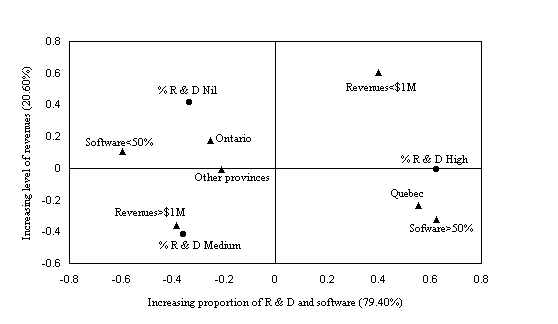
The three independent variables retained by the multiple regression of the total sample were crosstabulated by three levels of the dependent variable (0% R & D employees, more than 0% to 33.33% R & D employees and more than 33.33% R & D employees). The resulting frequency tables, weighted by sample size, were submitted to a correspondence analysis. Figure 1 portrays the relative level of R&D employees in relation to two levels of percentage of software revenue (less than 50% and 50% or more), three locations of the company (Ontario, Quebec and rest of Canada) and two levels of company revenues (less than the median of C$ 1 million and one million or more). Dimension one, accounting for 79,4% of the variance, can be interpreted as a continuum of increasing proportion of R&D employees and percentage of software revenues. The second dimension, accounting for 20,6% of the variance, can be associated with an increasing level of company revenues. Levels of software revenues and locations in Quebec and Ontario are clearly associated with different levels of RDEFFO. For example, a high proportion of software revenues and location in the province of Quebec are clearly associated with a high level of RDEFFO. Levels of company revenues are less clearly associated with the proportion of R&D employees, confirming the marginal contribution of this variable in the multiple regression result.
Figure 1: Correspondence analysis of R&D Determinants
Legend: s Independent variables
l Proportion of R & D employees
CONCLUSION
Traditional industrial economics does not fare very well in the analysis of a new industry like software. Larger size and wider product diversification are not associated with a stronger R&D effort, measured by the proportion of employees devoted to R&D. However, the propensity to conduct R&D increases - tough slightly - with size. Also, specialization in software, and location are more likely to be associated with a stronger commitment to R&D.
Country of control is moderately important: domestic firms (particularly the smaller ones) tend to conduct more often R&D than foreign firms. Finally, we found two very different regional structures in the two major provinces: Ontario boasts larger and more diversified firms; in Quebec, SMEs are overwhelming, and they use both federal and provincial support for R&D more often than the average Canadian software firm.
Industrial concentration in Canadian software production is low, but R&D efforts can be seen across the board, in firms of all sizes and market positions. This finding tends again to reduce the usefulness of more traditional industrial economics (i.e. Schumpeter, Villard, Scherer) and favour Audretsch hypothesis on the particular characteristics of the new R&D-intensive industries, where smaller firms have similar propensities to conduct R&D and be innovative than larger ones. High technology industries, and particularly the newest, science-based ones (software, biotechnology, advanced materials), tend to belong to a different paradigm were R&D is pervasive and not confined to large firms or concentrated industries, were barriers to entry are low, but where increasing returns to scale rapidly differentiate winners and losers, economies of scale in manufacturing are low, but they are key in both R&D and marketing. For this information-intensive industries a new conceptual framework may apply based probably more on the work of Pavitt (1985), Arthur (1994) and the new evolutionary economics, were cumulative causality brings industrial location to the forefront, and were increasing returns and path dependency are central. Science-based industries, such as software production, belongs to a different paradigm from the one that was the core of industrial economics.
Bibliography
Acs, Z. and D. Audretsch (1988):"Innovation and Firm Size in Manufacturing", Technovation, Vol. 7 N°3, July, pp. 197-210.
Acs, Z. and D. Audretsch (1990): Innovation and Small Firms, Cambridge, MIT Press, 1990.
Acs, Z. and D. Audretsch (1991): "R&D, Firm Size and Innovative Activity", in Z. Acs and D. Audretsch (1991): Innovation and Technological Change, N.Y., Wheatsheaf, pp. 39-59.
Arthur, W. Brian (1994): Increasing Returns and Path Dependency in the Economy, Ann Arbor, The University of Michigan Press.
Audretsch, D. (1995): Innovation and Industry Structure, Cambridge, MIT Press.
Bones, H.P. (1979): "Are Foreign Subsidiaries more Innovative?", The Canadian Business Review, Vol.6, N°2, Summer, pp.15-18.
Bonin, B. & C. Desranleau (1988): Innovation Industrielle et analyse économique, Montreal, G. Morin, pp. 50-55.
Chand, U.K.R.(1982): "Characteristics of R&D Performing Firms in Canadian Manufacturing", Research Policy, Vol. 11, N°3, June, pp. 193-203.
Cohen, W.M. and R.C. Levin (1989): "Empirical Studies of Innovation and Market Structure", in R. Schmalensee and R. Willig (eds.): Handbook of Industrial Organization, Amsterdam, North Holland, pp. 1059-1107.
Cohen, W.M. and S. Keppler (1992):¨ The Anatomy of Industry R&D Intensity Distributions¨, American Economic Review, 82, 4, pp. 773-799.
Coombs, R. et al. (1987): Economics and Technological Change, Totowa, NJ, Rowman and Littlefield, pp. 109-114.
Cordell, A.J. (1971): The Multinational Firm, Foreign Direct Investment and Canadian Science Policy, Ottawa, Science Council.
Cusumano, Michael (1991): Japan's Software Factories, N.Y., Oxford University Press.
Economic Council of Canada (1983): The Bottom Line: Technology Trade and Income Growth, Ottawa.
Gault, F. (1997): Research and Development in the Service Economy, A presentation to the NATO Advanced Workshop Quantitative Studies for S&T Policy in Transition Economies, Moscow.
Globerman, S. (1973): "Market Structure and R&D in Canadian Manufacturing Industries", Quarterly Review of Economics and Business, 13, 2, pp.59-67.
Grabowski, H. (1968): "The Determinants of Industrial R&D: A Study of the Chemical, Drug and Petroleum Industries", Journal of Political Economy, Vol. 76, N°2 March/April, pp. 292-305.
Kamien, M.I. and N.L. Schwartz (1982): Market Structure and Innovation, N.Y., Cambridge University Press.
Kleinknecht, A. (1987): "Measuring R&D in Small Firms: How Much Are We Missing?", Journal of Industrial Economics, Dec., 36, 2, pp. 253-256.
Kraft, K. (1989): ¨¨Market Structure, Firm Characteristics and Innovative Activity¨, The Journal of Industrial Economics, Vol.XXXVII, 3, pp.329-334.
Mansfield, E. (1988): "Industrial R&D in Japan and the US: A Comparative Study", American Economic Review, Vol.78, N°2, May, pp.223-228.
Mowery, David C. (1996): The International Computer Software Industry, N.Y. Oxford University Press.
Nelson, R. (1959): "The Simple Economics of Basic Scientific Research" , Journal of Political Economy, Vol. 67, N°3, June, pp. 297-306.
Niosi, J. and R. Landry (1993): "Les gouvernements et les alliances technologiques", Gestion, 18, 3, pp. 32-39.
Pavitt, K. (1985):"Sectoral Patterns of Technical Change: Towards a Taxonomy and a Theory", Research Policy, (13): 343-368.
Pavitt, K. (1991): "Key Characteristics of Large Innovative Firms", British Journal of Management, Vol. 2, pp. 41-50.
Ronstadt, R. (1984): "R&D Abroad by US Multinationals", in R. Stobaugh and L.T. Wells Jr (eds): Technology Crossing Borders, Boston, Harvard Business School Press, pp. 241-264.
Rumelt, R. (1984):"Towards a Strategic Theory of the Firm", in R.B. Lamb (ed.): Competitive Strategic Management, Englewood Cliffs, Prentice-Hall.
Safarian, A. E. (1966): Foreign Ownership of Canadian Industry, Toronto, McGraw-Hill.
Scherer, F.M. (1965): "Firm Size, Market Structure, Opportunity and the Output of Patented Inventions", American Economic Review, Dec., pp. 1105-1113.
Scherer, F.M. (1970): Industrial Market Structure and Economic Performance, Chicago, Rand-McNally.
Scherer, F.M. (1984): Innovation and Growth. Schumpeterian Perspectives, Cambridge, Mass. MIT Press.
Scherer, F.M. (1992): ¨Schumpeter and Plausible Capitalism¨, Journal of Economic Literature, Vol. XXX, pp. 1416-1433.
Schumpeter, J. (1942): Capitalism, Socialism and Democracy, N.Y., Harper.
Scott, J.T. and G. Pascoe (1987): "Purposive Diversification of R&D in Manufacturing", Journal of Industrial Economics, Dec., 36, 2, pp. 193-205.
Soete, L. (1979): "Firm Size and Inventive Activity", European Economic Review, Vol. 12, pp. 319-340.
Statistics Canada (1991): Industrial R&D Statistics, Ottawa, Cat. 88-202 (Annual).
Statistics Canada (1998): Software Development and Computer Service Industry, Ottawa, Cat. 63-222-XPB.
Taggart, (1991): "Determinants of the Foreign R&D Locational Decision in the Pharmaceutical Industry", R&D Management, Vol. 21, N°3, pp. 229-240.
Villard, H.H. (1958):"Competition, Oligopoly and Research", Journal of Political Economy, Vol. 66, N°6, Dec., pp. 483-497.
Watkins, M.H. (1968): Report on the Task Force on Foreign Ownership and the Structure of the Canadian Industry, Privy Council Office, Ottawa.