Family:
Growth Form: Large tree with 1 or more trunks; usually straight and leaning.
Stems: upright branches form narrow or irregular crown.
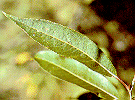
Leaves: Shiny, green abve, paler below; 3-5 inches long, narrowly lance-shaped, often curved to one side; pointed, with finely saw-toothed edges.
Flower Arrangement: Appears at ends of twigs in spring.
Flowers: Tiny, in compact clusters 1-3 inches long, with yellow, hairy scales.
Petals:
Stamens: .
Pistil:
Fruits: Reddish-brown capsule, 3/16-inch long.
Habitat: Wetland areas, along stream banks and lakeshores, and especially in floodplains; in pure stands or with cottonwood.
Range: Great Lakes to Atlantic Coast, south through Mississippi Valley to Gulf Coast.
N 38 degrees 34.755 minutes
W 89 degrees 04.146 minutes
Elevation 475 feet