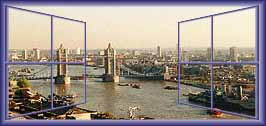
 London
 London
is the capital of the United Kingdom
and the centre of the Commonwealth. It lies astride the River Thames in southeastern England, 50 miles (80 km) from the river's estuary on the North Sea. The city was once the industrial, commercial, and political hub of a wealthy and extensive empire; it continues to be the United Kingdom's main centre of population, commerce, and culture.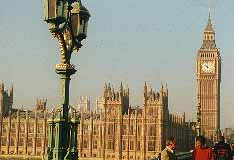
The chalk basin within which London is built is filled with younger sediments, including solid rock, sands, clays, terraced pebble gravels, and Thames alluvium. The climate within the basin is relatively mild, with mean temperatures ranging from 37.4º F (3º C) in January to 72.5º F (22.5º C) in July; rainfall amounts to 23 inches (584 mm) a year.
Founded by the Romans as Londinium in the 1st century AD, the town experienced tremendous growth in trade and population during the late 16th and early 17th centuries. Extensive building projects were initiated after the Great Fire
in 1666, and London became the dominant centre not only of the nation but of its expanding empire. During the 19th century the problems caused by rapid industrialization, such as environmental pollution and disease, were slowly remedied through advances in public health and other services. Heavy damage from aerial bombings during World War II brought the greatest setback in the history of modern London. Reconstruction and new development restored much of the city's grandeur, and relocation of manufacturing and shipping outside the city shrank its population and hastened its transition to a centre of international trade and finance. Tourism and retail trade are other major sectors of the city's economy, and, because London is the nation's capital, government services are also important.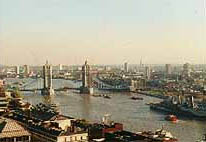
The City of London, 1.2 square miles (3.2 square km) in area, is the core of what is called Inner London, which contains the City of London and 13 of the 33 boroughs of Greater London. The central financial district of the City of London is located just north of London Bridge. Within this area is Lombard Street, the traditional banking street, as well as the Bank of England
headquarters, the Royal Exchange, and the Stock Exchange.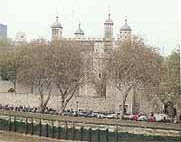
To the east is the fortress-castle known as the Tower of London, whose core dates from the late 11th century and is surrounded by constructions from many periods of English architecture. To the west lie the Inns of Court, longtime chambers and offices of barristers and lawyers-in-training, and the Royal
Courts of Justice, or Law Courts. The City of London and the City of Westminster are linked by the Strand, an avenue along which are located two of London's historic churches, St. Clement Dane's and St. Mary le Strand.The City of Westminster, which stretches along the River Thames, is one of London's wealthiest boroughs and is famed for its commitment to historic renovation. It includes Westminster Abbey
and Westminster Cathedral, Buckingham Palace, the principal government offices, important shopping districts, Scotland Yard, luxury hotels, the Tate Gallery, and the National Gallery. Retail shopping areas are concentrated around Oxford Street. Kensington Road and Knightsbridge are also major shopping districts. The shops spread west and south, down such high-scale shopping areas as Sloane Street, to connect with the trendier King's Road in Chelsea.London's East End, containing neighbourhoods such as Aldgate and Whitechapel, is now mainly within the borough of Tower Hamlets. The area, which is historically associated with the Cockney dialect, became an infamous slum during the 19th century. The East End was the most heavily bombed area of London during World War II and subsequently benefited from extensive rehabilitation.
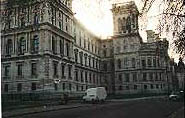
Parks, gardens, and churchyards abound in Inner London. The most celebrated parklands are the six royal parks that sweep through London's West End: St. James's Park, oldest of the six, bordered on the north by the mile-long Mall that terminates at the Queen Victoria Memorial; Buckingham Palace Gardens, bordered on the east by the royal residence; Green Park, plainest of the royal parks but fringed on the east by lavish, once-private buildings; Hyde Park, with its famous Speakers' Corner for soapbox orators; the more elegant Kensington Gardens, with the Victorian Gothic Albert Memorial; and Regent's Park, home of the London Zoo
and Regent's (Grand Union) Canal.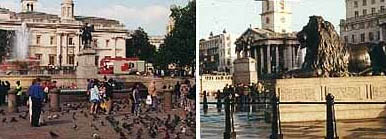
Squares and variously shaped commons are prominent features of London's landscape. Of note are Grosvenor Square, site of the Franklin D. Roosevelt Memorial, and Trafalgar Square, which features Nelson's Column, a 185-foot (56-metre) column with a statue of Lord Nelson, hero of the Battle of Trafalgar (1805), at its top; the National Gallery
borders Trafalgar Square.London's other major cultural institutions include the British Museum, which houses collections of antiquities, prints, and manuscripts; the British Library; the Victoria and Albert Museum
of decorative arts; and the music and arts complex located on the South Bank of the Thames, begun in 1951 for the Festival of Britain.The development of the city's outlying areas was promoted by the opening of the world's first electric underground railway in 1890. Major roads and rail lines radiate in all directions. Dock activity and river traffic are controlled by the Port of London Authority. The London (Heathrow) International Airport is located in the western reaches of Greater London. Area City, 1.2 square miles (3.2 square km); Inner London, 118 square miles (306 square km); Greater London, 656 square miles (1,699 square km). Pop. (1994 est.) City, 5,200; Inner London, 2,434,400; Greater London, 6,967,400.
Source
: Encyclopædia BritannicaAdditional information about London:
Encyclopædia Britannica: London|
|

 Previous Page