|
|
|
Ravenna |
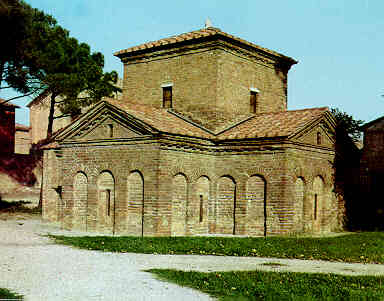
Ravenna was probably founded in the 2nd millennium BC by the Tessali, on several islands of coastal dune bar. In Roman times became seat of the Eastern Mediterranean fleet under the empire of Augustus (1st century BC). Honorius transferred the capital of Western Roman Empire here in the year 402 AD because of its favourable position. With the port of Ravenna it was possible to have control of the sea, whilst the vast swamps that surrounded the city rendered it easily defendable from the land. Galla Placidia, the Emperor's half-sister, who had become regent on behalf of her son Valentinian III, expanded the city, endowed it with monuments, and developed the Christian cult. Odoacre, chief of the Eruli and the Turingi, conquered Ravenna in 476 AD, but was obliged to surrender to Theodoric the Goth in 493 AD. His reign, over the city, which lasted 30 years, represented a second golden age and was characterised by the diffusion of the Arian cult. In 540 the Byzantine general Belisario took over Ravenna on behalf of Justinian, defeating Vitige the Gote. The Byzantine government of the city, which had once again become the seat of the imperial power in Italy, continued to endow it with more great monuments up until the year 751 AD; following this, the city was conquered by the Lombards and then by the Franks. In the 773 Pipin the short presented it as gift to the Pope.
In the following years the port of Classe became silted up and the city, whose history was so closely linked to water, went through a long period of decline. Governed by Da Polenta family during the years in which Dante Alighieri found refuge there (and died in 1321), the city passed in turn from the Venetian State to the Holy See. In 1512 Ravenna was the site of the bloody battle between the French and the Spanish, in which Gastone de Foix died. The Papal government, resumed in 1530,ended in 1859 and Ravenna was united with the new Italian State. At the beginning of this century the first co-operatives were formed in Ravenna and are today still a predominant feature of the social and economic life of the area. The city has contributed decisively to the birth of the Italian Republic, meriting a Gold Medal for bravery at war. Today it is a protagonist of the ideals of Europeanism, having received the European Civic Trophy for the municipality with the largest number of voters at the 1979,1989 and 1994 European election.
THE COUNTRYSIDE
As we have seen from our brief history, Ravenna owes a large part of its fortune to water: the water of the rivers, inland waters separated from the sea by lines of dunes. In this environment of constantly contested land and water, the piallasse - whose name comes from piglia (grab) and lascia (let go)- an undergrowth has developed, first broad-leaved, and then with pines, the wood of which must have been useful to the Roman fleet.
TOURISM
Ravenna has always been a centre of cultural tourism.
It has been visited by Oscar Wilde, Jung and Klimt. Leopardi and Byron stayed here too. However, in the past few decades, the coast of Ravenna has become and important area of international tourism. Apart from the well-organised seaside service, restaurant and shops, Ravenna offers peace, greenery and space. Among the night-life, sport facilities and places of entertainment, which are fully in the style of the Romagna coast, the show-park Mirabilandia, Savio di Ravenna, the largest theme park on the Adriatic coast, completes your vacation with an ideal day of fun and entertainment for all ages. Yet the town of Ravenna has still remained true to its ancient pact with the water that surround it, and for man to enjoy it. Tourism in Ravenna is not only art or beach life. You can discover the delicious taste of typical food, or spend a day browsing in the markets. Walking along the jetties or riding through the pine you can find the peace of holiday resort that offers both charm and stimulus.
MOSAICS BY NIGHT
Ravenna is always the same from its golden age to its renaissance nowadays. Eternal and solemn......
But during the night, when its street are desert, probably because of artificial lights, its monuments seem to become animated as if they where ghosts who want to tell their story.
Theodoric's mausoleum seems to be about to disclose the great king's secret.
S.Apollinare and S.Vitale look desirous of opening their "backed clay sides".
The mystic Dantesc Area evokes the figure of S.Francis and of the great poet who sang him.
The main square dominated by the Venetian Palace becomes more comfortable and confidential and wonderful Baroque facade of Santa Maria In Porto flings elegant and triumphal to testify continuity in the history of our very ancient city.
Additional information about Ravenna:
|
|

 Previous Page