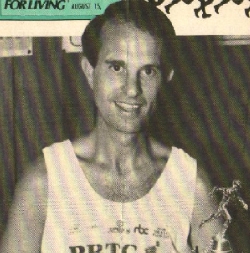
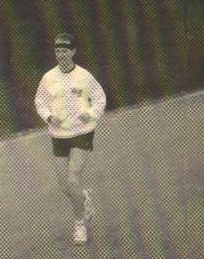
�He may not live through the night,� the neurologist warned Buddy Ritter�s parents when he contracted polio, the dreaded disease of the �50s. The doctors didn�t realize, however, what an indomitable spirit God had given the six year old lying motionless on the sterile white sheets before them, nor the power of parental prayer for committed Christians like Harry and Jerri Ritter. Buddy was one of the last Americans to have the paralyzing disease in September 1960. He took the vaccine-laced sugar cube along with the other children in Malvern, AR in the summer. His first grade school year began normally. He especially liked riding the big yellow school bus. Then one day something went wrong. He began falling st school for no apparent reason. He felt as if his feet were asleep. At first, it seemed funny. As the numbness spread to his legs, though, he couldn�t walk at all without staggering or falling. Then his upper body grew numb. It was no longer funny. �Get him to the hospital,� the doctor said. �He may have polio.� Two of the state�s best doctors were waiting when Harry carried his little boy into the emergency room. Spinal tap tests proved the family doctor was right. �He may live for another hour, maybe a day, or a few,� was the grim report. �If he does pull through, he�ll probably never walk again.� By morning Buddy couldn�t talk or move. He was conscious, but could feel nothing. Doctors pricked his skin with pins to test reflexes. He bled from the tiny wounds, but couldn�t feel them. �He may take a turn for the better, or he may die any time,� they warned Jerri and Harry. The parents felt completely helpless. Fear of the unknown tested their faith. The Ritter�s believed God could make the difference, though, and they did a lot pf praying. Ultimately, all they could do was turn their son over to the Lord. It was up to Him. Ten year old sister Judy was oblivious to what was going on. She knew her brother was terribly sick, but she stayed with friends to continue school. She was not aware of the seriousness of the crisis in her family. After many hours, the doctors offered the parents a glimmer of hope. �He�ll probably live,� they said when the paralysis began going away. �Of course, you can�t expect him to be active again.� Tears glistened in his dad�s eyes as he looked from Buddy to the doctor. �I�ll take him any way I can get him,� he said in a voice strong with emotion. God had answered their prayers. They didn�t expect Buddy to amount to much physically, but praise God, he was alive. Days turned into weeks and then months in the hospital. Progress was slow. Finally, on Christmas Eve, Buddy�s dad insisted on taking him home. His mother continued the daily therapy, praying as she worked every muscle. A strong therapeutic vitamin also helped Buddy regain strength. It wasn�t easy. His legs were simply not strong enough to support him. But he had a will to walk. �I didn�t want to be like so many other polio victims who were confined to a wheelchair or who had to walk with crutches,� he now says. Buddy learned to drag his body across the floor by pulling with his arms. After six or seven weeks, he could stand by holding onto his bed. He practiced for hours, falling on his face many times. But he kept trying and believing he could do it. Eventually, he walked again on his own. It was a funny shuffle, with knees bent and shoulders slumped. In the spring he returned to school. His first grade teacher had tutored him during the months at home, so he didn�t miss a year of school. Buddy�s legs were so stiff that, try as he might, he couldn�t straighten them. When he tried to run, he�d tumble. The children laughed when he fell time after time. Small and skinny, Buddy got picked on and knocked around a lot. �Cripple� became his nickname. �It bothered me terribly to hear their comments,� Buddy admit, �but I couldn�t defend myself.� Determination and practice made a difference. He kept trying, very conscious of his posture, and became more proficient in walking and running as time went on. The ridicule took it�s toll, though. Anger that God allowed him to be different was always beneath the surface. The spiritual struggle became more intense as he grew up. Trusting Jesus for eternal life when he was nine, Buddy believed God had a purpose for his life. He realized it was the Lord who stopped the progress of the paralysis before it reached his brain or to the point of taking his life. But why do I have to walk so funny and not be able to stand straight? He questioned. In the summer of 1973, when Buddy was 19, he surrendered to the inner tugging of God�s call to the ministry. It thrilled Jerri and Harry to know that God chose their son for a special work for Him, especially after they had been told he would never amount to much. A short time later he met a beautiful young lady who said �yes� to becoming his wife. LaDonna and Buddy married in May 1974. She knew of his bout with polio and accepted and loved him completely. But the resentment in Buddy�s spirit continued. For Buddy, overcoming paralysis and learning to walk was not as difficult as accepting his body. He felt cheated in having abnormal posture. All through seminary and after becoming a pastor, he couldn�t shake the disappointment of an irregular walk and stance. Even though he believed God had a personal plan for his life, the bitterness he felt was persistent. The spiritual hurdle of accepting himself as God allowed him to become was the biggest one Buddy had to cross. In 1985, while attending a Bible-based seminar on life conflicts, he made a conscious choice to accept himself as God�s creation. �I know God made me the way I am through experiences He allowed in my life,� he says. �He accepts me as I am regardless of the way I walk or stand. I know He loves me and has a definite purpose for my life that I can accomplish through Him. I am His.� At that moment of decision, peace permeated his entire being. Bitterness melted away and joy took its place. His irregular walk and the way he stands are part of God�s design, he realizes. For Buddy, they are �God�s marks of ownership.� He lives today with gratefulness to God for His goodness. In 1985, Buddy began jogging to lose weight and get into shape. Then he began running, short distances at first, then farther and faster. A few months later in 1986, 26 years after the doctors told him he�d never be active again, Buddy entered and finished a 10 kilometer race. �I was overwhelmed,� Buddy reports, �that God enabled me to run in completion after the doctors� predictions.� The little boy once paralyzed with polio is now a long-distance marathon runner. He ran his first marathon, 26 miles nonstop, in 1987 to prove to himself that he could finish with God�s help. �My thoughts were similar to those I had about walking,� Buddy remembers. �I just kept believing I could do it, and kept pushing. I had a will to run.� Bible verses give Buddy encouragement: �I can do everything through Him who gives me strength� (Phil. 4:13, NIV) and �Be strong in the Lord and in His mighty power� (Eph. 6:10, NIV) �Pressing toward the mark� became Buddy�s goal in January 1988 as he ran his first 50 mile race in Dallas. God enabled him to run in under eight hours to earn a first place trophy. In the years since, he has repeated that feat. He finished in the top 20 percent in the New York Marathon in 1987, competed in the Pike�s Peak Marathon in 1988, and ran in the Western States 100-mile Endurance Run in 1989. In each race he enters, Buddy feels a special closeness with God. Each race is a spiritual experience for him. LaDonna and sons Michael and Jarred form his support group. The first thing they do when Buddy finishes a race is b ow their heads in prayer to thank God for the ability He gives. Scheduling his training runs around responsibilities as a pastor, Buddy runs between 40 and 60 miles each week, usually early in the morning. �If this special gift of running were taken away from me today, I�d still be thankful to God for the ability He has given me over the past few years,� Buddy says. �I can now accept my body with its distinctive stride, because the Lord accepts me just as I am.� �To God be the glory for His work in my body!� That is Buddy Ritter�s convincing testimony.
By Lena M. Case
� 1993, SP Publications, INC. |