SCBWI writers and illustrators from all over the world: meet some of them here!
2003 March: Q&A with a children's author in Alabama
Joan Broerman
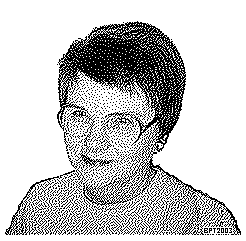
Joan Broerman began her writing career by being banned from the theater. As a teen-aged
drama critic for a community paper, she expressed her honest opinion and the director of the
local amateur theater objected. She recovered her dignity and after graduating from Miami
University in Oxford, Ohio, wrote feature articles for the Louisville Courier-Journal. She won
the first Pockets magazine fiction contest and has had short stories, articles, and book reviews
published in magazines and newspapers for all ages. She is the creator of the "We Love to
Write" workshops for young authors and teaches writing for the Institute of Children's
Literature. -From Weekend Getaways In AlabamaCan you tell us a little about yourself and how you got started as a children's writer?
A cross-country move from Kentucky to New Jersey took my family close to New York
City where I attended my first SCBWI conference. Already published in other fields,
I learned quickly that cracking the children's market requires attention to craft, an
understanding of highly selective readers, and extreme patience. It seems to me there
is a higher standard for children's writers--which I applaud. The SCBWI members I know
strive to give our children the best literature possible. We'd like to be the ones to
write it, but if we can't, we want to be sure someone does. The supportive attitude
among SCBWI members extends beyond a flow of information and an opportunity to make
professional contacts. Many published authors of children's literature will tell you
that SCBWI members kept them writing at times of rejection and disappointment. Look in
the dedication sections of books published within the last twenty years, and It won't
take you long to see a reference to SCBWI. When my family was transferred again, to
yet a different section of the United States, there was no SCBWI region, so my new
writing friends and I started one. Today the Southern Breeze Region of SCBWI is ten years
old and has over 400 members in three states, Alabama, Georgia, and Mississippi. The
Panhandle of Florida has dual membership in Southern Breeze and the region of Florida.
What were your formative influences as a maker of children's books? Were there
experiences, certain books or images which marked your own childhood that you'd
like to talk about? Reading was my reward for whatever I had to do, homework,
household tasks, a trip to the doctor's office for dreaded immunization shots. If I received
six books for Christmas, my dilemma was how to make them last when I wanted to read
them all without moving from my spot under the Christmas tree--like opening a huge box
of chocolates. The happy difference about books was I could read them many times.
And I did. I still have all of them.
What is the most inspiring children's book you've ever read? Why? Tuck Everlasting
by Natalie Babbitt. Every child thinks about death. The subject is covered in many
different ways, but author Babbitt turned the topic upside down. What if a person didn't
have to die? It's a good story, compelling, engaging, extremely well written. But in addition,
it's a story that stirs the reader's mind and never leaves the reader's heart.
What features grab your attention in a picture book? Expressions on the faces of the
characters coupled with delightful turns of phrase. This happy marriage of talents and skills
keeps the reader turning pages and discovering surprises.
Are there any authors, illustrators or both whom you'd like to single out for special
attention? Why? Nina Laden is an author/illustrator whose playful style is spiced with
wordplay. Her first book The Night I Followed the Dog not only captures the attention of
young readers, it brings smiles to adults. Sue Alexander pays loving attention to each word
of her engaging picture books. I might add that Sue, the first member of SCBWI and now
the chairman of the SCBWI Board, has lavished similar attention on many of the members
of the organization. She also demonstrates the patience children's writers need. It took
many years for her recent book, Behold the Trees, to catch the interest of a publisher.
Who would you consider to be the most interesting writers, illustrators, or both, for
children today? Why? Writers: Han Nolan, Susan Bartoletti, and Jen McVeity. Illustrators:
Chuck Galey and Karen Stormer Brooks. All have lives and families, yet they are dedicated
to their craft. Han writes edgy young adult fiction and won the National Book Award for
Dancing on the Edge. Susan's nonfiction is acclaimed. She won the Robert F. Sibert Medal
for Black Potatoes, The Story of the Great Irish Famine, 1845-1850. Jen's books have won
prestigious awards in her home country of Australia and they've been successful in the
United States, too. Chuck is an American illustrator who is generous with his time and
delights aspiring young illustrators with his witty classroom presentations. His latest picture
book is My Brother Dan's Delicious. Karen is also an American illustrator, and her sly sense
of humor is evident at home where she and her husband, both working artists, juggle kids
and after school carpools. One of her many books is I Bought a Baby Chicken by Kelly
Milner Halls. My point is that all of these people have full lives, yet manage to create
wonderful children's books. For them, "I'm going to ... 'someday' " is "I will do this today."
Who would be your all time favourite writer or illustrator for children's books? Why?
Writer--E.B. White. He not only wrote my favorite children's book,Stuart Little, but the
constant on my work table, The Elements of Style, known as "the Strunk and White",
a writer's handbook by William Strunk, Jr. and E.B. White. He wrote for all ages.
Illustrator: Ted Rand. His work is always new and fresh. When he illustrated Faye Gibbons'
picture book, Mama and Me and The Model T, he guaranteed authenticity by visiting
Faye's home and seeing up close some of the items mentioned in the author's hilarious text.
What would you consider your areas of "special interest"? I continue to write for
all ages and stages, even though it might be wise to concentrate all my efforts in one area.
"People" stories lure me, no matter when they happened.
How would you describe your writing style? My published work for children includes
short stories, articles, and poetry published in magazines. My children's early readers, early
chapter books, middle grade and young adult novels are all at what I call the warm letter
of rejection stage. My writing style for adults has been described as "One on one" and that's
what I hope young readers feel, too.
Can you summarize how you progress from the first idea to the final product?
I like to have an outline, even for fiction, but it is not rigid. It's open to great change as
I settle into the writing process from rough draft to first draft, the one I feel is ready to
read to my critique group, to many, many revisions. Some of my novels have been revised
as many as three times for editors who then, for a variety of reasons from "I'm changing
jobs" to "This still doesn't work for me" have not acquired the work. Again, my SCBWI
relationships keep me working through these frustrations.
Is there a particular article or book you have written which you are particularly proud
of or would like to refer us to with regard to your work? Many years ago, before
I became Regional Advisor for Southern Breeze, I was the Alabama Advisor for the
National Association for Young Writers. A beautiful full color magazine was published six
times a year and it featured work by young authors. Highly talented young authors. The
organization also published a newsletter for parents and teachers. For this I wrote an
article titled, "What Young Authors Have Taught Me" based on my experiences as the
creator of a wordshop series for young writers which I've been taking into schools and
libraries across the country for many years. Today I look back at that article and think
it is all still true. Young authors have taught me most of what I know.
Are you aware of any trends in children's publishing at the moment? How do you
feel about them? I see the publishers respecting the demographic studies. Middle grade
and young adult novels are receiving greater consideration.
I have this impression that the idea of a publisher "buying all rights" makes writers and
illustrators feel exploited. Can you comment on that? Can you give us a short and sweet
explanation of what "buying all rights" means? Is it really all that bad? Is it to be
avoided in all cases? I've read or heard several definitions of "all rights" and the one that
stays with me is what Kent Brown, publisher and editor of the 3 million circulation
children's magazine, Highlights for Children, said at a Southern Breeze conference. He
said if you sell all rights to a nonfiction piece, you are selling rights to an arrangement
of words on a page. My interpretation is that you could recycle your research and sell
other articles, slanted differently, on the same topic. However, if you sell all rights to
your fiction, Mr. Brown continued, you are selling the characters, the plot, even the right
to change your characters' names. The writer gives up all ownership and control. Pretty
scary. However, the integrity of the publisher may play a role here. An established
publisher with a good reputation could buy all rights to an author's story and still treat the
author well in future negotiations, should the first publisher want to reprint the story
in an anthology, for example. Another example: Some publishers of children's magazines
say they will return certain rights to an author who wishes to expand the story into a book.
Personally, I'd think about the future of the piece. Is it likely I'd want to turn my
short story into a book? Then that's what I'd concentrate on. I wouldn't risk it to the
generosity of another. Do I need the credit? In that case, I'd submit nonfiction or a
piece that I would craft exclusively for that magazine and a one time exposure.What can you say about self-publishing? Is it something you'd categorically advise
writers or illustrators against? You can't talk people out of this. My advice is to
learn as much as possible about how to do it. I like to ask those contemplating
self-publishing this question, "Why do you want to do this?" Is it because you are tired of
rejection? This is the reason given most often, but it is also the worst reason because it
comes from fatigue and frustration. People who self-publish successfully must have great
resources, especially time, energy, and money. Is it because you have researched the market
and no one is publishing what you are offering, yet you know there are potential readers
(who must be buyers) yet to be reached? You may have discovered a niche. You will have to
develop your niche. Again, people who self-publish successfully must have great resources,
especially time, energy, and money. Is it because you are a well-established author with name
recognition and you'd like to have creative control and all the monetary rewards? This seems
to be the newest group of writers who are self-publishing successfully. They are already
successful and just cutting out the middle man. They've paid their dues and have mountains
of rejection slips and stories of disappointment that would make a strong man cry. May
these survivors continue to succeed!
_____________________________________________________________________
Joan Broerman writes fiction and nonfiction for all ages and stages. Her by-line has appeared in over 200
publications including The Writer, Children's Writer, Pockets, Child Times, and Southern Lady and she
has made contributions to eleven books including the annual publications The Children's Writer Guide,
The Children's Magazine Market, The Children's Book Market. She presents an interactive wordshop
series for young authors in schools and libraries and has been an instructor for the Institute of Children's
Literature. Her professional memberships include SCBWI, the Author's Guild, the International Reading
Association, and the National Council of Teachers of English. Joan was regional advisor of Southern
Breeze for ten years and was named SCBWI member of the year in 1998. She is a graduate of Miami
University in Oxford, Ohio and lives in Birmingham, Alabama, with her husband, Neal. They have seven
children and seven grandchildren. website: www.joan-broerman.com
This interview was conducted by Beaulah Pedregosa Taguiwalo in March 2003.
Copyright 2003 by scbwiphilasia and the contributors. Please do not copy without permission.
Back to www.geocities.com/scbwiphilasia/index.html
