
Sea Creatures Sea Creatures Sea Creatures

What do you want to see?

Bottlenose Dolphin Facts
Gray Whale Facts
Starfish Picture Gallery
Whale Picture Gallery
Dolphin Picture Gallery
Contact me
Links to related sites

The Bottlenose Dolphin
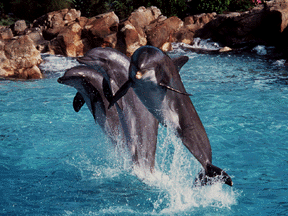
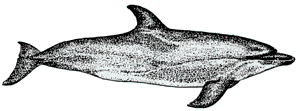
Bottlenose Dolphins

The bottlenose dolphin is perhaps one of the most well known cetaceans, because of its widespread use in marine parks and research facilities. The bottlenose dolphin may be best known as "Flipper" (as seen in the television series). This is the dolphin most frequently seen along the shores of the United States. This species is very flexible in its behavior.More

The Bottlenose dolphin information List:-

More dolphin pictures

PHYSICAL DESCRIPTION����� This is a relatively robust dolphin with a usually short and stubby beak - hence the name "bottlenose". The bottlenose dolphin (like the beluga) has more flexibility in its neck than other oceanic dolphins, because 5 of the 7 neck vertebrae are not fused together as in the other oceanic dolphins. There are 18-26 pairs of sharp, conical teeth in each side of its jaw.

Back to the dolphin information list����Back to the top

COLOUR����� The color of the bottlenose dolphin varies considerably, but generally this dolphin is light gray to slate gray on the upper part of the body shading to lighter sides and pale, pinkish gray on the belly. The belly and lower sides are sometimes spotted.

Back to the dolphin information list����Back to the top

FINS AND FLUKES����� The dorsal fin is high and falcate (curved) and located near the middle of the back. The flukes are broad and curved with a deep median notch. The flippers are of moderate length and pointed.

Back to the dolphin information list����Back to the top

LENGTH AND WEIGHT����� Length is from 6-12 feet (1.9-3.8 m). These dolphins may weigh as much as 1430 pounds (650 kg) off Great Britain, though most are much smaller in other parts of the world. Males are somewhat larger than females.

Back to the dolphin information list����Back to the top

FEEDING����� Feeding behaviors are diverse, ranging from coordinated efforts to catch food, feeding in association with human fishing, to chasing fish into mudbanks. An adult bottlenose dolphin may consume 15-30 pounds (8-15 kg) of food each day. Bottlenose dolphins eat a wide variety of food, including fishes, squid, and crustaceans.

Back to the dolphin information list����Back to the top

MATING AND BREEDING����� Males reach sexual maturity at about 11 years. Females reach sexual maturity at about 5-7 years. The gestation period is 12 months. Calving can take place year-round with peaks in some areas during spring and fall. Calves nurse for over a year (12-18 months), and stay with their mothers for up to three years learning how to catch fish and other important tasks.

Back to the dolphin information list����Back to the top

DISTRIBUTION AND MIGRATION����� Bottlenose dolphins are found worldwide in temperate and tropical waters, absent only from 45 degrees poleward in either hemisphere. They are frequently seen in harbors, bays, lagoons, estuaries, and river mouths. There appear to be two ecotypes: a coastal form and an offshore form. Population density appears to be higher nearshore. Biochemical studies now are providing more information about the relationship within and between the ecotypes. In some areas, dolphins have limited home ranges; in others, they are migratory generally ranging further.

Back to the dolphin information list����Back to the top

NATURAL HISTORY����� Based on a number of studies of nearshore populations, bottlenose dolphins seem to live in relatively open societies. Mother and calf bonds and some other associations may be strong, but individuals may be seen from day-to-day with a variety of different associates. Group size is often less than 20 nearshore; offshore groups of several hundred have been seen. Much of what we know of the general biology of dolphins comes from studies of bottlenose dolphins, both in captivity and in the wild.

Back to the dolphin information list����Back to the top

STATUS����� The bottlenose dolphin is protected in U.S. waters by the Marine Mammal Protection Act. Bottlenose dolphins are still generally plentiful in numbers, but are at or near depletion in some areas. Both incidental and direct exploitation of bottlenose dolphins are known to occur, generally at low to moderate levels. The largest direct kills have traditionally been in the Black Sea, where Russian and Turkish hunters apparently have reduced local populations. Bottlenose dolphins are accidentally caught in a variety of fishing gear, including gillnets, purse seiners used to catch tuna, and shrimp trawls. These dolphins also are occasional victims of harpoon and drive fisheries. Live captures of bottlenose dolphins for captivity have had effects on some local dolphin populations in the Gulf of Mexico and southeastern United States. Bottlenose dolphins are vulnerable to pollution, habitat alteration, and human disturbance (such as boating). Several die-offs of bottlenose dolphins have occurred. Retrospective analysis of tissues of dolphins that died in 1987-1988 during a large die-off (approximately 800-1,000 dolphins) on the Atlantic U.S. coast indicates that mortality may have been caused by a morbillivirus. This virus has been linked to dies-offs of Gulf of Mexico bottlenose dolphins as well. Dolphins with disease symptoms appeared to have elevated levels of PCB�s, leading researchers to conclude that pollutants are playing a role in these events.

Back to the dolphin information list����Back to the top

The Gray Whale

The Gray Whale

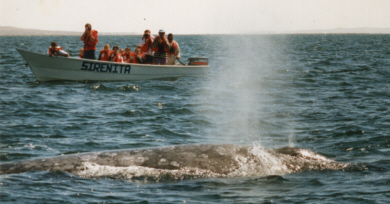
The only member of the family Eschrichtiidae, the gray whale is a mysticete, or baleen whale. It is a "coastal" whale that migrates along the North American Pacific Coast between arctic seas and the lagoons of Baja California, Mexico. Frequently visible from shore, gray whales provide a unique opportunity for land and boat observation, and commercial whalewatching has become a major industry along its migration route. Visitors to the calving and breeding lagoons sometimes encounter the phenomenon of the "friendlies"; gray whales that closely approach small boats and allow themselves to be touched by humans.More

The Gray Whale information list:-

Click
for more whale pictures
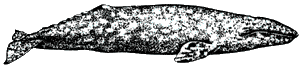
PHYSICAL DESCRIPTION����� Gray whales have a streamlined body, with a narrow, tapered head. The upper jaw is arched in profile, and slightly overlaps the lower jaw. The rostrum (upper jaw) is dimpled and each of the little depressions contains one stiff hair. There are 2-5 grooves on the ventral throat 5 feet (1.5 m) in length.

Back to the Gray whale information list����Back to the top

COLOUR����� The gray whale received its name from the gray patches and white mottling on its dark skin. On the skin are many scratches, scattered patches of white barnacles, and orange whale lice. Newborn calves are dark gray to black, although some may have distinctive white markings.

Back to the Gray whale information list����Back to the top

FINS AND FLUKE����� The gray whale has no dorsal (top) fin. About 2/3 of the way back on its body is a prominent dorsal hump followed by a series of 6-12 knuckles along the dorsal ridge that extend to the fluke (tail). Its flippers are paddle shaped and pointed at the tips. Its fluke is about 10-12 feet (3.7 m) across, pointed at the tips, and deeply notched in the center.

Back to the Gray whale information list����Back to the top

LENGTH AND WEIGHT����� Adult males measure 45-46 feet (13.7-14 m) and adult females measure slightly more. Both sexes weigh 30-40 tons (27,200-36,300 kg).

Back to the Gray whale information list����Back to the top

FEEDING����� Gray whales feed on small crustaceans such as amphipods, and tube worms found in bottom sediments. They feed primarily during the summer months of long daylight hours in the cold Arctic waters of the Bering and Chukchi seas. As a baleen whale, it has a series of 130-180 fringed overlapping plates hanging from each side of the upper jaw, where teeth might otherwise be located. These plates consist of a fingernail-like material called keratin that frays out into fine hairs on the ends inside the mouth next to the tongue. The plates are off-white and about 2-10 inches (5-25 cm) in length. To feed a whale dives to the bottom, rolls on its side and draws bottom sediments and waters into its mouth. As it closes its mouth water and sediments are expelled through the baleen plates, which trap the food on the inside near the tongue to be swallowed.

Back to the Gray whale information list����Back to the top

MATING AND BREEDING����� Gray whales reach sexual maturity at 5-11 years of age, or when they reach 36-39 feet (11-12 m) in length. Gestation is 12-13 months. The calf weighs 1,100-1,500 pounds (500-680 kg) and is about 15 feet (4.5 m) at birth. Calves nurse 7-8 months on milk that is 53% fat (human milk is 2% fat). Females bear a single calf, at intervals of 2 or more years. Courtship and mating behavior are complex, and frequently involve 3 or more whales of mixed sexes. Mating and calving both occur primarily in the lagoons of Baja California, Mexico, although both have been observed during the migration.

Back to the Gray whale information list����Back to the top

DISTRIBUTION AND BREEDING����� Gray whales inhabit shallow coastal waters of the eastern North Pacific. The gray whale makes one of the longest of all mammalian migrations, averaging 10,000-14,000 miles (16,000-22,530 km) round trip. In October, the whales begin to leave their feeding grounds in the Bering and Chukchi Seas and head south for their mating and calving lagoons in Baja California, Mexico. The southward journey takes 2-3 months. The whales remain in the lagoons for 2-3 months, allowing the calves to build up a thick layer of blubber to sustain them during the northward migration and keep them warm in the colder waters. The return trip north takes another 2-3 months. Mothers and calves travel very near shore on the northbound migration. There are some individual gray whales that are found year round in the Straits of Juan de Fuca between the State of Washington and Vancouver Island, Canada and possibly off the central California coast.

Back to the Gray whale information list����Back to the top

NATURAL HISTORY����� A migrating gray whale has a predictable breathing pattern, generally blowing 3-5 times in 15-30 second intervals before raising its fluke and submerging for 3-5 minutes. A gray whale can stay submerged up to 15 minutes, and travel at 3-6 miles per hour (4.8-9.6 km/hr). Mothers are very protective of their calves, and earned the name "Devilfish" from early whalers in the lagoons because of their violent defensive behaviors. Orcas (killer whales) are a cause of gray whale deaths, and many gray whales have orca teeth scars on their flukes.

Back to the Gray whale information list����Back to the top

STATUS����� At one time there were three gray whale populations: a north Atlantic population, now extinct, possibly the victims of over-hunting; a Korean or western north Pacific stock now very depleted, also possibly from over-hunting; and the eastern north Pacific population, the largest surviving population. Hunted to the edge of extinction in the 1850's after the discovery of the calving lagoons, and again in the early 1900's with the introduction of floating factories, the gray whale was given partial protection in 1937 and full protection in 1947 by the International Whaling Commission (IWC). Since that time the eastern North Pacific gray whale population has made a remarkable recovery and now numbers between 19,000 and 23,000, probably close to their original population size.

Back to the Gray whale information list����Back to the top

Links
Animal Where? Rating
Dolphins Dolphinwise.com 10/10
Whales Whale Facts 7/10
Starfish Starfish (Asteroidea) 10/10
Back to top

Hosted by www.Geocities.ws

1