 |
|
|
|
|
|
|
|
|
|
|
|
|
Matt Harpring, A Worker |
|
|
 |
|
|
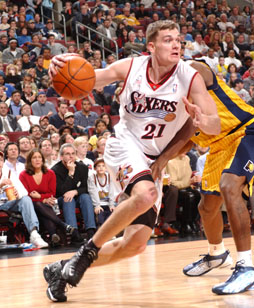
In an era where teams consist of high-flying and athletic players the Jazz are the odd-team out. The Jazz don�t necessarily need those guys, they just want the best players with the best fundamentals and they proved that once again this off-season. First they sign Calbert Cheaney and now they have signed Matt Harpring, a 6-7 guard/forward who studied at Georgia Tech. Harpring is known for his hard work. He is a hard-worker, good defensive player and he has a good shot, although his three-point shooting leaves room for improvement. Harpring is a guy who Sloan will like. The Jazz are a reflection of it�s coach, Jerry Sloan. The team is known for it�s players who work hard and will do everything for the team while not thinking about themselves. Sloan was like that too and Harpring is like that as well. Harpring is officially with the Jazz and the 26 year-old guard/forward signed a four-year deal worth 18.5 million dollars.
Matt Harpring averaged 11.8 ppg, 7.1 rpg and 1.3 apg last year while shooting |
|
|
|
46% from the field and 30% from beyond the arc. He is an adequate free throw shooter, shooting 74% from the charity stripe. He was picked 15th in the 1998 draft by the Orlando Magic. He only played 4 games in his second season because of an ankle injury and that same ankle injury caused him to miss a part of his third NBA season as well, this time in Cleveland. Harprings agent said he probably still would be playing in Orlando if coach Chuck Daly wasn�t fired. And he has reasons to believe that, as the young Matt Harpring impressed Daly: �What Matt brings to us is toughness,� Daly said. �He brings us rebounding and he can make shots. And, above all, he will play defense.� And that is exactly what he brings. He may not be a dominating offensive force but he knows that. �I will not dominate, but I will give it my all.� Harpring said. And that is what Sloan wants. A workhorse. A hard working guy who crashes the boards, plays defense and has a good shot selection. If he really does all that Sloan will be pleased to have him and Harpring is pleased to be coached by Sloan. "He's a guy I've enjoyed watching on the sidelines," Harpring said. "There's a handful of coaches in the league I'd want to play for, and he's one of them." And one more thing Sloan will like is that he will do whatever Sloan will ask him to do. Just like Harpring did with Daly and all the other coaches he has ever had, including 76�ers coach Larry Brown. "My role is to do whatever Larry Brown tells me to do. I know Larry knows how to win. He's trying to get me to get better."
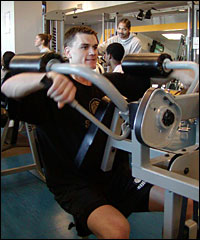
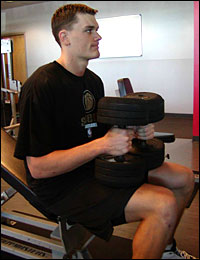
Something else that the Jazz management likes about Matt Harpring is how he keeps on training and working out, even in the off-season. Harpring, coming from a family which has produced a lot of football players, Harpring was a talented one, has his own training routine. A routine that is more often used by football players. "The clean jerks Matt does, there's probably not even seven or eight guys who do that in the league. I would guarantee that," Lloyd, the strength and conditioning coach of the 76�ers, boasts. "There's no way. As soon as a guy sees that, he thinks that's football stuff. And Matt used to play football so he does a lot of football-specific lifts and I think that definitely gives him an advantage strength-wise because those are power movements." And even in the off-season he continues to train. "In the offseason, I get up, lift in the morning, do shooting drills for an hour and a half, then we play. I eat, take a couple hours and then play again at night. So I leave the house at eight and don't usually come back until 7:30," Harpring says. "This is in Atlanta because I can play with a bunch of NBA players that live there and then I play with the Georgia Tech guys too, at night." When most players after a game go home to their families or to eat, Harpring stays a little longer. "I actually just started working out after games last year," Harpring explains. "I'm already loose; I'm already going. I might be a little tired but that's actually good because then you're getting your muscles even more fatigued. And then you're getting a day of recovery � actually two days of recovery before you have to play again so it really works out well for me." And it is effective, at least Harpring thinks so. "With how much I run and how much I exercise -- and I'm not taking anything to get big," Harpring says. "I do all my exercises to get strong and maintain what I do. With my body, I've found that if I don't do squats and things like that, my legs feel weaker on the court. If I do all that stuff, I feel as strong at the end of the season as I did at the beginning of the season." |
|
|
| So Harpring brings toughness, hard work and defense to the Jazz. But why didn�t the Jazz make signing him a priority instead of Marshall? That�s pretty simple. Marshall had the potential to be a 20 ppg and 10 rpg kind of guy. He was an inside presence and shot the ball at an amazingly high percentage, well above the 50%. He may not be the defender Harpring is, but he brought inside scoring, which, with him leaving, is a major weakness of the Jazz. If you would make a trade between these two guys 80% would probably say the team getting Marshall gets better. But there�s also a thing called money. The Jazz signed a young guy, who has improved every year and who works hard, on and off the court, to a four year deal worth 18.5 million dollars. Marshall, 29, wanted more. A lot more. With the big free agent race next off-season the Jazz don�t want a long term contract of so much value because they want enough money to sign a good free agent. The Jazz also want to avoid the luxury tax. If the Jazz signed Marshall to the contract he wanted the Jazz might just have enough to sign a third-string point guard but that�s it. If someone went down with an injury the Jazz wouldn�t have the money to sign someone to replace him. Now they have more than enough. |
|
|
 |
|
|
|
Some say a four-year deal is crazy but I say it is a smart move. You get a young hardworking player, who has improved every year, for four years for little money. He would be a great bench player to have and a reasonable starter. And he could start. Probably not in place of Andrei Kirilenko but in place of the free agent Bryon Russell, as the starting shooting guard. Can he play it? Yes he can. He played the shooting guard spot in Cleveland and did a fine job. Although Harpring feels he is a natural small forward he thinks he could play the shooting guard position and the power forward position, thanks to his training routine which allows him to guard bigger players and still have an advantage because of his strength. He will challenge Cheaney and Stevenson for the starting SG spot. If Harpring wins he will be the starting SG and Stevenson will back him up while Cheaney will back-up Kirilenko at the small forward position. If he doesn�t win he most likely will back-up Kirilenko at the small forward position. The problem with him playing the SG spot is that is quickness isn�t that good and that will probably be exposed by the quicker guards, although he does make up for that a little bit with his hard work.
But some say the four-year deal was crazy and one of their biggest arguments is his injury proneness. He has had a severe ankle injury and only played 4 games in his sophomore year and 52 games in his third year. Harpring says it is not fair to judge him on that because he has had a great college career, injury free, and has had an injury free rookie year and played all the games last year except for one. But injuries can happen to everyone and if you just keep your body healthy and in good shape injuries are not as likely to happen as with players who don�t keep their body in good shape, and Harpring keeps his body in good shape. And Marshall was injury prone as well so, especially then, it is not fair to say they should have spent all their money on Marshall just because Harpring is injury prone. That doesn�t make sense.
So what can we expect from Harpring? Probably the same as he always brings to the table. Good defense, good rebounding and a good shot selection. Harpring might not be the offensive presence Marshall is but he can still knock down that mid-range jumper and can still go to the basket while connecting on a three-pointer occasionally. He will probably score 10+ ppg and adds 7+ rpg. And don�t forget he is now working with John Stockton instead of Allen Iverson. Iverson is known for not always passing the ball when he needs to while John Stockton is known for always getting the ball where the ball needs to be, and that could be in the hands of a wide open Harpring. Harpring knows that and loves to play with Stockton and Malone because they always work hard, on and off the court. "John Stockton has been a role model for me, just the way he plays and how hard he plays," Harpring said, no doubt aware of who puts the ball in shooters' hands on this team. "I get to play with a point guard who knows how to play the game. It's going to be fun." He will fit in the Jazz system perfectly as he knows how to make lay-ups and hit the mid-range jumper and he knows that hard work will open doors that remain locked for people who don�t work hard. He will probably be compared to Marshall a lot and people will |
|
|
talk about Harpring not being the inside presence Marshall is and whenever he does something wrong pessimistswill say Marshall would have done it better. He knows that is what is going to happen as Marshall, who was theJazz man with the most ppg and most rpg behind Karl Malone, was liked by the press and by the crowd. But Harpring will probably become a fan favourite as well because he will fight for every ball and will always play as hard as he can, just how the fans and the Jazz management wants it. And even if he gets compared with Marshall, he doesn�t care although he doesn�t like it either. In Philadelphia he was in the same situation only then it wasn�t Marshall but George Lynch. "I don't like to get compared to other players," said Harpring. "My thing is, if they wanted me to be like George Lynch, they should have kept George Lynch. I'm not George Lynch. I don't really want to be like George Lynch. He's a great guy, but I don't think I play like him." And with that attitude, the way he approaches the game and the way he works he will definitely be a great addition to a Jazz team who now probably only consists of hard workers, players who will fight for every ball and for every point and Harpring will do the same. And that is what everyone wants and what the Jazz need. |
|
 |
|
|
|