 |
|
|
|
|
|
|
|
|
|
|
|
|
|
|
|
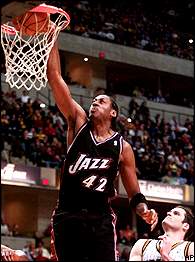
The Match-Up: O'Connor and Miller versus Marshall and Manley |
|
|
 |
|
|
The Jazz top priority this summer was to sign Donyell Marshall. The Jazz, who didn�t use the team option on Marshall�s contract, initially offered a 21 million-dollar contract of three years starting at 6.75 million dollars. Marshall and his agent Dwight Manley refused the offer and demanded more years and more money. But then, for the first time, the salary cap was lowered and the Jazz, already with 10 players who are certain of a roster spot, lowered the offer to a contract of four years worth 23 million dollars and starting with 5 million dollars. And Marshall and Manley didn�t like that. �The collective-bargaining agreement is at work now, both positively and negatively.� said Jazz president Dennis Haslam.
Manley immediately started a media campaign. He said the Jazz don�t know how to do business and that you just can�t take one offer of the table and lower it. Manley told the press that the Jazz are not willing to negotiate and that Marshall is considering to throw the offer in the dustbin and walk away, preferably to the East or the Kings, who have shown interest. O'Connor |
|
|
responded by saying: "If he had something to say to me, he should have called me himself." And after a hard beginning it keeps getting harder. "There's nothing new. There's no backward or forward -- it's standing still right now," O'Connor said.
From the Jazz point of view it is very normal that they do this. They didn�t use the team option because they wanted him to take a pay-cut instead of getting the raise the team option would allow him to. Another big reason was that now he is a free agent this year and otherwise he would have been a free agent next year. And, as we all know, next year almost every team has money, this year they don�t. The Jazz knew that Marshall could only get 4.5 million at best from any other team in the league so they, after one offer, made an offer just a bit higher than that 4.5 million so that if he wants the best financial situation he has to come to Utah. The Jazz know that but what they didn�t know was that Marshall would decline the first and the second offer, which leaves the Jazz with empty hands at the moment. But they have options.
Someone who is also still with empty hand but also has options is Marshall. Marshall, who wants to make as much money as possible but says he likes to be with the Jazz, could go to another team as easily as the Jazz could get another small forward. Marshall wants more money but could sign with another team for less money. The Jazz want to get Marshall back but at the same time could get a small forward with less quality. So both practically have an equally strong negotiation stand point and both are not willing to give in. But if they both play this game too long, both negotiating stand points could get less and less strong because the free agent small forwards will sign with other teams but the other teams also use their mid-level exception which would cause Marshall not to get what he wants. So one of them eventually has to give in or has to take a contract or player of lesser quality but whatever they do, they have to act fast.
So, the Jazz can�t offer Marshall more because of the luxury tax and won�t give in. Marshall wants more money and a longer contract to get some extra insurance. Because the longer the contract, the longer you are assured of a pay-check. So he won�t give in. Both though, have other options. |
|
|
|
 |
|
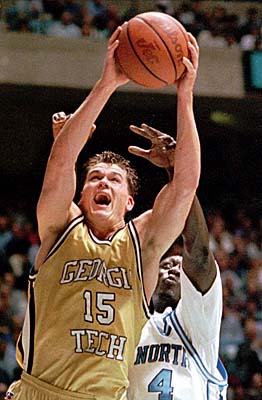
Marshall already said he would like to go East and in the East there are still some teams that need a good small forward. Pat Riley of the Miami Heat still needs a good starting small forward and the Sacramento Kings also have expressed their interest in Marshall and although they are in the West Marshall probably wouldn�t mind playing for them. So there are enough teams interested in him but he needs to accept a pay-cut but if he, for example, signs with Miami he would probably get the starting job, which isn�t guaranteed in Utah. And with a healthy Mourning the Heat should get back in the play-offs and so it is a tempting offer. A one-year deal is certainly possible then because he will become a free agent in the year where all the teams will have money and could easily give someone like Marshall 6 million dollars. A longer contract for the full mid-level exception is still very attractive. If you do that with the Kings you will play 4 season with one of the leagues best teams and if you play in a team like Miami then you would be one of the cornerstones and could be heralded if you play well. Pride and reputation also play a role in this. Not only the pride and reputation as a player but if he would accept this Jazz offer after rejecting the first one his reputation would go down, and then he also has to play back-up for Kirilenko and Malone. So that makes those offers interesting and if you get those offers, you get a stronger negotiating position.
The Jazz meanwhile have options as well. One of them is Matt |
|
|
|
Harpring who probably won�t ask for the whole mid-level exception, leaving some money for a back-up point guard and an additional player in case of an injury. Harpring�s stats are comparable to Marshall�s, although Marshall�s stats are a bit better, but he might come cheaper. Getting Harpring would also allow Scott Padgett to come back, who had a good season with the Jazz last year. Other free agents are Jim Jackson, whose stats are also comparable with Marshall�s but is already 32 years old, and Ricky Davis, a young Cavalier again with stats comparable to Marshall�s. And don�t forget about the free agent shooting guards who also can be signed. Cheaney will then move to the small forward position while the free agent will battle Stevenson for the starting spot. Michael Redd and Voshon Lenard are examples of that. Marshall has better stats than all of them but not that much better that the difference would be intolerable. Especially if the signing of one of the free agents allows the Jazz to re-sign Scott Padgett and another point guard. In the worst case scenario the Jazz will get Padgett which isn�t that bad but it is two notches below the scenario in which the Jazz get Marshall. So the four players above are possibilities, but the Jazz have to act extremely fast as there are other teams who would like those four players. The Jazz already spoke with Matt Harpring and manoeuvred itself in a better negotiation position than it already was.
Marshall also needs to act fast as all the teams are probably willing to spend their mid-level exception on him but they also have other needs and the other teams also have to act fast if they want another free agent. And if they sign another free agent it will likely be for a part of the mid-level exception and so the number of teams with their mid-level exception fully intact are shrinking. Marshall needs to act fast and the Jazz need to act fast.
So, both sides� end result would be better of if they reach a deal because Marshall is the best small-forward on the free agent market and the Jazz can offer the most money. But Marshall wants more money because what he get extra with the Jazz in comparison to another team is pocket change for him, although it is very nice to have |
|
|
that extra money, so he might as well try to get a million or � million dollar more because financially he won�t get that much worse if he signs with another team. So he figures he might as well take the gamble. But if the clock strikes twelve and he is too late, he will face the same destiny as other players for the Jazz.
Remember Olden Polynice who wanted to test the free agency market? Now he is unemployed. If he had taken the Jazz offer he would still play but hey, he figured he could get more money elsewhere. Or what about Shandon Anderson? He still plays for the Knicks but doesn�t get significant minutes there, minutes he would have gotten in Utah. The quality of his play has made a jump backwards and he, just as Polynice, should have taken the money the Jazz offered.
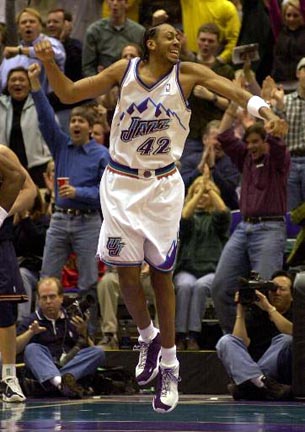
The Jazz, on the other hand, are not taken the bait but if they don�t act fast they could lose another free agent while not getting anything valuable back. Just like with Anderson. Marshall could just as well end up with nothing, or at least with less than the full mid-level exception. The negotiations are standing still and both sides are waiting for the other to give in. And they are waiting, and waiting and waiting. And the clock keeps on ticking. Tick, tock, tick, tock, tick, tock, tick, tock�� |
|
|
 |
|
|
|
|