 |
|
|
|
|
|
|
|
|
|
|
|
|
|
|
|
Damn Right I�ve Got The Blues |
|
|
Jazz center Greg Ostertag has always been one of the players the fans just couldn�t like. Even today he adds chapters to a book full of problems he self created. The inconsistent veteran has shown flashes of brilliancy in the past, but it stayed with flashes. Some say he tries but just can�t do it. Others say he can do it but just doesn�t want to. Before the draft people questioned his heart and today they still do. Reason enough to put this plagued center in the spotlight as I will give facts and (my) opinion(s) about the big center who just can�t do the right thing for the fans.
Gregory Donovan Ostertag was born on the sixth of March, 1973. He went to college at the University of Kansas and he has found the love of his life in his wife Heidi with who he has three children. He wanted to get into farming but he chose the path of basketball. |
|
|
|
College Basketball |
|
|
|
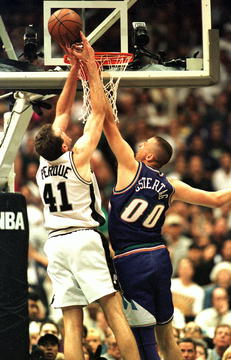
Greg Ostertag started to play college basketball in the 91-92 season. In 31 games (he started 1) he averaged 4.8 ppg and 3.5 rpg. He led the team with 34 blocks. He had a good fg% with 54.5. They had a very good season despite of the lack of famous names. Only Ostertag and Rex Walters made it to the NBA. In his second season with Kansas he again didn�t start but still managed to block 36 shots, again a team high, in 34 games. His stats rose a bit as he averaged 5.3 ppg and 4.1 rpg. The next season he got company at the center spot as this was Scott Pollard�s first season with the Kansas Jayhawks. Greg Ostertag started 34 of the 35 games and was the team leader in rebounds and blocks (307 rebounds and 98 blocks.) His stats rose significantly. He almost averaged a double-double with 10.3 ppg and 8.8 rpg. Future Jazz player Jacque Vaughn also joined the team and in his first year he started and was the team leader in assists. Rex Walter didn�t play that year as he entered the NBA draft and got selected by the Philadelphia 76�ers. The roster consisted of the guards Vaughn, Weichbrodt, Whatley, Rayford, Reed and Sean Person. The forwards: Patrick Richley, Scott and B.J. Williams and the four centers Pollard, Ostertag, Proud and Greg Gurley. In the NCAA tournament they won 2 games before being knocked out. In his senior year Ostertag started 28 of the 31 games and he formed a dangerous duo with forward Raef LaFrentz who had joined the team. Ostertag led the team for the fourth consecutive time in blocks and for |
|
 |
|
|
|
the second consecutive time in rebounds. His stats dropped, probably because of LaFrentz who had a great first year with the Kansas Jayhawks. The Jayhawks won 2 in the NCAA tournament, against Colgate and Western Kentucky before losing to Virginia. In all his college years he was coached by Roy Williams, who is still coaching the Kansas Jayhawks. Williams said he was fortunate coaching Greg Ostertag: "He jokes that half my gray hairs were put there by him," Williams said. "But I feel fortunate to have coached him. We've won a lot of ballgames with him." Before Osterag�s last match against Virginia the staff of the Virginia Cavs talked about the height the Kansas roster had. "We haven't played anybody else that has the type of size KU has, and the quality as well," Virginia coach Jones said. "They've got a bunch of guys who can and will shoot the perimeter jumper. But their real focus is inside. That sets up everything else." And, the article reports, most intimidating is Greg Ostertag. �Most intimidating is Ostertag, the genial senior who shares something meaningful with Burrough.
He, too, never quite realized the awesome potential experts charted for him in high school. He, too, was never a first-team all-conference choice.
Still, while averaging only about 14 minutes per game, he's deflected 256 shots and re-directed many hundreds of more. His intimidating presence in the paint is a major reason the Jayhawks were third nationally with a 37.8 percent field goal defense.�
Virginia coach Jones knows that: "He changes things in there, he's so big -- just the amount of space available in the paint," Jones said. "Then when you throw another 6-10 and another 6-11 guy in there, there's even less space."
Virginia won and Ostertag never won the college title. He faced a hard decision which would effect his entire live and he decided to go into the NBA draft.
NBA Draft
A lot of people didn�t know what to think of Greg Ostertag. A lot of people had him in the early twenties and many experts thought that he would be gone before Utah�s pick. Everybody agreed that he was an inside presence. He was a good defender in college and was a good shot blocker. �Very good at blocking shots into his own hands rather than into the fifth row.� That was one of the many comments about his shot blocking abilities. The problem was, and that�s why he got drafted so low, his heart. Kansas coach Roy Williams once said: �If you could put Jerod Haase's heart into Greg Ostertag, you would have one of the best players that ever played this game.� They said he had the basketball instincts to become a great player but wasn�t in shape most of the time and if he didn�t want to play he just doesn�t play. His offensive game was a big question. He had shown some flashes of brilliancy but most of the time he would struggle to put in a ball when he is right in front of the basket. One time he got the ball at the free throw line and he dunked the ball after making two quick steps. Fans said it looked a bit like a move of David Robinson. Nobody questioned his defense as he was able to shut down Bryant Reeves in college and that was quite an accomplishment back then. The Draft came closer and many questions about Ostertag were still unanswered and that was probably the reason why the Jazz were able to get him. He should have been the fourth center in the draft but Loren Meyer and, very surprisingly, George Zidek were taken ahead of him. He was taken by the Jazz with their first round pick at number 28. Lower than expected and maybe lower than he deserved. |
|
|
|
The Utah Jazz |
|
|
|
It looked like a fine choice by the Utah Jazz. A shot-blocking big man. Especially after Mark Eaton retired in 1994. Eaton, one of the better defensive centers in the league, retired after playing 12 seasons for the Jazz, from 1982 to 1994. After an up and down rookie season, in which he got 10 starts while averaging 3.6 ppg, 1.11 bpg and 3.10 rpg in 11.6 mpg, the Jazz expected a lot of him. But not everyone was happy when the Jazz traded Felton Spencer after Ostertag�s rookie season. An up and down rookie season. Up and down. Something that would be typical for his play.
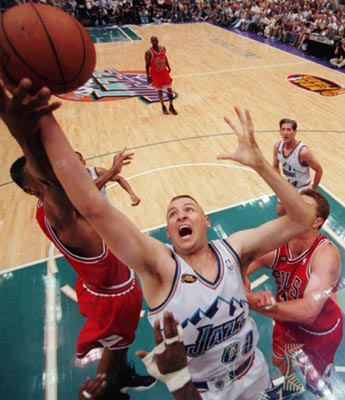
The 96-97 season was a great season for the Jazz as they reached the NBA finals. Ostertag had a nice season especially for a sophomore. He averaged 7.3 ppg, 1.97 bpg and 7.3 rpg. But the Jazz lost the finals and Ostertag lost his good stats because it went downhill from there. The Utah Jazz signed Greg Ostertag to a 6 year contract worth 39 million dollars. "We expect Greg to be our center of the future," Larry Miller said, beaming. "He knows we've got a lot riding on him." Unfortunately instead of being a top defender in the league he became the favorite target of reporters, fans and even |
 |
|
"Greg's had some rough times this year," guard Jeff Hornacek said. "He's tough about it, but it gets to anybody." Ostertag tried not to let it get to him but some things, like the punch Shaquille O�Neal gave him, could just not be ignored. "Things that people do, they get to you," he said. "You ignore things and just play your game ... but it all builds up." Ostertag had a disappointing year in 97-98 but the Jazz made it to the finals but again lost against the Chicago Bulls. Ostertag numbers dropped to 4.7 ppg, 2.1 bpg and 5.9 rpg in 20.4 mpg. Who can blame him? His self-confidence got a huge blow when Malone asked the Jazz to sign center Ike Austin in December that year. And he didn�t get along, excuse me, and he doesn�t get along very well with coach Jerry Sloan. That year he even was banned to the locker room in the match against Washington when Sloan yanked him out after missing a rebound. The two got into a shouting match and Ostertag kicked a chair to the ground before being thrown off the bench. Unfortunately that kind of shouting matches with Sloan would not stop there. �Greg and I both said some things, and that was it," Sloan said. "We've worked all that out." That was Sloan�s impression in 1998. But that wasn�t the case. Take this year for example. They again had two heated arguments. When Sloan yanked Ostertag out for lack of concentration and lack of intensity Ostertag said he was all right and went to the scorer�s table to check himself back in. Sloan didn�t want him to check in and again they had a shouting match resulting in a one-match suspension. There weren�t only low points. He got the Delta Center crowd to like him for at least one match as he blocked a potential game tying lay-up by Brent Price. On Christmas. In the shortened lockout season Ostertag did have a good year. He averaged 5.7 ppg, 7.3 rpg and a dazzling 2.7 bpg. But after that season there were barely ups as he lost his starting position to Olden Polynice. He got less than 20 minutes but still averaged 6 rpg, 4.5 ppg and 2.12 bpg. The year after that, the 00-01 season, his stats dropped while his minutes only went down by 1.
And this year it is worse than ever. He seemed to be in his best shape ever when reaching the training camp. Polynice didn�t resign with the Jazz and it seemed that he had to battle Amaechi for the starting center position. But both were so disappointing that rookie Jarron Collins got the job. Malone back up minutes at the center position while Ostertag only gets 15.4 mpg averaging a career-low 3.5ppg. He is a mystery to most of the fans, reporters and coaches. One day he is completely immovable and the next day he gets 6 blocks and connects on all of his field goal attempts. Up and downs. That is Ostertag. Playing brilliantly one game and playing horribly the next. Hated by the fans because they see what he can do but he rarely does it. And that for that kind of money. He has been called a Baby Huey, Dopey, a goon, a slob, a slug and a goofball. And that was just by one Salt Lake columnist. Fans already say that he has one good game per month and they aren�t surprised anymore when he totally, let me just say this like it is, sucks. His whole career consisted of up and downs but lately, especially this season, there are more downs than ups.
The Future |
|
|
|
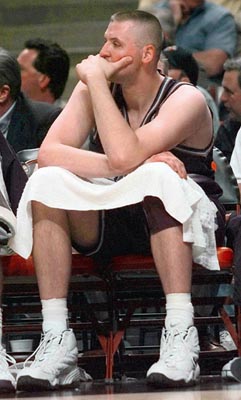
Well what are you going to do about it? The Jazz still hope he will realize his potential one day and that he just has a great season but the fans wouldn�t be surprised if he would be a back-up for Collins for the rest of his Jazz career which is likely to end in the 03-04 season because that will be the last year of his contract. He was hated for his entire career but did he really deserve it? Deserves anyone to feel the same kind of misery he has felt? Because like he said it will get to you. No matter what, it gets to you. And of course he doesn�t deserve it. Of course he sometimes lacks intensity and of course his play has been disappointing but it only has been disappointing because of his contract. After two reasonable seasons he got that contract and if you don�t start the season on a good note then the reporters will jump on you. They will tear you apart and then the fans will follow. And if don�t find a way to win that mental game your stats will drop and your intensity level will drop. Then your teammates follow and then you can�t do anything but just watch how everything suddenly turns against you. A painful process. And you can get motivated at some times but you just can�t do it all the time. Why should you? Everybody just wants you and your fat contract to get away. Especially that fat contract. There is a limit to what a human can endure. Ostertag�s limit has been passed a long time ago. |
|
 |
|
|
|