 |
|
|
|
|
|
|
|
|
|
|
|
|
|
|
|
|
|
|
|
|
|
Donyell Marshall In The Spotlight |
|
|
Donyell Marshall could never reach the level many thought he would reach after college. Marshall was a standout at Uconn but he wasn�t able to be the go-to-guy on the teams that needed a leader. But no one, especially players in the league, underestimate him because he is a big man who can not only mix it up inside but also shoot the three-pointer. The Jazz got him in a trade but even now, when he is playing with Karl Malone and John Stockton, he can�t live up to the expectations many had during draft day. But still on every team he played, with maybe the exception of the Minnesota Timberwolves who drafted him, he was a solid contributor. A star that doesn�t shine but gives enough light to help the team. Now he is standing at a crossroad as his contract expires and before he either re-signs with the Jazz or goes Donyell Marshall will be in the spotlight.
Donyell Lamar Marshall is born on the eighteenth of May, 1973. He went to the University of Connecticut. He has four children, Marquis, Paryss, Donyell Jr. and Devynn. He isn�t the only family member who plays/played on a professional level as his uncle, Lenny Moore, was a running back and he even made it to the football hall of fame. He didn�t finish his college as he entered the draft after his junior year. |
|
|
|
College Basketball |
|
|
 |
|
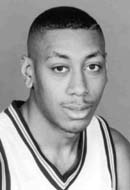
| As said in the introduction Donyell Marshall was a great basketball player in college. In his first year he averaged 11.1 ppg, 6.1 rpg and 2.6 bpg. The rest of the team consisted of guards Kevin Ollie, Chris Smith, Gilad Katz, Tim Pikiell, Rich Ashmeade, Brian Fair and Scott Burrell, forwards Toraino Walker, Donny Marshall and Rudy Johnson and the centers were Dan Cyrulik, Rod Sellers and Nantambu Willingham. The team had a overall record of 20-10 and Donyell Marshall started in his first year and he got 27 minutes per game. He was a member of the All-Big East Rookie Team. In his second year the team was even more impressive as center Travis Knight joined the team and Marshall was a year older. He again started and he again averaged brilliant numbers. He scored 17 ppg and added 7.8 rpg and 2.1 bpg while shooting 50% from the field and 37% from beyond the arc. He was a member of the All-Big East First Team and he repeated that in the next season, 93-94. He again had a great season just like the team which improved it�s overall |
|
|
|
record to 29-5. The starters of that team were Kevin Ollie, who went to the NBA, Doron Sheffer, Donny Marshall, who also went to the NBA, Donyell Marshall and Eric Hayward. The bench was impressive with not only Travis Knight but also with Ray Allen who is now one of the top players in the league. Marshall, who now averaged 34 minutes per game, scored 25.1 ppg and he added 8.9 rpg and 3.2 bpg as he shot 51% from the field. He was a unanimous member of the 1st Team All-American and he was Big-East Player of the Year. In most of the polls he was runner-up for player of the year to Glenn Robinson. If that wasn�t enough he was also a member of the Big East Conference Tournament All-Tournament Team and he was Big-East Defensive Player of the Year. So it was absolutely no surprise that he entered the 1994 NBA draft. Last year in a chat he was asked what coach Calhoun, who was the coach of Uconn, taught him. Marshall ansewered: �I guess pretty much how to handle certain situations. Even if I didn't like the situations, to be able to handle it myself and not blow it out of proportion or get in trouble or anything like that.�
The Draft
The 1994 draft had some good players in it like Jason Kidd, Glenn Robinson, Juwon Howard, Grant Hill, Eddie Jones, Brian Grant etc. Donyell Marshall was considered one of the best. In many mock drafts he was in the top 5 and he was always in the top 10 as he had long arms, a good shot, a low post game and he was quick and had good ball handling skills. In comparison with other small forwards in the NBA many thought he was better in the low post than most of them but he wasn�t as good as other small forwards in defending the perimeter. Another concern was that he had, according to some, a fragile confidence which could easily be broken. One thing that hurt his stock was the game Connecticut-Florida in the NCAA tournament in which he had to shoot two free throws which would likely give Uconn the win. He missed both. And that from a guy who in one game attempted, and made, 20 free throws. Normally he is a good pressure performer but he was frustrated because he, and the whole team, had played a poor game. And that, according to some, broke his confidence which led to the two missed free throws. This should have been an indication that Marshall couldn�t be, at least in an early stage in his career, the main man. The go-to-guy in crunch time. But it wasn�t a surprise that he didn�t fell in the draft because of that because everyone expected a lot from Marshall. He had, especially for a small forward, a good low post game although he lacked the strength to bully his way inside. But he was a good offensive rebounder and usually finished it with the tomahawk slam. That wasn�t his only frequently used move because another move he used with great success was the midrange turn around jumper, a jumper he was likely to get in the NBA. He was good in defending low post players and he got his share of blocks in college basketball, mainly because of his long arms. Everyone agreed that he would be the second or third small forward to go after Glenn Robinson and maybe after Grant Hill and that indeed was the case as Donyell Marshall was drafted by the Minnesota Timberwolves as fourth overall. Behind Glenn Robinson, Jason Kidd and Grant Hill. Some of the players drafted after Marshall were Juwon Howard (5th), Lamond Murray (7th), Brian Grant (8th), Eddie Jones (10th) and Jalen Rose (13th). |
|
|
|
Highway To Hell |
|
|
| Minnesota wasn�t good for Donyell Marshall. After 40 games and 8 starts he was traded to the Golden State Warriors for Tom Gugliotta. In 26 minutes the rookie averaged almost 5 rpg and 11 ppg while adding at least 1 block per game. Golden State on the other hand wasn�t the place to be either. He finished his rookie season in style, averaging 15 ppg and 6.5 rpg in 33 minutes but it soon would go down hill from there. His minutes went down and so did his stats. In his sophomore year he only got 15 mpg and averaged 5.5 ppg and 3.4 rpg. In the season 96-97 he got 20 starts but still only averaged 17 mpg and thus his stats didn�t rise like they should have done. He averaged 7.3 ppg and 4.5 rpg. He was called the biggest mistake of draft history, also because of his huge contract. He made 2,730,000 dollar which, in that time, was a huge amount of money. Chris Mullin, �Mully�, only got 100,000 dollar more than Marshall. Only the leagues elite would make more than 3,000,000 dollar. Today 3,000,000 dollar is nothing but did you know what John Stockton made that year? Approximately 2,800,000 dollar. Only 70,000 dollar more than Donyell Marshall. In the 96/97 season he even earned |
|
 |
|
|
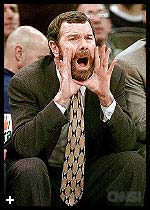
P.J. Carlesimo, picture from CNNSI |
|
|
3,360,000 dollar and was third on the Golden State Warriors pay-list only to Latrell Sprewell and Mark Price. After that year, in the 97/98 season, he was second on the pay-list because Mark Price and Chris Mullin both left Golden State leaving a team behind that really wasn�t worth looking at. Latrell Sprewell and Donyell Marshall were reasonable but after that came Brian Shaw, Joe Smith, B.J. Armstrong and Felton Spencer. Golden State fans didn�t like that but they did like that Donyell Marshall actually started earning his money. He started all of his 73 games and averaged 15.4 ppg, 8.6 rpg and 2.2 apg. He got some unofficial awards by NBA sites and papers and he was generally considered as comeback player of the year. One would say: �The Warriors can be happy that the biggest overpaid bust in NBA history, Donyell Marshall, has resurrected himself from the basketball dead to have, what looks like, a stellar season.� The Golden State Warriors, although not the worst, were very close to reach the bottom of the league. After a 30 win season with Mark Price and Mullin they fell back to a 19 win season. Donyell Marshall finished third in the voting of Improved Player of the Year with 24 votes. Alan Henderson would win with 33 votes and Corliss Williamson was second with 25 votes. But light shone at the end of the tunnel as the Golden State Warriors almost recorded a 50% season in the shortened lock-out season as they won 21 games and lost 29. That was also because of the additions of John Starks, Muggsy Bogues, Chris Mills, Jason Caffey and Antawn Jamison. Remarkable because star player Latrell Sprewell didn�t play. It wasn�t a complete surprise that Latrell Sprewell was traded because Sprewell served a 68 game suspension in the 97/98 season because he had a run in with coach Carlesimo. As a matter of fact, he choked him. Marshall said the penalty, it was a year but it was reduced, was too harsh. "He didn't do anything to me," Marshall said after Sprewells suspension was reduced and he would come back to the team. "But the damage probably has been done. I don't think they would bring P.J. (Carlesimo) and Sprewell back together at the same time." In the 99/00 season he earned more than 5 million dollars but he couldn�t prevent that the Warriors only won 19 games and that coach Carlesimo got fired. "Sometimes, you can't blame it on the coach, even though coaches are always the first ones to get axed," Warriors forward Donyell Marshall said. "But I think it was a decision the organization probably needed to make. I think they've been waiting to make it for a long time, and it just finally happened." After that season Donyell Marshall was shipped out of hell straight into heaven as he finally got traded in a complicated four-team deal. Finally, he was out of Golden State.
Stairway To Heaven |
|
|
 |
|
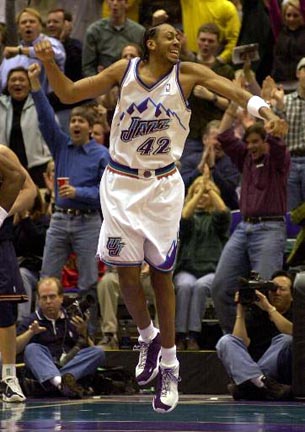
| When you think making a trade is easy then I will smack that thought right out of your head. In a four-team deal involving 9 players Boston received Robert Pack, John Williams, cash and a conditional first round pick from Utah. Dallas received Dana Barros, Bill Curley and Howard Eisley while Golden State received Danny Fortson and Adam Keefe. The Jazz got Donyell Marshall and Bruno Sundov. Eisley wanted out anyway so the Jazz decided to trade him and at least get something in return. That something was Marshall. His first day at the Jazz was a great day and the acquaintance was a good one, especially with John Stockton. At the first practice Stockton came up to Donyell, shook his hand and asked: �Where do you want the ball?� "I just thought that was his way of introducing himself," Marshall said. "But he was dead serious. He asked me again, 'Where do you want the ball?' So I told him. And he gets it there every time." Utah was so different from the Warriors. "Their work ethic," Marshall marvels. "Guys don't come in here and complain about going to practice the next day. I've been on teams where guys have played for 16 or 17 years, and after they played 35 or 40 minutes they want to take that next day off practice. Karl and John and these other guys don't do that. Coach makes them come in and practice for a few hours and they do it. And they do it hard." Marshall worked his way into the starting line up and Bryon Russell moved to the shooting guard spot which was vacant since Jeff Hornacek retired just before Marshall came. |
|
|
|
|
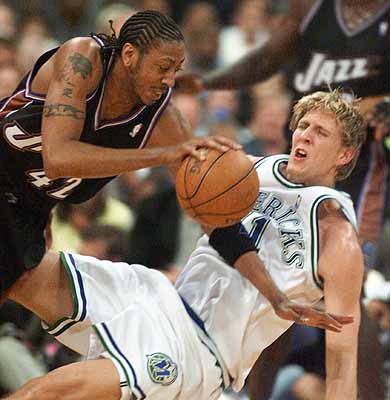
| According to some journalists adding Marshall even gives Utah a greater advantage than they had with Jeff Hornacek: �But now, Marshall, at 6-10, gives Utah somebody big on the weak side, away from Malone, that defenses have to worry about. And as an added bonus, he can knock down the 3. Maybe not as regularly as Hornacek, but, hey, who can? He is averaging 13.7 points and seven rebounds, but since the beginning of the new year, since Marshall has been starting (when Russell got hurt), he is averaging 18.8 points and 9.6 rebounds, and those are All-Star numbers.� Marshall averaged 13.6 ppg and 7 rpg in 29 mpg. He shot 50% from the field. He had a good year and even had 3 votes for most improved player of the year that year. He didn�t only like to be in Utah but Utah also liked him. "He's been huge," Malone said. "If I had to pick an MVP for our team, it's him.I've waited my whole career to play alongside a guy like him. I'm really enjoying this." Not only players on the Jazz think that way but he even got praise and respect from people and players who didn�t have anything to do with the Jazz. "I mean, this guy, he is 6-10, long arms, he can hit the three, he can rebound," Sonics guard Brent Barry says in wonderment. "He had numerous 20-rebound nights in Golden State. And to have that guy play the three, and allow Russell to slide to the two, you have a very very difficult matchup for a lot of teams. We have Rashard (Lewis) at 6-10, but he doesn't have the inside game that Donyell has. He is helping them play at a level that they really haven't played at for three years, which is scary to say because they were winning 55 or 60 games a year. I think they are the team to beat." The Jazz lost in the first round against the Dallas Mavericks in a heart braking series. This year he averaged almost 15 ppg and 7.6 rpg while he added 1.2 bpg in 30 mpg. And that despite an injury and despite the great season rookie Andrei Kirilenko had. He has great respect for the older players in the league and especially in Utah were not only Stockton and Malone learned him things but everyone in the organization. "I never really had a leader before to show me the way, how to get things done," Marshall explains. "Mully was there, but at that time he wanted to get out of Golden State, as well. I have guys on this team, not just Karl and John that are leaders. Everybody on this team helps me in certain ways, helps me adjust to |
|
|
| the system. The leadership on this team, all the veterans, have done a great job of helping us younger players out." The Jazz lost again in the first round this season but in the play-offs Marshall played his best basketball not only mixing it up inside but he also hit several clutch three-pointers in a extremely tight series. Last season he still had some problems at the end of the game making things happen. In the Dallas series for example. In his first play-off match he went to the free throw line with 3.3 seconds left. The Jazz were ahead 87-86 and Marshall missed the first, but made the second. "I was kind of nervous on that as well. There was a similar situation when I was in college and actually I missed both free throws. I was just trying to make sure I made at least one out of these two and give our team the best chance to win. The second one I just knew I had to get up. Stockton was laughing at me and just telling me to loosen up and I think that was able to help me relax for the second shot.� This year however he was more clutch than ever not disappearing at the end. |
|
 |
|
|
|
|
Crossroads |
|
|
After two seasons with the Jazz his contract is up and the Jazz want him back, but he probably has to take a pay cut. "John is not going to play forever and Karl [Malone] is not going to play forever," Marshall said. "I would love to keep learning from those guys and then take over. But it's up to the Jazz."
Marshall does not believe the Jazz want to start over.
"We don't know if this team is going for a big shakeup or not," he said. "But you don't want to go where Chicago's at, or where Boston was. Nobody ever wants to get that low." He wants to come back but the Jazz also have to look at the other positions since Marshall is the only player with trade value so it could be that the Jazz will try to sign and trade Marshall to get better at one of the other positions. But I think that Marshall will come back to be Kirilenko�s and Malone�s back up, getting minutes at both positions and he will get many minutes since Malone is aging and playing at the center spot more than ever. Marshall likes to come back and who wouldn�t do that after the things he has been through. "You guys are so talented and so long," Brent Barry told Marshall. "With Karl and Stock and you, you are hell to play. Pure hell."
"Brent," Marshall said, "I went through six seasons of pure hell to get here." |
|