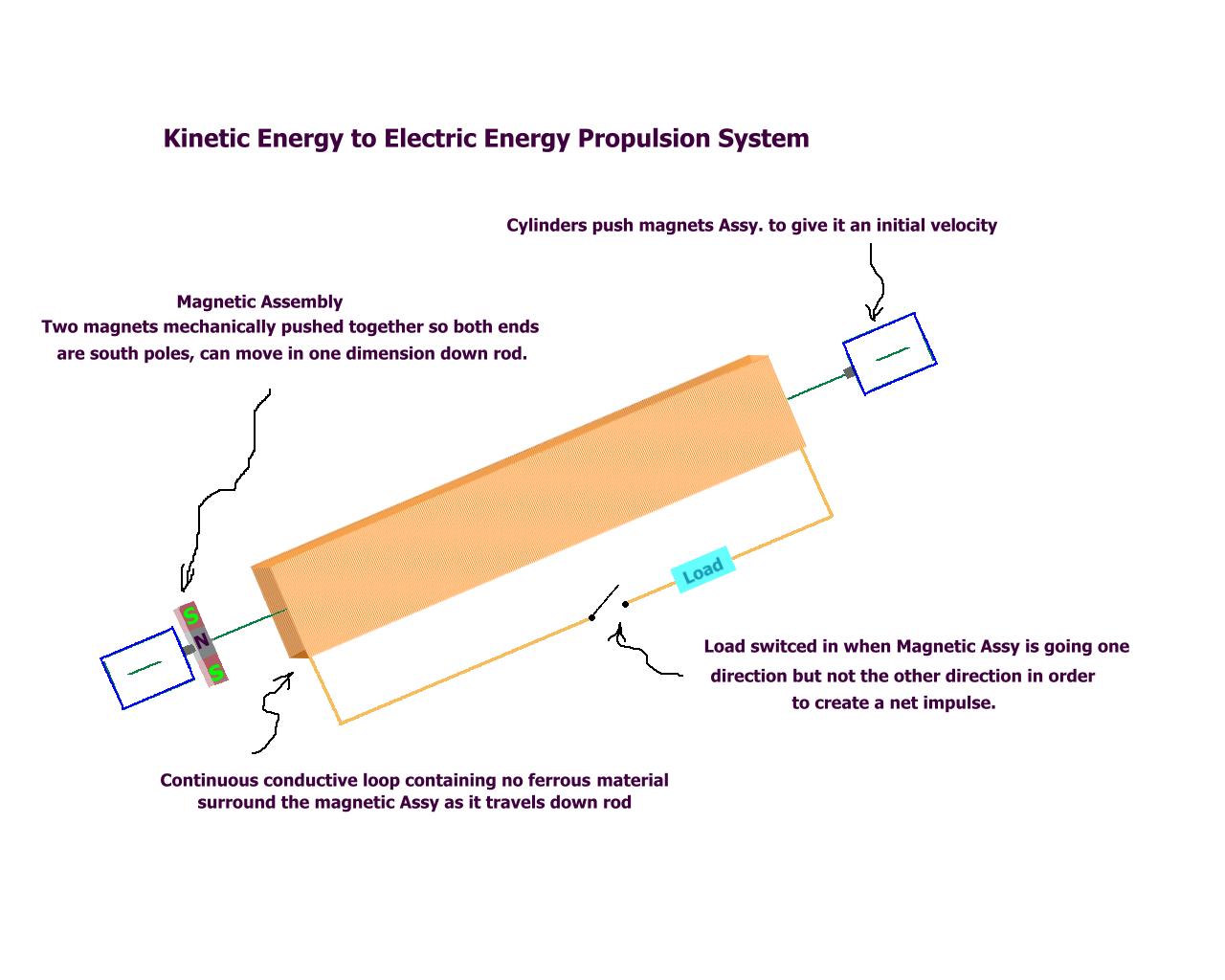
The Kinetic Energy to Electric Energy Propulsion System works by imparting a velocity to the magnetic Mass by use of piston cylinders or some other means. The Magnetic mass is free to move up and down a straight path on a rail or rails. As the magnetic assembly moves it goes through a conductive coil of wire. As the magnet travels through the loop it creates an electric potential in the loops of the coil that are cutting the flux lines of the magnetic field. If the electric potential is allowed to create an electric current by closing the circuit for the coil, then real energy will be produced in the load, which is the resistance of the coil and what ever other impedance there is. The source of this energy can only come from taking kinetic energy away from the moving magnetic assembly.
The kinetic energy of the magnetic assembly is: 1/2 mv^2. If the kinetic energy is reduced that means that the magnet is slowing it's velocity and losing momentum. This means that there must be some drag on the magnetic assembly due to it's interaction with the coil assembly. The drag on the coil may or may not be equal and opposite to the drag that the magnetic Assy. experiences. I see a possibility that if the coil Assy is made of paramagnetic and diamagnetic materials in some proportion, (maybe a little ferromagnetic material), that the attractive and repulsive forces can be made to cancel out for the coil while still allowing the current to flow when the circuit is closed as the magnet Assy. moves through it. This is the hard part but if we are able to construct a coil assembly that experiences less drag than the magnet assembly we could have a violation of Newton's 3rd law of reciprocal reactions. I would attribute the symmetry breaking if it exists to some unknown gauge theory that relates Linear Momentum Conservation to Energy Conservation and possibly Charge Conservation.
With the drag unbalanced and much greater for the magnetic assembly, when the magnetic assembly reaches the other end of the rod where the return cylinder is, there will be not enough residual momentum to stop the forward momentum of the whole system in free space,(The whole system is the sum of all the parts). The magnetic assembly should now be pushed back to it's starting point. If the coil is open circuited during the return stroke, there will be no current in the load, that is bound to change the diamagnetic propertiesw of the coil. That may be allright if the moving magnet now wants to drag the coil with it as it returns. When the magnetic assembly reaches the other end of the rod from which it started the forward momentum of the system will be about the same as it was before the magnetic assembly was returned. Now we are ready for another power stroke.
The method of generating electricity in the drawing above is different and if anybody has done it like this before they didn't write about it to my knowledge. I think it will work as I have shown it as while the magnet assembly moves through it there is changing flux at all time in some portion of the loop. If it doesn't work then there are other more traditional ways of generating electricity with a linearly moving magnet but the coils will be in a bunch of little loops in that case.
I am interested if there is an organization out there that is interested in building a working model of this Kinetic Energy to Electric Energy Propulsion system and verifing that it works. Hopefully by mounting it on a pendulum and showing that it can work in free space. If so contact me please.
The kinetic energy of the magnetic assembly is: 1/2 mv^2. If the kinetic energy is reduced that means that the magnet is slowing it's velocity and losing momentum. This means that there must be some drag on the magnetic assembly due to it's interaction with the coil assembly. The drag on the coil may or may not be equal and opposite to the drag that the magnetic Assy. experiences. I see a possibility that if the coil Assy is made of paramagnetic and diamagnetic materials in some proportion, (maybe a little ferromagnetic material), that the attractive and repulsive forces can be made to cancel out for the coil while still allowing the current to flow when the circuit is closed as the magnet Assy. moves through it. This is the hard part but if we are able to construct a coil assembly that experiences less drag than the magnet assembly we could have a violation of Newton's 3rd law of reciprocal reactions. I would attribute the symmetry breaking if it exists to some unknown gauge theory that relates Linear Momentum Conservation to Energy Conservation and possibly Charge Conservation.
With the drag unbalanced and much greater for the magnetic assembly, when the magnetic assembly reaches the other end of the rod where the return cylinder is, there will be not enough residual momentum to stop the forward momentum of the whole system in free space,(The whole system is the sum of all the parts). The magnetic assembly should now be pushed back to it's starting point. If the coil is open circuited during the return stroke, there will be no current in the load, that is bound to change the diamagnetic propertiesw of the coil. That may be allright if the moving magnet now wants to drag the coil with it as it returns. When the magnetic assembly reaches the other end of the rod from which it started the forward momentum of the system will be about the same as it was before the magnetic assembly was returned. Now we are ready for another power stroke.
The method of generating electricity in the drawing above is different and if anybody has done it like this before they didn't write about it to my knowledge. I think it will work as I have shown it as while the magnet assembly moves through it there is changing flux at all time in some portion of the loop. If it doesn't work then there are other more traditional ways of generating electricity with a linearly moving magnet but the coils will be in a bunch of little loops in that case. I am interested if there is an organization out there that is interested in building a working model of this Kinetic Energy to Electric Energy Propulsion system and verifing that it works. Hopefully by mounting it on a pendulum and showing that it can work in free space. If so contact me please.