Agra, once the capital of the Mughal Empire during the 16th and early 18th centuries, is one and a half hours by express train from New Delhi. Tourists from all over the world visit Agra not to see the ruins of the red sandstone fortress built by the Mughal emperors but to make a pilgrimage to Taj Mahal, India's most famous architectural wonder, in a land where magnificent temples and edificies abound to remind visitors about the rich civilization of a country that is slowly but surely lifting itself into an industrialized society.
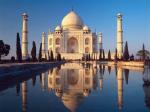
The postcard picture of Taj Mahal does not adequately convey the legend, the poetry and the romance that shroud what Rabindranath Tagore calls "a teardrop on the cheek of time". Taj Mahal means "Crown Palace" and is in fact the most well preserved and architecturally beautiful tomb in the world. It is best described by the English poet, Sir Edwin Arnold, as "Not a piece of architecture, as other buildings are, but the proud passions of an emperor's love wrought in living stones." It is a celebration of woman built in marble and that's the way to appreciate it.
Taj Mahal stands on the bank of River Yamuna. It was built by the fifth Mughal emperor, Shah Jahan in 1631 in memory of his second wife, Mumtaz Mahal, a Muslim Persian princess. She died while accompanying her husband in Burhanpur in a campaign to crush a rebellion after giving birth to their 14th child. The death so crushed the emperor that all his hair and beard were said to have grown snow white in a few months.
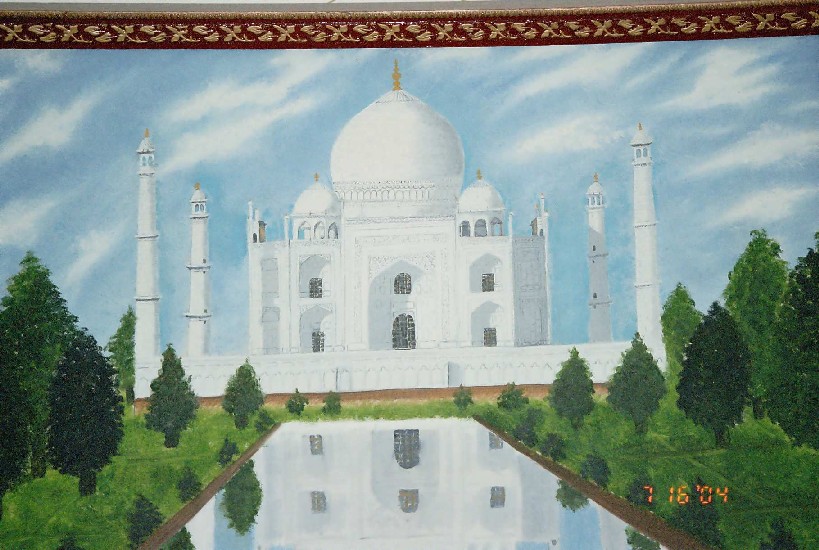
The Taj rises on a high red sandstone base topped by a huge white marble terrace on which rests the famous dome flanked by four tapering minarets. Within the dome lies the jewel-inlaid cenotaph of the queen. So exquisite is the workmanship that the Taj has been described as "having been designed by giants and finished by jewellers".
As a tribute to a beautiful woman and as a monument for enduring love, the Taj reveals its subtleties when one visits it without being in a hurry. The rectangular base of Taj is in itself symbolic of the different sides from which to view a beautiful woman. The main gate is like a veil to a woman's face which should be lifted delicately, gently and without haste on the wedding night. In indian tradition the veil is lifted gently to reveal the beauty of the bride. As one stands inside the main gate of Taj, his eyes are directed to an arch which frames the Taj.
The dome is made of white marble, but the tomb is set against the plain across the river and it is this background that works its magic of colours that, through their reflection, change the view of the Taj. The colours change at different hours of the day and during different seasons. Like a jewel, the Taj sparkles in moonlight when the semi-precious stones inlaid into the white marble on the main mausoleum catch the glow of the moon. The Taj is pinkish in the morning, milky white in the evening and golden when the moon shines. These changes, they say, depict the different moods of woman.
For those with a passion for The Taj mahal here is a link to know further details and to have a virtual panoramic tour.
http://www.taj-mahal.net/blackLarge.htm |