
HEADS-UP
http://www.sph.uth.tmc.edu/chppr/headsup/
http://lib200.library.tmc.edu/headsup/
http://theleader.uthouston.edu/archive/2002/june/spring_branch.html
http://www.uthouston.edu/distinctions/archive/2002/august/heads_up.html
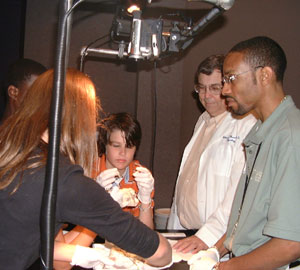
Students from Spring Branch Independent School District view a sheep heart dissection at the John P. McGovern Museum of Health & Medical Science as part of a taping of instructional films that will be used in their school district to teach science and health and to educate children about careers in these fields. The children are joined by, far right, Adam Benjamin, dissection program coordinator for the museum, and William A. Weems, Ph.D., second from right, UT-Houston's assistant vice president for academic computing and professor of integrative biology and pharmacology at the Medical School. Photo by Shannon Rasp
Public
Health at Houston is working now toward implementing an innovative science
curriculum for students at Spring Branch Independent School District's middle
schools this fall. The program, designed by and featuring UT-Houston faculty in
interactive video presentations, aims to educate children about science not only
as a discipline, but also as a career.
"This is a really exciting program, and we are looking forward to its unveiling
this fall," said UT-Houston Interim Executive Vice President for Academic
Affairs Gilbert A. Castro, Ph.D., the program's director.
The project, Health Education and Discovering Science while Unlocking Potential
(HEADS-UP), uses computer and video technology to increase middle school
students' proficiency in science and math while at the same time encouraging
their interest and confidence in pursuing careers in these two fields.
UT-Houston faculty will be taped conducting research, teaching classes and
delivering lectures on selected topics. Children will tour lab facilities via
CD-ROM, and students can also watch a heart dissection and other medically
oriented demonstrations.
Castro is also planning to offer the curriculum to middle school children in the
Hidalgo, Mission and Lajoya Independent School Districts in the Rio Grande
Valley.
The HEADS-UP program was made possible by a grant of more than $860,000 from the
National Center for Research Resources, a division of the National Institutes of
Health.
--By Shannon Rasp, Public Affairs
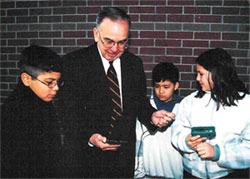
Disadvantaged seniors with an interest in pursuing a teaching career and who are graduating from Spring Branch Independent School District (SBISD) will benefit from The UT Health Science Center at Houston Presidential Scholarship. The $32,000 endowment fund for the scholarships came mostly from two $15,000 gifts from UT-Houston's Interim Executive Vice President for Academic Affairs Gil Castro, Ph.D., and his wife, Georgia. Sam's Club has pledged $2,000. The scholarship will be administered by the district's Hispanic Advisory Committee. (See related story here.) Castro is shown monitoring ozone readings with students at SBISD's Cedar Brook Elementary. Photo courtesy of SBISD