http://www.worldwideschool.org/library/books/hst/biography/TheodoreRooseveltAnIntimateBiography/chap1.html
In summer the children spent the long days out of doors at some country place,
and there, in addition to the pleasure of being continuously with nature
Collected specimens whereever they went
1870 - started training
His father fitted up in the house in Twentieth Street a small gymnasium and said
to the boy in substance, "You have brains, but you have a sickly body. In order
to make your brains bring you what they ought, you must build up your body; it
depends upon you." The boy felt both the obligation and the desire; he willed to
be strong, and he went through his gymnastic exercises with religious precision.
What he read in his books about knights and paladins and heroes had always
greatly moved his imagination. He wanted to be like them. He understood that the
one indispensable attribute common to all of them was bodily strength. Therefore
he would be strong. Through all his suffering he was patient and determined. But
I recall no other boy, enfeebled by a chronic and often distressing disease, who
resolved as he did to conquer his enemy by a wisely planned and unceasing course
of exercises.
Actual fight that the president got into as a kid: http://www.worldwideschool.org/library/books/hst/biography/TheodoreRooseveltAnIntimateBiography/chap1.html
Roosevelt immediately dropped his hands, but the other man dealt him a savage
blow on the face, at which we all shouted, "Foul, foul!" and hissed; but
Roosevelt turned towards us and cried out "Hush! He didn't hear," a chivalrous
act which made him immediately popular. In his second match he met Hanks. They
both weighed about one hundred and thirty-five pounds, but Hanks was two or
three inches taller and he had a much longer reach, so that Theodore could not
get in his blows, and although he fought with unabated pluck, he lost the
contest. More serious than his short reach, however, was his near-sightedness,
which made it impossible for him to see and parry Hanks's lunges. When time was
called after the last round, his face was dashed with blood and he was much
winded; but his spirit did not flag, and if there had been another round, he
would have gone into it with undiminished determination. From this contest there
sprang up the legend that Roosevelt boxed with his eyeglasses lashed to his
head, and the legend floated hither and thither for nearly thirty years. Not
long ago I asked him the truth. "Persons who believe that," he said, "must think
me utterly crazy; for one of Charlie Hanks's blows would have smashed my
eyeglasses and probably blinded me for life."
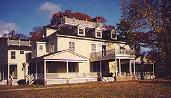 |
One of the Roosevelt houses in Sayville. Three Roosevelt Families lived in Dutch Sayville. Young Theodore spent much time with his Uncle Robert who lived on Lotus Lake. He spent about 6 months per year to get fresh air because of his health. Pictured is the home of John Roosevelt in Sayville. Used as the president's legal office during the summers of TR's term. |
|
|
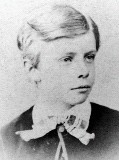
Young Teddy Roosevelt |
|
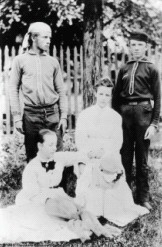
Teddy Roosevelt with his brother Elliot and sisters on Long Island. |
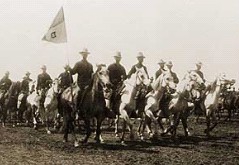 |
The Rough Riders on Long Island. They were stationed in Suffolk County, and stopped in Sayville on the way to NY City. |
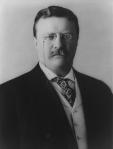 |
TR spent much time with Uncle Robert and John Roosevelt when the summer Whitehouse was in Long Island every summer. His uncle was the president's official legal advisor. |
Sign the Guest Book View the Guest Book