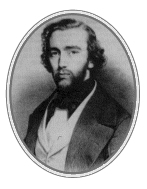
The saxophone was invented by Antoine-Joseph (Adolph) Sax. He was born in Dinant, Belgium on November 6, 1814. Charles-Joseph Sax, his father, was a manufacturer who built a factory for woodwind and brass instruments. From his father he developed the technique and creativity needed for the trade. At Brussels Conservatory he studied flute and clarinet and soon developed his own ideas for improving the instruments. While refining the bass clarinet he began to form plans on building a new instrument. The instrument was a cross between the woodwinds and brass. It would be a bridge between the woodwind and brass sections that would blend not only with both, but also with strings. It was made of brass, yet had a mouthpiece and body fairly similar to the clarinet. The saxophone was born.
In 1841, Adolph first displayed his saxophone. Then in 1842, he moved to Paris in order to reach a broader audience. There he also began his own instrument making business. The saxophone was given its official 15-year patent in 1846.
Adolph's Models
The patent for the saxophone included 14 variations: E flat sopranimo, F sopranimo, B flat soprano, C soprano, E flat alto, F alto, B flat tenor, C tenor, E flat baritone, F baritone, B flat bass, C bass, E flat contrabass, and F contrabass. The E flat and B flat saxes were classified as military instruments. Saxes in F and C were considered orchestral. The latter has become nearly obselete.
Sax knew he would have to make the saxophone more familiar in the music industry. A few classical composers became interested. Amoung those were Donizetti and Bizet. Some composers tried to write sax parts in their scores specifically for the sax. However, a great majority of the classical musicians refused to take any part in the inventor's cause. In 1845 the French government saw a lack in quality of its infantry music. Adoplph saw this as an opportunity. Taking advantage of the situation, he recommended to the Minister of War that a contest between a band composed of saxophones and one of traditional military instruments be held. The band of saxes overwhelmed the audience. From then on, the saxes were adopted into the French military music where the helped to fill the weak lower and middle registers.
After the debut, Adolph was met with even heavier opposition. Sax maintained the small workshop in Paris and never made a great money. He didn't build large factories or mass produce the instruments. Hoping to nullify his patents, other instrument makers pressed lawsuits on him. They finally succeded in pushing him into poverty. Twice he declared bankruptcy in 1856 and 1873. It didn't stop there, though. The vicious plotters went so far as to wreck and set fire to his workshop. For ten years he fought this battle. When he was 80, three composers, Emmanuel Chabrier, Jules Massenet, and Camile Saint-Saens, petitioned the French Minister of Fine Arts to come to his aid. That very year, still struggling to overcome his misfortune, Adolph Sax passed away. thanks to sax appeal for the bio
 HOME
HOME