--From A.T. Mahan's The Influence of Sea Power Upon History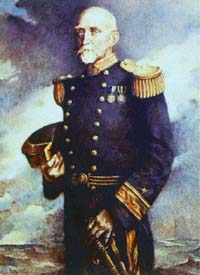
Copyright 1996
Revised May 1998
All rights reserved
From time to time the superstructure of tactics has to be altered or wholly torn down; but the old foundations of strategy so far remain, as though laid upon a rock.
--From A.T. Mahan's The Influence of Sea Power Upon History
The nature of the international order as experienced by Americans has changed dramatically over the last century. In 1897, the United States was a regional power, whose only unassisted victory over another nation had been its defeat of institutionally weak, revolution-prone Mexico. American territory, and the virtual limits of American power, were restricted to the North American continent. Like today's Japan, the United States had demonstrated sophisticated technological development and business success through the course of the nineteenth century, but it had not translated this economic strength into international power. The nation of Franklin, Edison, and Bell (the first two were sons of immigrants, the third an immigrant himself) depended upon its vast oceans and weak neighbors to protect its interests. Though Americans had invented the machine-gun and the naval submarine, these inventions were not put to use in furthering American interests abroad.
Just over a century ago, in 1890, an electrifying book was published with the singular aim of revising this state of affairs. Alfred Thayer Mahan, an American naval officer, published The Influence of Sea Power Upon History 1660-1783 in an effort to goad his fellow citizens into utilizing their skills and their blessed geography to achieve greatness, and to secure their growing interests at home and abroad. Although the title indicates that the work is very restricted in terms of chronology, Mahan does not allow himself to be straitjacketed; he explores naval warfare from Roman times to (his) present, discussing the Punic Wars between Rome and Carthage, the Napoleonic Wars, and the American Civil War. His book was read extensively by virtually everyone of importance in naval affairs, as well as many political leaders, including Theodore Roosevelt, Kaiser Wilhelm, and Franklin Roosevelt.
Mahan was not merely a descriptive historian, but a prescriptive analyst who aimed at strategic gains for his country and its navy. He called for the United States to achieve a dominant position in the Caribbean Sea, lest a great foreign power establish a more powerful position so close to American shores. He urged the digging of the Panama Canal, and that America have strong influence over the passageway; in this way, the United States would avoid having its Atlantic and Pacific fleets almost insurmountably separated in time of war, as had all too often happened to France's Atlantic and Mediterranean forces. Mahan further argued that the United States should acquire a global network of colonies, as several European powers had done, which would symbiotically shelter and be protected by a growing American navy.
Mahan's legacy is evident in the events of subsequent decades, even up to the middle of this century. America's dramatic seizure of Spain's remaining overseas possessions in 1898 marked the beginning of an American empire, including the Philippines, Puerto Rico, and Guam (and a virtual protectorate over Cuba). The American flag soon waved over Hawaii and parts of Samoa. The United States created a country called Panama, and dug a canal through it which will remain in American hands until the end of this century. Mahan's book also had unintended consequences, though; it was avidly read by German and Japanese naval officers, whose understanding of Mahan's strategic lessons bolstered them in their later struggles with the United States.
Mahan's work receives little attention today, in no small part because it is tempting to dismiss the strategic thoughts of one who wrote before the advent of the airplane, much less before the emergence of advanced rocketry and satellite capabilities. But just as Sun Tzu's The Art of War has enjoyed a renaissance in the last few years, despite its great age (2,500 years old), so, too, may it be hoped that Mahan's deep understanding of sea power will be brought to the fore once more in our time.
Mahan is still of the utmost importance in understanding naval and political affairs, and even other fields altogether. His insights into the nature of leadership in naval battles have broad relevance in corporate management. His views on how and why nations attain sea power have become firmly incorporated into political understanding of what a navy does and is for. A sampling of quotes best illustrates this:
The continuance of [Great Britain's] prosperity at home depends primarily upon maintaining her power abroad. Men may be discontented by the lack of political privilege; they will be yet more uneasy if they come to lack bread.[Britain's] power was everywhere that her ships could reach.
The possession of unlimited power...is seldom accompanied by a profound respect for the rights of others.
[The navy] sweeps the sea for the service of the land, it controls the desert that man may live and thrive on the habitable globe.
Mahan's work, though, has one glaring defect: it says little, per se, about technology. In his chapter on the elements of sea power, he cites six contributing factors to maritime greatness: geographical position, physical conformation, extent of territory, number of population, character of the people, and character of the government. The technological advances which transformed the nature of naval warfare, and sailing generally, are scarcely mentioned.
Mahan had to be aware of the importance of a great range of technological advances in shaping the nature of his craft: compasses and accurate clocks for navigation, steam power for mobility, better-designed cannons and rifles for battle, advanced metallurgy for sturdier ships and weapons, canning for food storage, and submarine technologies, to name just a few. These points are given short shrift in the book. Reading Mahan, one gets the impression that his focus is solely quantitative and not qualitative: he often speaks of the importance of numerical superiority, and rarely of the importance of qualitative advantages, such as superior technology well-implemented. Even when he speaks of whether the American character is well-suited for sea power, he speaks of Americans' independent drive and instinct for commerce, but not their abilities to develop and implement new technologies.
Despite this deficiency, Mahan's insights in a great many areas are immensely useful. In addition to these, though, there are also two additional lessons to be learned, not from Mahan's words, but from his approach. The first is that by under-rating the importance of technology, Mahan missed a central element of the evolving nature of his field, an all-too-common error among historians. The second is that, despite all the changes of the twentieth century, especially those brought about by technological advances, many of Mahan's maxims and conceptions still ring true. Great thoughts transcend their age, remaining relevant long after the specific conditions which engendered them have ceased to exist. The reason for this is not hard to discern, and Mahan himself said it well:
Among all changes, the nature of man remains much the same.
