
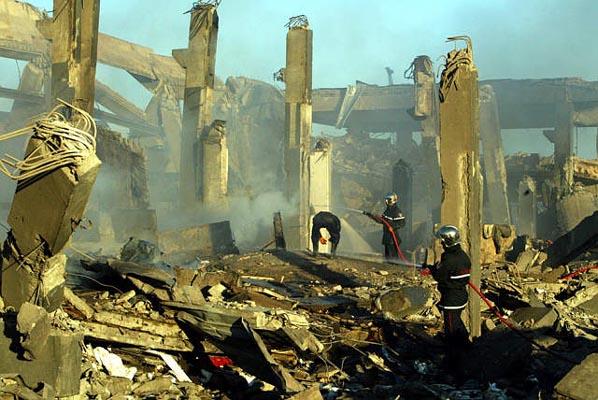
PHYSICAL HAZARDS OF LNG
Natural gas is extremely combustible. If an uncontrolled amount is released it would pose a serious risk of explosion and fire. LNG is a cryogenic liquid, becoming liquid at -256 degrees fahrenheit. This intense cold causes most metals to become brittle and crack. Research of possible catastrophic LNG accidents have led to scientists and risk analysis professionals to consider these as some of the most possible scenarios.
POOL FIRES:
If LNG spills near an ignition source, the evaporating gas-air concentration would burn directly over the spilled LNG, warming the surface and vaporizing more of it to feed the inferno. The pool fire would expand as the liquid flowed from the spill. This type of fire burns more intense than an oil or gasoline fire and can't be extinguished. The LNG must be totally consumed before the fire goes out. Because LNG fires burn so hot their thermal radiation can cause injuries or death and damage property a considerable distance from the fire.Experts agree that a pool fire on the water due is the most serious LNG hazard.
Flammable Vapor Clouds:
If an LNG spill does not ignite immediately, the evaporating natural gas will form a vapor cloud that may drift a considerable distance from the accident site. As the cloud encounters an ignition source portions of the gas-air concentration will ignite. Because the gas-air cloud is not concentrated in an enclosed area, it would not explode at once but the fire could cause a considerable amount of damage. An LNG vapor cloud fire would gradually burn its way back to the spill source and burn as a pool fire. If an LNG tanker was involved in a serious collision or attacked by trerrorists, experts believe this could trigger a pool fire before a vapor cloud could form.
FLAMELESS EXPLOSION:
If LNG spills on water it could vaporize into a flameless explosion also known as rapid phase transition.The data on rapid phase explosions are not conclusive since no large-scale experiments have been done. Experts believe that the mixing of water and LNG does not constitute an explosion. If it did, it would not form as large a vapor cloud or pool fire.
In addition to these catastrophic events, an LNG spill poses other hazards. An LNG vapor cloud is not toxic but could cause death by asphyxiation, displacing the breathable air as it moves. Such clouds rise as they warm diminishing the threat to people. The extreme cold can cause injury to people and equipment through direct contact.
LNG SECURITY RISKS
According to the Department of Homeland Security (DHS), land based LNG facilities and tankers are a high risk terrorist target.
Tankers can be attacked by different methods to destroy or ignite their cargo and use the ships as a weapon of mass destruction. Land based LNG facilities may also be attacked physically with small rockets, explosive laden planes, or computer hacking into the control system to disrupt the plant. LNG facilities are vulnerable to attack through disruption of the regional electricity grid or communication system. Disruption to the LNG infrastructure would cause additional downstream risks since it is used to fuel a growing number of electrical generation facilities, commercial bussinesses and many homes across the country,
Although no LNG facility in the United States has been attacked that is not the case in other countries.In the last two years gas and oil pipelines have been targeted in a half a dozen countries. In June 2002 Moroccan authorities foiled an Al-Qaeda plot to attack US and British warships, and possibly commercial vessels in the Straits of Gibraltar. LNG tankers traveling from Algeria to the United States pass through these waters constantly. In October 2002 the French oil tanker Limberg was attacked off the coast of Yemeni by a bomb laden boat. The United States have had information since 911 that warns about Al- Qaeda threats to our energy infrastructures. In June 2003 Us Intelligence has warned about possible threats and attacks on energy facilities in Texas. The potential of a terror attacks on LNG tankers is a possibility and must be addressed.
