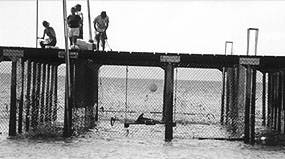
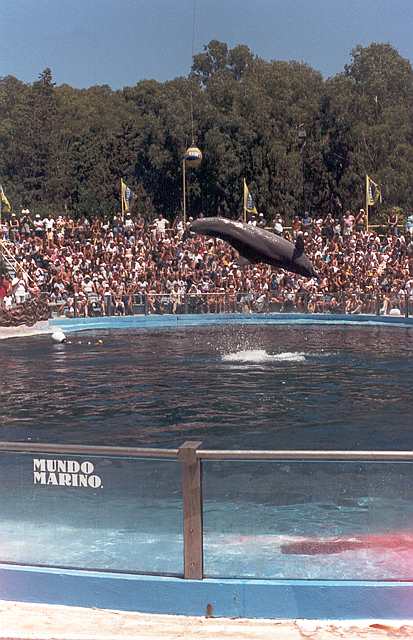
The Capture How is a dolphin captured? The capture of dolphins is a violent procedure. Pods of bottlenose dolphins are chased to exhaustion; surrounded with a net and dragged onto the capture boat where the capture team searches through the terrified group for the specimen they want. The lucky ones are thrown overboard. Those selected are taken ashore. They will never see their ocean world and their pod again. According to dolphin captors, the most desirable dolphins are between two to four years old and still associate with their mothers. Many bottlenose dolphins have been brutally separated from their calves, regardless of the fact that a bottlenose dolphin normally protects and remains with her calf for at least five years. The violent and permanent separation is a traumatic experience for both mother and calf, and while the exact number of animals killed during the capture procedure remains unknown, we have documentation to show that dolphins have died from shock during capture. Training: How are dolphins trained? The performance of captive dolphins is achieved through a strictly controlled training method that takes advantage of the dolphins' hunger and total dependence on their trainers for food. Dolphins are wild animals whose natural behavioral repertoire does not include behaving like pets and circus clowns. In order to train dolphins to perform these unnatural behaviors, the trainer must first obtain complete control over the animals. This is accomplished by taking advantage of the captive dolphins' powerless predicament: They depend totally on their keepers to be fed. Once the hungry dolphins have surrendered to eating dead fish, the trainer teaches them that only when they perform a desired behavior; such as tolerating human swimmers or waving at the audience, do they receive their reward: a fish. This is how abnormal behaviors are enforced in a dolphin. No doubt, keeping the dolphins a little hungry induces them to continue performing in order to be fed. The captivity industry calls this training method "positive reward." From the dolphin's perspective, however, it's food deprivation. Are dolphins social animals? Absolutely! Bottlenose dolphins live in groups known as pods. It is within the pod that the individual dolphin finds his own identity. In fact, there is a very distinct pattern to bottlenose dolphins' pod structure: "As they become socially and sexually mature, the youngsters leave the subadult groups they joined after weaning, and males and females go their separate ways. Females join up with other females in "bands", which typically include ten or so mothers and their most recent offspring. (�) Often a young female leaving a subadult group will rejoin the female band into which she was born, and genetic studies show that many bands consist of the females of families, which have remained together for generations." (Chris Catton, "Dolphins", 1995) When a dolphin is captured and taken out of its ocean home, it not only affects the victim dolphin but also has a detrimental consequence for the pod it leaves behind. How do dolphins communicate? Dolphins communicate by hearing and emitting sound, and by reading body language. Dolphins are sound oriented. They communicate with sound by producing a large spectrum of sounds in the form of clicks and whistles. Furthermore, they constantly send out bursts of sounds of many different frequencies to navigate, forage, and explore their diverse ocean environment. With reflected sound, called echolocation or sonar, dolphins can "see" elements that are invisible for animals -- including humans -- that are sight oriented, depending on reflected light for vision. This is how dolphins searching for food can easily detect a fish that's hiding under the sand. The use of sonar is as important to dolphins as eyesight to humans. Chris Catton in his book Dolphins writes: "The ability of dolphins to make a wide range of sounds and to hear clearly underwater is important because they rely on these faculties in almost every aspect of their daily lives." Captive dolphins are severely restricted in using their sonar. They can't use it to catch live fish, as they are fed dead fish as food rewards. They can�t put it to full use to explore their underwater world, because there isn't much to explore in a barren, concrete tank or a cage in the sea. They certainly can�t use it to navigate, because they aren�t going anywhere. Depriving dolphins of the ability to use their most important sense -- their sense of sonar -- is stressful for dolphins. The sensory deprivation imposed on captive dolphins is one of the most damaging aspects of dolphin captivity. Why does the dolphin captivity industry use a deceptive change of language? The dolphin captivity industry doesn�t want the public or the media to do know how dolphins are captured. Therefore, when asked where the dolphins came from, they use a deceptive change of language: Instead of saying that the dolphins were captured; they will tell you that they have been "collected" or �acquired.� A training manual used by tour guides at Sea World, Orlando, Florida, clearly shows the captivity industry�s attempt to mislead the public by disguising reality. At Sea World, the employees are told to avoid the words �captured,� �cage,� �tank,� and �captivity.� Instead they must use the words �acquired,� �enclosure,� �aquarium,� and �controlled environment.� The training manual goes on to say about the words �dead� and �die�: �If people ask you about a particular animal that you know has passed away, please say, �I don�t know.� In other words, Sea World staff is told to lie to the public. �If marine parks were truly educational, they would not need to rely on circumlocution to make their practices palatable to the public. When hotels and restaurants can obtain permits to display dolphins, education and science become mere distortions designed to make us feel comfortable with what are actually lucrative commercial ventures -- circuses of the sea.� Does captivity of dolphins help dolphin conservation? No. In order to justify the capture and confinement of dolphins, the dolphin captivity industry and the Alliance of Marine Mammal Parks and Aquariums (AMMPA) present the dolphins as "ambassadors" of their own species and maintain that captive dolphin displays serve the purpose of being educational. They are not in this business for the money, they say. They want us to believe that they capture and confine dolphins in order that the paying audience learns to appreciate dolphins and, based on that, grows motivated to contribute to the protection of dolphins in nature. But how can the spectators learn anything about the true nature of dolphins when the captive dolphins are trained in unnatural behaviors, mere circus tricks that these once-wild, opportunistic foragers of the oceans are performing for food rewards of dead fish? And how are the spectators supposed to become aware of the importance of preserving dolphins in nature when the dolphins they are watching have been either stolen from nature, kicking and screaming, or were born in captivity and have never seen the ocean? There is no scientific evidence to support the claim that the capture and confinement of wild animals helps conserve them as a species. Humpback whales are appreciated and protected by people who have never seen a humpback whale. On the other hand, the elephants and tigers are on the brink of extinction today, despite the fact that these animals have been displayed in zoos and circuses for thousands of years. Since the world's first formal dolphin show opened in St. Augustine, Florida, in 1938, hundreds of dolphins have been captured from the wild and trained to perform silly circus tricks. When the dolphins died, the captivity industry captured more. These are disposable dolphins for our disposable society, and to call them ambassadors is simply an obviously desperate attempt at sanitizing the exploitation of these animals. What is the positive educational value of captive dolphin displays? There is none. Educational is the buzzword most frequently used to defend the capture and confinement of dolphins. The irony is that while the captivity industry's strongest justification to use dolphins in dolphin shows and dolphin swim programs is the alleged wish to educate the public about the importance of preserving dolphins in nature, the same industry refers to the fact that bottlenose dolphins are not threatened by extinction to defend the position that it is okay to capture them. It is precisely this utilitarian view of nature and its inhabitants that has destroyed wildlife everywhere on the planet. The capture, confinement, and exploitation of dolphins works against the spirit of wildlife conservation in that it cherishes human dominance over nature, leaving the public with the fatal message that turning wild animals into performing circus clowns and pets is permissible. Captivity of dolphins is a form of education, but it�s a form of bad education in that it teaches millions of people, of whom many are impressionable children, that abusing nature is acceptable, as long as you can call it research, education, or therapy. Is captivity stressful for dolphins? Yes. Dolphins have evolved over millions of years, adapting perfectly to life in the ocean. They are intelligent, social, and self-aware, exhibiting evidence of a highly developed emotional sense. Imagine the panic dolphins must experience as they are yanked from the ocean, forever separated from their ocean world, their family, and their ability to swim freely. Putting these complex, large brained animals through a violent capture and lifelong confinement in a small tank or sea cage inevitably exposes them to trauma and stress. Even people who work for the dolphin captivity industry admit to the fact that confining a free-ranging marine mammal in a restricted area has a negative impact on the welfare of these animals. Dr. Sweeney has said the following: �Husbandry problems of marine mammals in captivity often come directly from exhibiting animals in a closed environment.� (Marine Mammal Behavioral Diagnostics, in L. Dierauf (ed.), Handbook of Marine Mammal Medicine. 1990, Boca Raton, CRC Press.) Tagamet, Malox, and other kinds of stomach medication are commonly used to treat captive dolphins for stress related complications. The US Marine Mammal Inventory Report (MMIR) will show many examples of stress related deaths. (MMIR is available on request). Do captive dolphins live as long as their wild co-species? There has been much debate about the longevity of captive dolphins compared with that of dolphins in the wild. When studying the data provided by the captivity industry of the United States -- gathered in the Marine Mammal Inventory Report (MMIR) -- it becomes evident that captive dolphins have died from appalling causes: Captive dolphins have died from shock at capture. They have died during transport. Some have died from drowning, others from crashing into the wall of their tank. A great number of captive dolphins have died from stress related diseases. However, rather than getting into an argument with the captivity industry about the longevity of captive dolphins -- thereby reducing the issue to being a question of how long a captive dolphin can be kept alive -- we have long ago taken this position: That the dolphin captivity issue is not about quantity of life, it's about quality of life, not about science but ethics. Is this true that dolphins live better lives in captivity than in nature? No, this is not true. People who are in favor of keeping dolphins captive will often make the statement that life in the sea is so stressful for dolphins; they are far better off being captured and used in dolphin shows and swim programs. �If you are a dolphin you do not know where your next meal will come from; when you are going to run into a hungry shark or killer whale; where the next drift net is or what pollutants humans have dumped into the ocean,� says Dolphin Fantaseas. This is like saying a human being would be better off never leaving his house out of fear of being hit by a car. Living is doing things. It is expressing who and what you are by living in accordance with your true nature and, in doing so, letting all of your natural skills unfold. For a dolphin, this means chasing fish, surfing, diving deep, leaping high for the sheer joy of it, navigating, foraging, socializing with other dolphins, and moving in a straight line mile after mile. Yes, we need to stop polluting the oceans. We need to stop drift-netting and over-fishing. And we need to stop capturing, exploiting, and killing dolphins for casual amusement. To add to the destruction of nature by capturing dolphins is not going to solve any of our environmental problems. The contrary is true: It enforces the widespread misconception that nature and its inhabitants exist for humans to make use of as we please. The fact is that captive dolphin swim programs only serve to perpetuate our insidious utilitarian perception of nature. To claim that it is in the best interest of dolphins to be captured and sentenced to lifelong confinement is nothing more than propaganda used to sanitize the commercial exploitation of these complex, intelligent, and wild creatures. Have human swimmers ever been injured in captive dolphin swim programs? Yes. The forced interactions with people are demanding for dolphins that must be kept under constant and strict control by their trainers during the swim sessions. Dolphins used in SWTD programs have demonstrated agitated and aggressive behaviors under the stressful conditions of confinement and forced interactions with people. These behaviors have resulted in serious injury to swimmers. There are accounts of human injuries in the form of lacerations, tooth rakes, internal injuries, broken bones, and shock. Captive dolphins are known to become sexually frustrated in SWTD programs, and it is common to see them masturbate on human swimmers. (Video documentation of this phenomenon is available upon request) A dolphin trainer who works in a Cuban SWTD program supports this statement. During an interview in 1997, he said: �The method used to train dolphins is very strict, like the military method used in training soldiers. Captive dolphins are exposed to a lot of stress as a result of it. They release their stress through depression, aggression, or sexual activity.� Are the behaviors of captive dolphins that much different from those of dolphins in nature? Very much so. Habitat dictates behavior. This is a major reason why captivity does not work for dolphins. The environment of captive dolphins is unnatural, and so the behavior of captive dolphins becomes unnatural. This is precisely what the captivity industry wants, of course, since it's the unnatural behaviors of dolphins that attract the paying audiences. The spectators have come to be amused and expect the dolphins to jump though hoops, kiss their trainers, walk on their tail, and tolerate being petted and prodded by tourists who have paid to swim with them. These abnormal behaviors are methodically enforced in captive dolphins by two methods: 1. Depriving the dolphins of living in accordance with their true nature. 2. Controlling the dolphins with food. --------------------------------------------------------------------------------------------------------------------------------------- Article by Helene O�Barry, The Dolphin Proyect. |
 |
| Dolphins: Alarming Information |
| More Info: |
 |
 |
 |
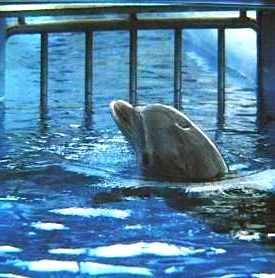
Attractions where people can have direct contact with dolphins and other marine life are becoming increasingly popular amongst the tourism industry. Known as "Swim with" attractions, captive animals including dolphins are not only expected to socialise with humans in small pools, but feed from their hands and perform tricks. The keeping of cetaceans in captivity in is covered by some legislation and guidelines, which ensure a certain standard of care- North America and Canada are covered by these regulations, though these are still deemed unsuitable and restricted by experts. Similar attractions in countries including Cuba, Mexico, Portugal and the Dominican Republic are governed by lax regulations, if at all. The UK does not have any cetacea in captivity, and has not done so since the last two dolphins were moved from Brighton Aquarium to the Turks and Calcos Islands by Born Free in 1991. The capture of the eight Bottlenose Dolphins (Tursiops Truncatus) to supply the swim with attraction in La Paz Mexico highlighted the issues of unregulated capture without licence. The establishment of attractions without full inspection of plans, understanding and expertise of animal care, and that no laws and guidelines were in place to ensure specific levels of care, size of enclosures, feeding regimes and so on were also causes for concern. This has resulted in the death of one dolphin so far, and the discovery that the pools in which the dolphins are being kept are not only too small, but dangerously shallow too. If you are thinking of going on holiday this year to a location that offers Swim With attractions, please think about the dolphins, and read the following answers to the most commonly asked questions. Why should we be concerned about these dolphins, they seem happy? The dolphins famous smile can be very misleading. Unlike the beluga which can change its facial expression as it vocalises, the dolphins smile is a fixed one. Captivity is known to depress the animals and cause boredom, which can result in the development of stereotypic behaviours and lethargy. The dolphins wouldn't interact if they didn't want to This is a misunderstanding of the dolphins captive environment and training methods. The fact that you and the dolphin are in a small pool together does not leave the dolphin much choice but to be near you. If they were free, interaction would be minimal. The dolphin may also have been trained to interact quite possibly through a food reward regime. In such instances, the dolphins are only fed when they achieve their given tasks. In the mean time they are starved. The dolphin will interact if it is hungry and will be rewarded. Dolphins have healing and de-stressing qualities Another non-scientifically proven myth. Certainly to be close to and amongst wild and happy animals in their natural; habitat is an uplifting and unforgettable experience. Sadly the past decade has seen the promotion of captive dolphin attractions reach out to those with depression, disability and illness. The cost has been high for both the dolphins, and those desperate for release and cure. There are no studies of such interactions having such radical results. Dolphins are gentle creatures and pose no threat or danger to those who swim and interact with them Captivity can cause dolphins and other cetacea to become incredibly aggressive, butting, scraping with their teeth and biting are all possible and have occurred in attractions world-wide. In 2000, a girl was bitten by a dolphin at Marineland, Mexico. The attraction claimed no responsibility and was reluctant to even dress and see to the wound. Captive male cetacea are more prone to developing aggression through sexual frustration. These are strong, robust creatures that can cause harm even accidentally. Dolphins are also known to harbour various diseases and viruses such as salmonella and morbilivirus. It is unlikely that transmission possibilities will be mentioned to potential participants, but it is another concern that is being investigated, and that poses potential danger to the dolphin. In the same way, we may also pass disease and illness to them. The dolphins are also in danger of being damaged by being roughly handled. Their beaks and dorsal fins are particularly sensitive. Obesity is also a common problem amongst captive cetacea. The lack of space and depth means that muscle tone decreases, and they do not have the time to exercise sufficiently. They are many dolphins in the wild, and therefore it does not matter if some are taken Some dolphin species have healthy population numbers�.now. However, unregulated removal makes population change difficult to monitor. Disruption of wild dolphins from tourist boats and capture, may result in population fragmentation and movement to locations where food supply and shelter is more scarce. Dolphins are highly intelligent creatures and choose their habitat for very good reasons. Other dolphins are more scarce, and whilst it is unlikely that you should have an opportunity to swim with these, the unregulated capture may decimate these populations. I can learn about dolphins by swimming and interacting with them. Those that truly admire and respect the dolphin will not promote such a false experience. The level of expertise and knowledge by the people running many of these attractions is very low indeed. Many have seen this as an opportunity to make money quickly and easily, and have taken little time to learn about the animals they keep, or even provide suitable enclosures for them. What you will see at the attraction is likely to be a completely false impression of what a dolphin is. You are seeing a stressed, possibly obese dolphin in a cramped and false environment devoid of other marine life that it would be found amongst. The dolphin will also perform tricks taught to it, that are un-natural behaviours. You would learn more by watching a wildlife film, reading a book on the subject or watching them in the wild with a compassionate and knowledgeable guide. What is important to remember, is that our demand for these interactive experiences, and close up viewings of such wonderful creatures, is having a negative impact on the dolphins on show, whether in swim with attractions, normal dolphinariums and in the wild. Once the initial satisfaction has worn off, and you return from your holiday, the dolphins will repeat the same interactions and remain in their tiny tanks day after day. The only ones to benefit in any way are the proprietors of the attractions- Financially. -------------------------------------------------------------------------------- |
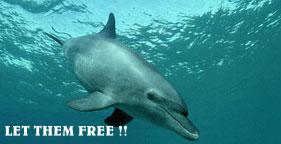
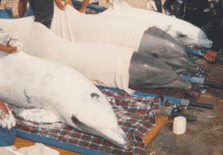
| In this section you will find information about the damage that captivity causes to dolphins. Please, pass this information to your fiends and familiy to develop concience. Don't go to Aquariums and Dolphinariums , don't pay for them to be in jail. |
 |
 |
 |
| Dolphin Captivity |
| Know the truth ... |
|
| �Swim With ..." Questions and Answers |
 |