Hawk Eating a Freshly Killed Pigeon in the Back Yard of a
House in Seattle's University District
Near NE 47th street and 15th
Avenue Northeast, March 7, 2004, about 2 PM
I had only seen three hawks during the 20 years that I have lived in the U District. All of them were flying within
a block of Cowan Park, a half a mile north of my house, so it was a real surprise to get out of my
car and see one eating a pigeon in the back yard just 25 feet away.
My guess is that this is an immature Cooper's Hawk (the
people at rec.birds
agree--go to the end of this page for their comments), but the field guide shows half a dozen
possible species, the immature forms of which all look pretty much alike. If you have a better guess, or any
questions or comments, please send e-mail.
There are seven photos here, totaling about 3
megabytes, so allow a couple of minutes for them to load if you're on a slow connetion.
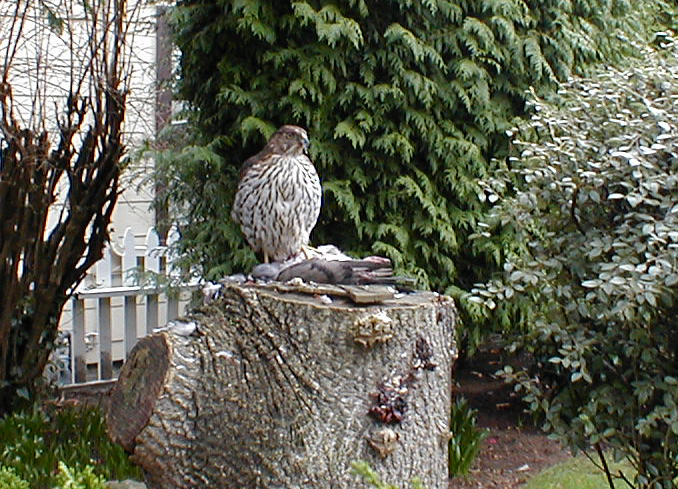
I was surprised at how close the hawk let me get to it. This photo was taken at a distance of about eight feet. Maybe it has lived in the area all its young life and is used to being around people, or maybe it's too
young to know better, or maybe it was too hungry to leave a fresh kill?
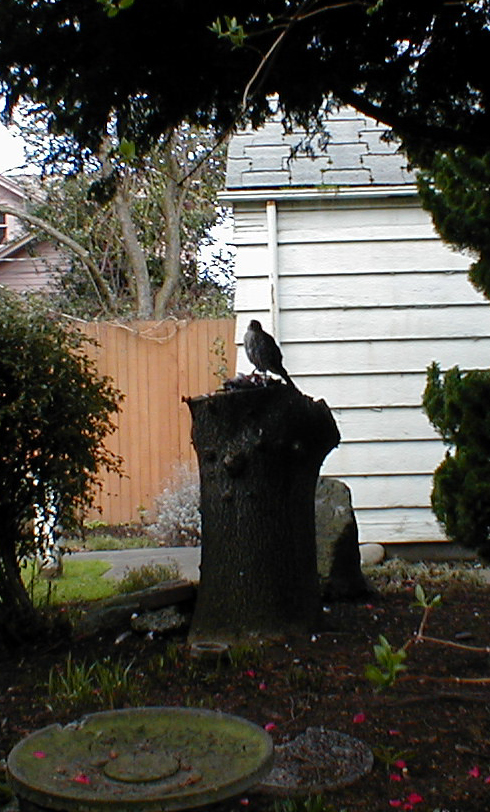
The hawk looking up as a crow flys overhead, cawing. Taken from about 20 feet.
I expected the hawk to fly away at any minute, but although it stopped eating and kept an eye on me (and all around) at first, it didn't leave when I moved closer. After I held still for a few minutes, some chickadees flew in and started chattering in the surrounding
bushes. Soon the hawk resumed eating.
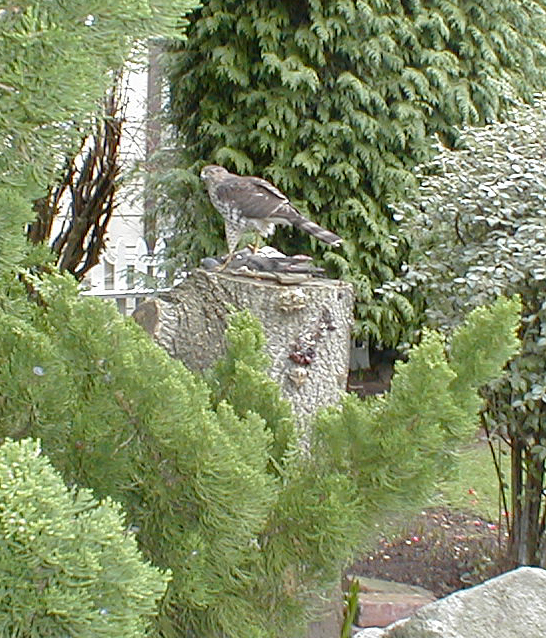
Note the banded tail and the pantaloons.
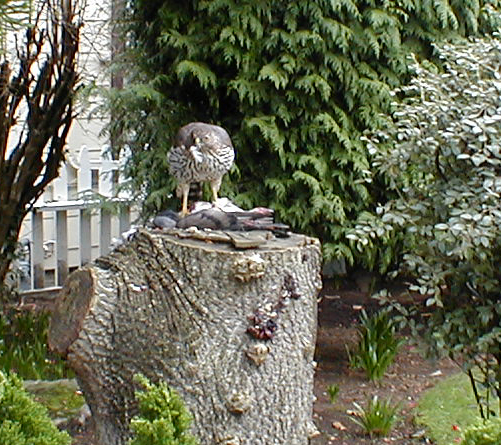
A beakful of feathers
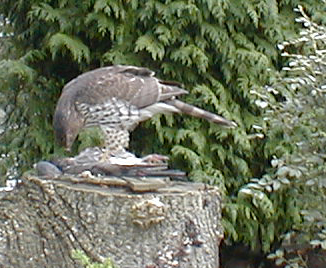
Eating
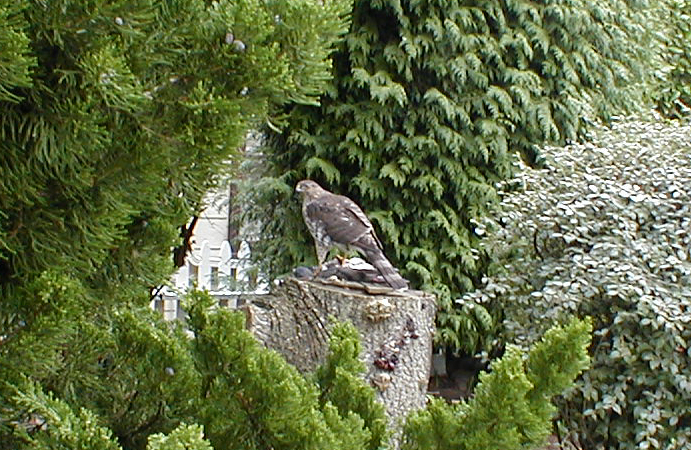
Back view, tail down.
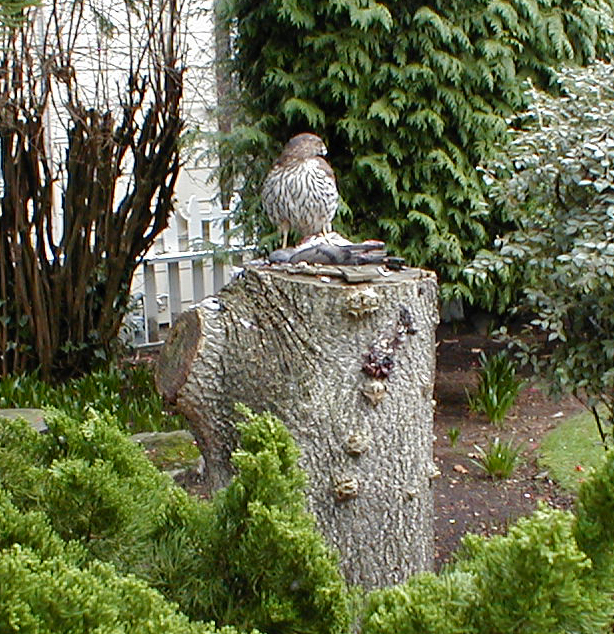
Head in profile. Note that the hawk isn't much bigger than the pigeon.
An hour later, all that remained was
some feathers and... (Be forewarned--the photo is kind of grisly.)
The
consensus at the rec.birds newsgroup is that this was an immature Cooper�s
hawk. Here
are the responses:
1.
Looks like a Coop.
2. I'd
agree with you and with the OP's web page--immature Cooper's Hawk. Size compared
to the pigeon seems too large for a Sharp-shinned. White terminal
band on tail is another possible indicator of Cooper's, although I don't know if
it is definitive. I've had an immature Cooper let me stand ten feet away and
watch while it took apart a Rock Dove. This was in an alley in an industrial
part
of San Francisco.
It seems more common for first-year birds to be
in unusual hunting
areas. Either lack of experience, or being driven to
marginal areas by
adults? They are also migrating this time of
year.
3. Sharpies have the white band too, but it is wider on the Coops.
I'd say by
general size, and relative length of tail, that this is a Coop.
Also, the
streaking on the chest of immature Sharpies tends to be more
spotty.
4. I
can't get there either, Bob - Geocities is saying that the site has
"exceeded
its allocated data transfer".
But hey, this gives me a great chance to prove
my "ID without seeing
the bird" skills. Tammie, are you
listening? OK - hawk eating bird
in the middle of the city =
Cooper's. ;-)
Thanks to all who weighed in.
