

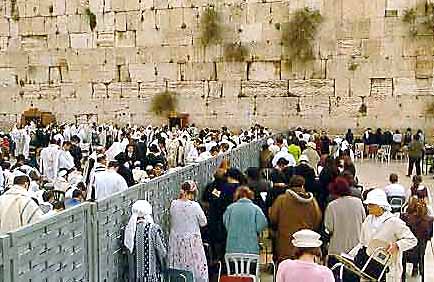
While the Bible does not mention the name Shekhina, she is nevertheless bound to extremely old traditions, and closely relates to the ancient goddesses. Particularly significant is the Canaanite goddess Ashera who, at the beginning of the Israelites' settlement in the land of Canaan, was often referred to as Yahweh's Consort. The literature also calls her the "Holy Spirit" which, in Hebrew, is also a feminine form. The feminine nature of the Shekhina is so easy to establish in Hebrew, because the gender of the subject plays an important role in the sentence structure. In English, you can say "The Glorious Shekhina returned to bless us" without mentioning gender. In Hebrew, both verbs and adjectives have a male or female forms, and many names suggest gender to anyone who understands the language. The simple sentence above indicates three times that the Shekhina is female, and the fact sinks easily into the consciousness of the reader
From the first covenant, Yahweh presented an image of a harsh, daunting God. His character almost demanded the birth of an entity like Shekhina. Also, He could not be seen by human eyes, and only a few prophets heard His voice. Yet almost every religion shows that human nature seeks intimacy with a deity. The manifestation of a loving maternal entity, ready to defend her people even from God Himself, brings a feeling of comfort that a paternal, invisible entity like Yahweh cannot bestow upon His worshipers. Shekhina represented compassion in its purest form, and despite being, officially, the female side of God, she was visible and audible as a feminine entity in her own right. A beautiful being of light, whose most important function was to intercede with God on behalf of her children. Such an entity had to come into being to soften the harshness of the original Judaism.
Another tradition claimed that she had always dwelt among her people, but their sins drove her, on and off, into Heaven. However, she was drawn back to her children and tried to save them, over and over. By that time, her image was so ingrained into real historical events, that when the Jews were exiled to Babylonia, she transferred her seat there, and appeared alternately in two major synagogues. She often made herself visible to the congregations there, particularly in one synagogue, which was built of stones and dust taken from a holy place in Jerusalem.
Like any good mother, she could punish too. When she behaved violently, her character came closer to her powerful aspect of the great Asherah, Yahweh's Canaanite Consort. She descended to Earth to punish Adam, Eve, and the Serpent when they sinned at the Garden of Eden. She confused the builders of the Tower of Babel. She drowned the Egyptians at the Red Sea crossing during Exodus. When needed, she even killed righteous people. Since the beginning of time, six people -- Abraham, Isaac, Jacob, Moses, Aaron, and Miriam -- could not be taken by the Angel of Death because of their perfect purity. Someone had to bring their souls to Heaven, and only Shekhina could do that. By kissing them, she released their souls from bondage to this world
Nor is this the end of her development. The Kabbalah greatly elaborated on the theme of the feminine aspect of God. She would appear as the powerful Matronit, the controversial Lilith, and finally, as the glorious figure of Shabbat Hamalka - Queen, Bride of God, celebrated every Saturday by Jews all over the world as they light the Sabbath candles. And by tradition, the candles must always be lit by a woman. Naturally -- Ashera, too, was served chiefly by priestesses. The cycle is very neatly completed.
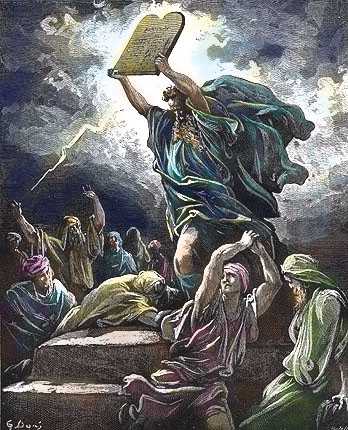
I am the Lord your God
You shall not recognize the gods of others in My presence
You shall not take the Name of the Lord your God in vain
Remember the day of shabbat to keep it holy
Honor your father and your mother
You shall not murder
You shall not commit adultery
You shall not steal
Do not give false testimony against your neighbor
You shall not covet your fellow's possessions