 Overview
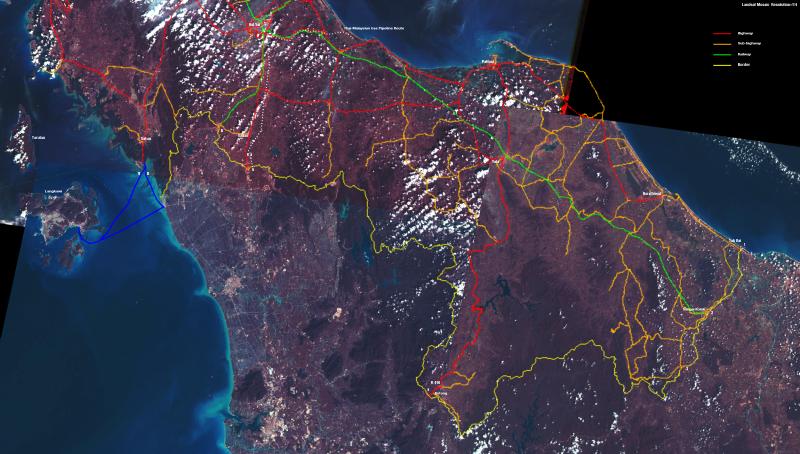
Landsat Resolution: 25%Dimensions: 2500 x 1420 pix Size: 594 KB |
Satellite Exploration of Thailand > Project
|
Overview
Landsat Resolution: 25%Dimensions: 2500 x 1420 pix Size: 594 KB |
|
|
|
|
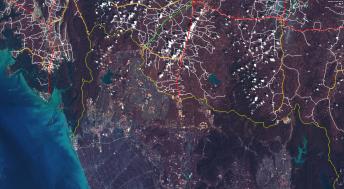
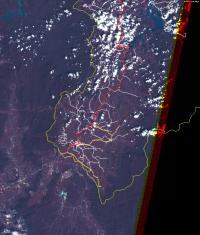
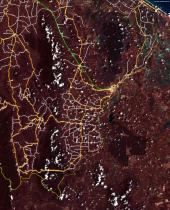
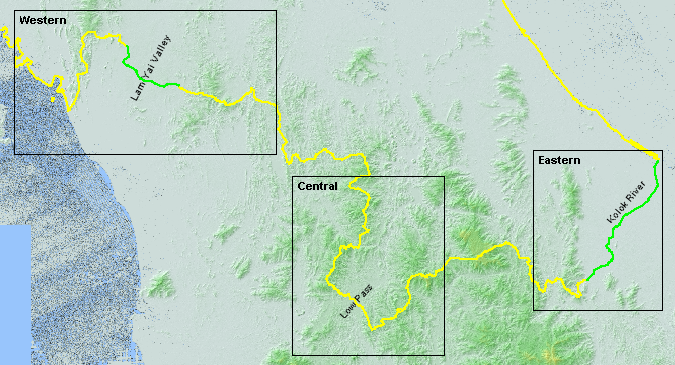
Quote: Malaysia – Thailand Boundary . Map In the west, the boundary originates in a low, undulating coastal plain, an area of dense mangrove swamps. The plain is constricted in the immediate area of the boundary but broadens both to the north and to the south of the boundary, penetrating 15 to 20 miles inland. Isolated hills appear in Malaysia and more continuous ridges and ranges of hills lie to the north in Thailand. These attain local elevations of almost 4,000 feet but the crests of the hills normally average about 1,000 feet above sea level. The Sayun Range, an extension of the Si Thammarat mountains of Thailand, forms the frontier region for approximately 15 miles on its northward extension from the coastal plain. The limestone range is narrow, varying from slightly more than two miles to over seven miles in width, and has an average elevation of approximately 2,000 feet. Many small tributary streams have dissected the range into jagged, steep-sided hills. Elevations fall sharply eastward to the Lam Yai valley. This lowland area extends for approximately 20 miles eastward to the Central Highlands, the main spine of the Malay Peninsula. The valley is the principal routeway from southern Thailand to Perlis State and is served by both a main highway and a railroad. The valley floor is gently undulating and broken by a few low, isolated hills. The Central Highlands, which comprise the middle half of the frontier region, consist of a massive but dissected granitic upland. The general alignment of the ridges is north-south with maximum elevations between 3,000 and 5,000 feet situated along the boundary. Slopes are steep and are, in general, covered with a thick evergreen, tropical rain forest. However, above the 4,000 foot line a deciduous type of forest, comprised primarily of oak, predominates. The larger valleys have been cleared in places for cultivation but the major part of the frontier remains in natural forest. The eastern coastal plain mirrors the forms and relief encountered in the west. The region is a flat, sandy lowland with swamp and mangrove forests along the coast. The shallow Golok River has a low gradient and the stream meanders across the plain. Generally elevations are below 250 feet but the occasional hills dot the landscape. The coastal plain offers excellent access between Malaysia and Thailand and a main highway and a railroad cross the frontier. The tropical monsoon climate of the frontier is directly influenced by both the southwest (May–September) and the northeast (November–March) monsoons. The Central Highland spine and the trend of the peninsula tend to restrict the southwest monsoonal influence to the west and the northeast to the east. Precipitation maximums occur during the monsoonal season but no period is without rainfall. Total annual precipitation is everywhere in excess of 80 inches. As a tropical region, temperatures are uniformly high throughout the year. Mean daily maximum temperatures range between 84o and 91o while the minima are between 74o and 76o. Seasonal variations are very slight. |
| Area | Province | No. | Thai Side | Malaysian Side | Approach | Condition | Motor Vehicle Crossing | |
| Eastern | Narathiwat | 1 | Ban Taba | Pengkalan Kebor | R 4057 . R 4084 | Small ferry across Kolok River |
|
|
| 2 | Sungai Kolok | Rantau Panjang |
R 4056 . R 4057 Railway | Bridge over Kolok River |
|
|||
| 3 | Ban Buketa | Bukit Bunga | R 4057 . R 4062 | Boat across Kolok River | Small boat for passengers only? | |||
| Central | Yala | 4 | Betong | Pengkalan Hulu (Keroh) | R 410 | Land | OK | |
| Western | Songkhla | 5 | Ban Khlong Phruan | Bukit Kayu Hitam | R 4 | Land |
|
|
| 6 | Ban Padang Besa | Padang Besar |
R 4054 Railway | Land |
|
|||
| Satun | 7 | Ban Wang Prachan | Wang Kelian | R 4184 | Land | OK | ||
| 8 | Satun | Kuala Perlis | R 406 | Boat along the coast | Small boat for passengers only? | |||
| 9 | Satun | Langkawi | R 406 | Ferry | Do they do it? |
 |
|
| Thai-Malaysian Border Wall News Clips - Source (Google) |
|
KAMIL TO MEET THAI COUNTERPART OVER BORDER ISSUES 1996/02/23 KUALA LUMPUR: Foreign Ministry Secretary General Tan Sri Ahmad Kamil Jaafar will have an informal meeting with his Thai counterpart to iron out any irritants arising from Malaysia's construction of a border wall in Perlis. He said he hoped the meeting with Thai Foreign Ministry permanent secretary Thep Devakula could be held during the March 1-2 Asia-Europe Meeting in Bangkok. "I do not know why the Thais are making such a fuss. The Malaysia-Thai Joint Commission is one of the most successful joint commissions," he told Bernama. Kamil was asked to comment on the statement by Thai Foreign Minister Kasem S.Kasemsri that there was no valid reason for construction of the 27-km wall which Malaysia says is meant to check smuggling, dadah trafficking and other illegal activities. He also said that he was co-chairman for the Malaysian side of the joint commission and its main task was to solve any problems arising between the two countries. "The commission did not meet last year because the Thais were having their national elections," he added. Meanwhile, in KANGAR, the site of the wall construction in Bukit Puteh again came under scrutiny by a team of top-ranking Thai officials -- the third visit by a high-level delegation this week. Thai Deputy Prime Minister Gen Chavalit Yongchaiyudh, who visited the site with a 150-man delegation last Monday, said that the issue had been resolved. Wednesday, another group of 21 members of a Thai parliamentary committee visited the site. Thursday's group comprised about 100 officials, including 11 members of Tahiland's Foreign Affairs parliamentary committee, who spent about an hour at the site. Led by the committee chairman Suwat Liptappalop, they watched the construction work which was still at the foundation-laying stage. Speaking to Malaysian reporters at the border, Suwat said the visit was to get a first hand look at developments following recent reports in Thai newspapers about the issue. Work on the RM54.6-million wall, stretching from Sintok in Kedah to Bukit Puteh in Perlis, began in 1994. -- Bernama Wall issue can be settled diplomatically 1996/02/23 KANGAR: Mentri Besar Datuk Seri Shahidan Kassim is confident the border wall issue can be resolved through diplomatic channels. He said the higher authorities, including the Joint Border Committee, Land Border Committee and the Malaysian-Thai Joint Commission could thrash out the matter amicably. Shahidan also urged Thai officials to refrain from making statements on the matter as they had told him that Thai Deputy Prime Minister Gen Chavalit Yongchaiyudh's recent visit to inspect the wall was to show their officials and reporters that it was being built on Malaysian soil. "I wish to reiterate that the wall is meant to curb smuggling, drug trafficking and the arrival of illegal immigrants," he told The Star. Shahidan said work on the 27km wall in Bukit Puteh would continue as the state government had not received any instruction to stop work. He was responding to questions regarding the three high-level Thai delegation visits to the wall since Monday. On Thursday, about 100 officials, including 11 members of Thailand's Foreign Affairs parliamentary committee, inspected the wall. The same day, Foreign Ministry secretary-general Tan Sri Ahmad Kamil Jaafar said he would hold an informal meeting with his Thai counterpart to iron out any problem arising from the construction of the wall. A day earlier, another Thai group of military and police officers visited the border wall, following Gen Chavalit's visit on Monday. Prime Minister Datuk Seri Dr Mahathir Mohamad had on Wednesday said Malaysia would look into claims that the project had allegedly been built on Thai soil. The border wall in Perlis is part of the 27km wall costing a total of RM54.9 million being built along the Malaysian-Thai borders in Perlis and Kedah, stretching from Bukit Puteh (in Perlis) to Sintok (in Kedah). High-level meeting to discuss border wall 1996/02/23 KUALA LUMPUR: Foreign Ministry secretary-general Tan Sri Ahmad Kamil Jaafar will hold an informal meeting with his Thai counterpart to iron out any problem arising from Malaysia's construction of a border wall in Perlis. Kamil said he hoped the meeting with Thai Foreign Ministry permanent secretary Thep Devakula could be held during the Asia-Europe Meeting in Bangkok on March 1 and 2. "I do not know why the Thais are making such a fuss. The Malaysian-Thai Joint Commission is one of the most successful joint commissions," he said yesterday. Kamil was asked to comment on the statement by Thai Foreign Minister Kasem Kasemsari that there was no valid reason for the construction of the 27km wall. Malaysia has said it is meant to check smuggling, drug trafficking and other illegal activities. Kamil is co-chairman for the Malaysian side of the joint commission, whose main task is to solve any problem arising between the two countries. In KANGAR, the site of the wall in Bukit Puteh again came under scrutiny by a team of top-ranking Thai officials -- the third visit by a high-level delegation this week. About 100 officials, including 11 members of Thailand's Foreign Affairs parliamentary committee, led by committee chairman Suwat Liptappalop, spent an hour at the site. Work on the RM54.6 million wall, stretching from Sintok in Kedah to Bukit Puteh in Perlis, began in 1994. -- Bernama Border wall to be completed next year 1996/05/05 KANGAR: Construction work on the Malaysia-Thailand border wall in Perlis is expected to be completed early next year, Public Works Department Director-General Tan Sri Wan Abdul Rahman Wan Yaacob said yesterday. The border wall, stretching 20.9km, is part of the entire 27km wall from Bukit Puteh in Perlis to Sintok in Kedah, costing a total of RM54.6 million. He said the wall in Perlis, costing about RM50 million, is 65 per cent complete, and work is progressing without any hitches except for some teething problems on its location raised by Thai officials. The wall is being built for security reasons and to curb cross-border smuggling. On other PWD projects in Perlis, Wan Abdul Rahman said the construction of the RM150 million new dual carriageway from the coastal town of Kuala Perlis to Changloon in Kedah is expected to be completed in two years. On the completion of PWD projects in Perlis under the Sixth Malaysia Plan, he said 223 projects or 95 per cent of the total projects involving RM400 million, had been completed. Agreement on realign border 1997/05/14 KANGAR: Malaysia and Thailand have agreed to re-align the border from Perlis to Kelantan. The realignment from Bukit Putih in Perlis to Jeli in Kelantan will soon be done by the relevant authorities. Mentri Besar Datuk Seri Shahidan Kassim said he was briefed on the matter by Home Ministry officers at his office yesterday. He said the new alignment would set right areas which had been encroached upon by both parties, adding that there were some Malaysian border areas being encroached by Thailand and vice-versa. "The new alignment will correct the encroachments so that it will be fair and agreeable to both parties," he said. He said that in Perlis the alignment would only affect Padang Besar town as there were certain grey areas there which needed to be resolved. He said the realignment would not disturb the border wall built from Bukit Putih to Padang Besar. "The new alignment will not affect the wall but if it is found to have encroached into Thailand, we will find another area along the border to replace it," he said. Shahidan said the realignment had been discussed for quite some time and was agreed upon recently by the higher authorities from both countries. "The arrangement was done on a very cordial basis with utmost respect to sentiments of both parties," he said, adding that both parties would benefit. The 20.9km Malaysia-Thai border wall in Perlis starts at Bukit Putih and runs across Wang Kelian, Mata Air, Bukit Kwang Chu and Padang Besar. The 2.4m high wall, which cost RM54.6 million, is part of the 27km wall stretching from Bukit Puteh in Perlis to Sintok in Kedah. |
| Title | Author | Year |
| Buddhism and Ethnicity: Social Organization of a Buddhist Temple in Kelantan | Mohamed Yusoff Ismail | 1983 |
| Rama III and the Siamese Expedition to Kedah in 1839: The Dispatches of Luang Udomsombat | Justin Corfield, ed. | 1993 |
| The British Acquisition of Siamese Malaya (1896 - 1909) | Tom Marks | 1997 |
| Whose Place is This?: Malay Rubber Producers and Thai Government Officials in Yala | Andrew Cornish | 1997 |