Satellite Exploration of Thailand > Projects
|
Quote: Three Pagodas Um Pang had originally been a Karen settlement until Thais from the northern provinces of Chiang Mai, Lampoon, Lampang and Prae began to settle there. The village was at least 100 years old because records showed that in 1889, when Um Pang district belonged to Utai Tani province, it had been an immigration point for people from Burma. This might account for its name, which is said to derive from the Karen um pa/oom pa, meaning variously 'issue pass' or the bamboo cylinder used by Burmese travelers for keeping their immigration documents in. In 1898, Tak provincial administration made nearby Mae Klong an ampoe (present day Mae Klong Gao). With two district seats so close, it was inevitable that they should merge. In 1926, ampoe Mae Klong was subsumed under Um Pang district, but at the same time the newly enlarged ampoe Um Pang was reallocated from Utai Tani to Tak province. (p294) |
| 1968 | Construction starts. |
| 1969 | First attack by the CPT kills a deputy district officer. |
| CPT attacks continue throughout the year. | |
| Tak Province hands over the construction to Highway Department. | |
| 1970 | CPT attacks continue. |
| Highway Department gives military training to its officials. | |
| 1972 | Major attack kills three policemen and wounds 20 workers. |
| Highway Department builds an airstrip in Umphang for strategic reinforcements. | |
| CPT shoots down a police helicopter in Umphang. | |
| 1973 | Highway Department hands over the construction to a private company. |
| Major attack kills four Highway Department officials and five workers (km 43). | |
| 1975 | The road is completed throughout (still dirt). First motorized vehicle passes. |
| Construction continues to pave the road. | |
| 1982-83 | Mass surrenders of CPT activists after the Government's announcement of amnesty for insurgents. |
| 1987 | The road is paved throughout. |
| Tourists start to arrive in Um Phang. |
|
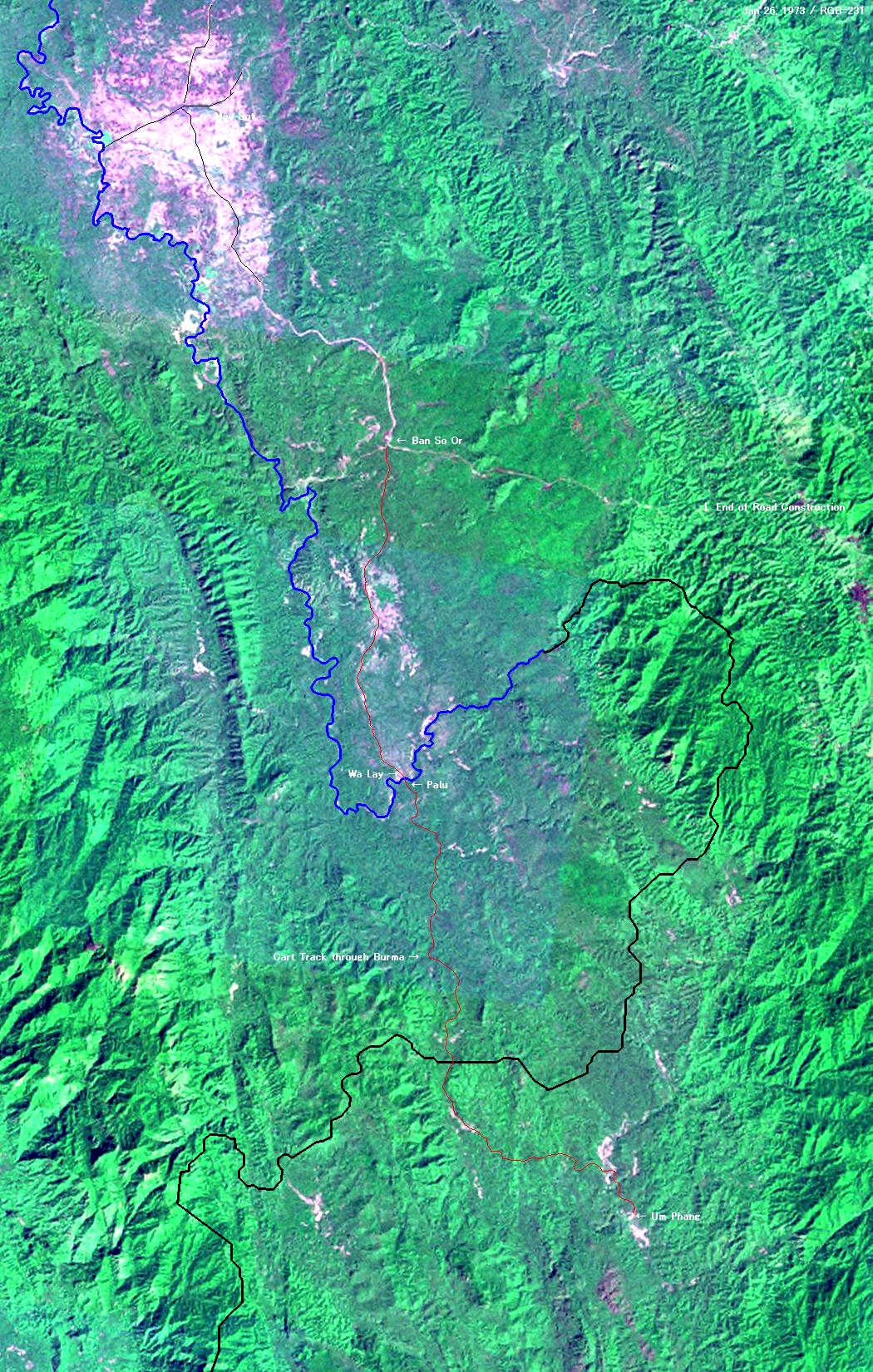
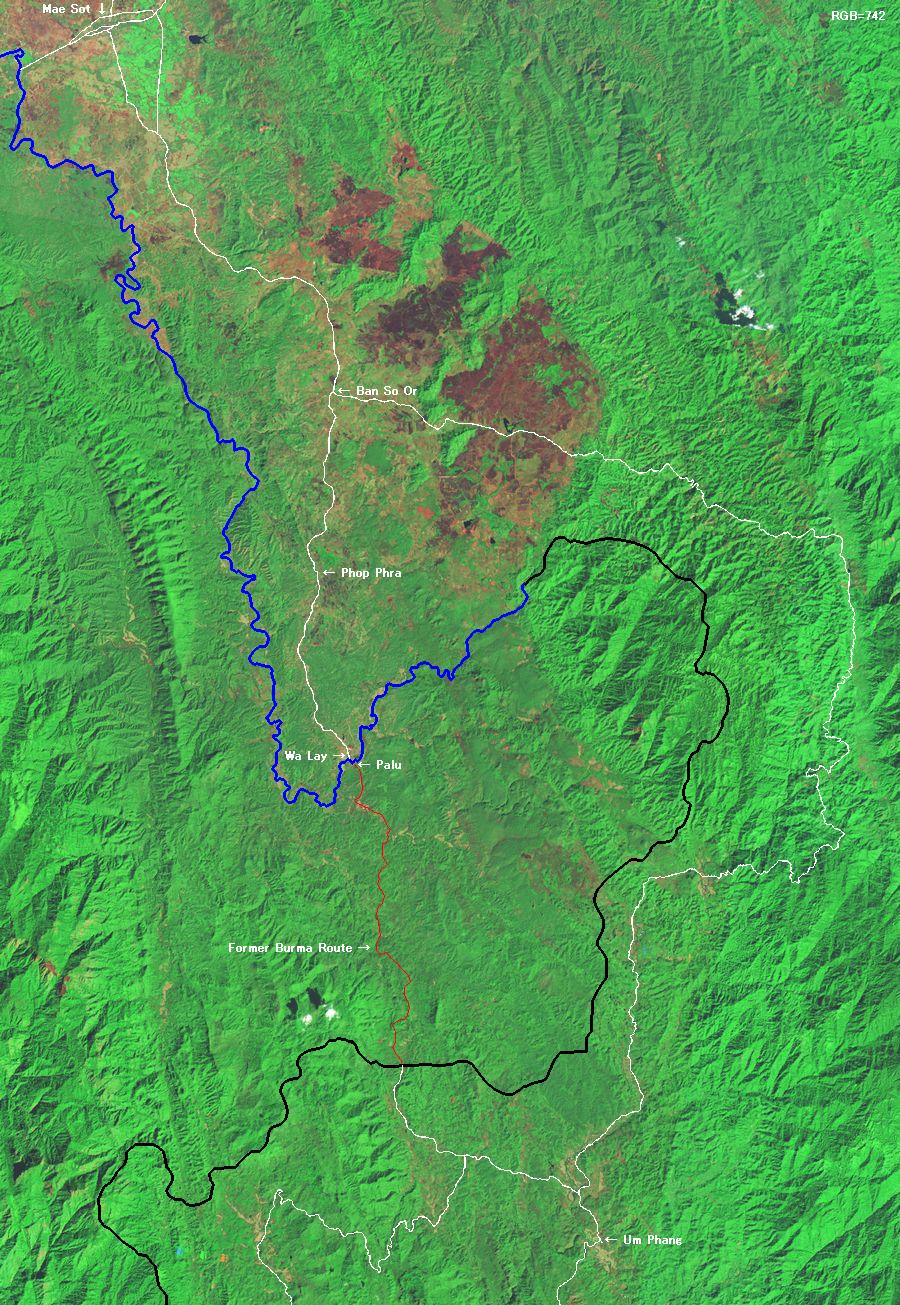
Quote: Three Pagodas According to contemporary newspaper reports, some 30 road workers were attacked and killed at km-marker 43, apparently by Thai, Hmong and Karen CPT insurgents wanting to stop the road from penetrating Um Pang district (one of the main communist strongholds in Thailand in the 1960s and 70s). The attacks were one of the factors which had delayed completion of the road for so long. Following them, the Thai authorities deployed anti-communist KMT forces from places like Kae Noi to guard the project and its construction workers. The security situation was alleviated in 1982-83 with the mass surrenders in Tak province of hundreds of heavily-armed communist rebels and thousands of sympathizers. Nevertheless, until the late 1980s, when 'Death Highway' was finally finished (a decade late), the CPT remained active in the region south of Mae Sot. (p290) Until recently, Um Pang had been even more cut off. Tong Lor Toed Yotin, the old man who ran the telephone booth at the 'Five Ways' (that nodal point in the village centre where five streets met), told us why. Until 1987, when the H1090 was completed, it had been difficult to get there at all. He had moved down to Um Pang from Mae Sot in 1968. In those days there had been no road, not even a track. The journey had taken the 'short' cut via Wa Lay through Burma - a four-day walk on foot or by elephant, camping three nights in the forest on the way. In 1971, people had begun building a cart track south from Mae Sot, so that rice could be transported from Um Pang up to town in four or five days. In 1975, the first motorized vehicles had started using the new cart track. Work on turning the cart track into a proper road had been unusually slow because of local CPT guerrilla activity and because of the two massacres near Rom Glao village No 2. As late as 1984, the 30-km route through Burma had still been in regular use, some people continuing to use it until, of course, it had been interdicted by the Burma army. In the rainy season, the new dirt road had often become impassable, leaving Um Pang cut off from the outside world for months on end. Finally, in 1987, 'Death Highway' had been metalled right through. (p291) |
|
Bangkok Post Sunday Magazine / August 5, 1973
|
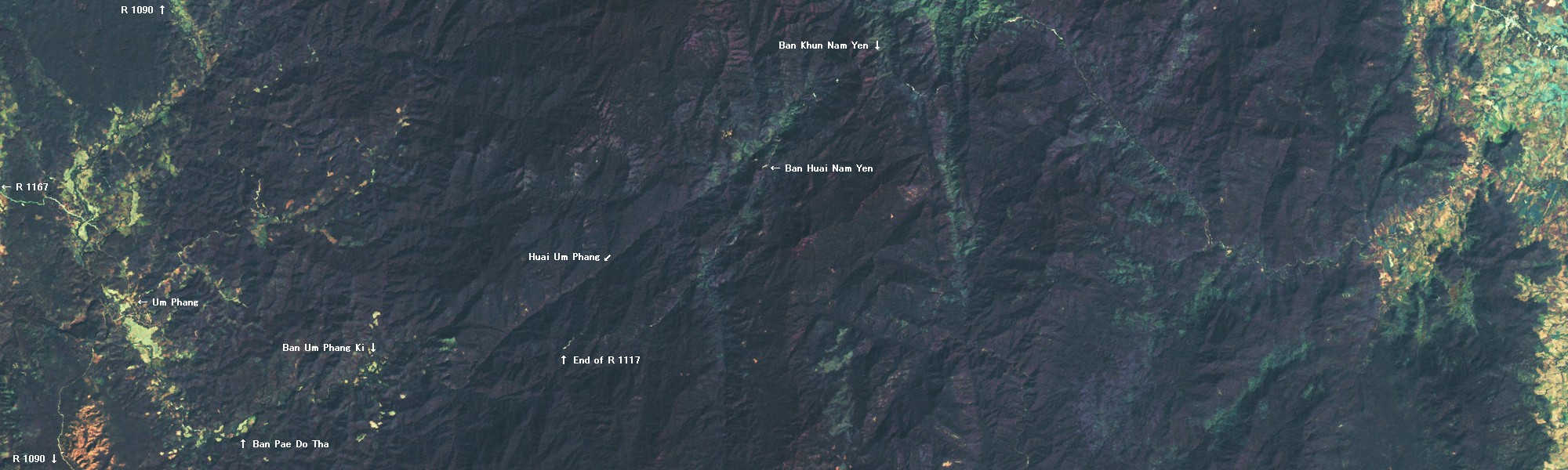 R 1117, if ever completed, was to be an alternative route to Um Phang. Its construction started in 1985, but suspended in 1987.
|
Quote: Three Pagodas The path through Mae Wong National Park from Klong Lan to Um Pang via Um Pang Ki (even marked on some maps as the H1117 road) was absolutely forbidden, the way having been closed eight or nine years previously, with all villages en route shut down. The truth of this we found out to our own great cost when we once went to a lot of trouble trying to take a short cut from Kampaeng Pet to Um Pang. (p296) |
|
Bangkok Post / March 19, 2002
BORDER
Surayud orders road project discontinued Army does not want to destroy forest Wassana Nanuam 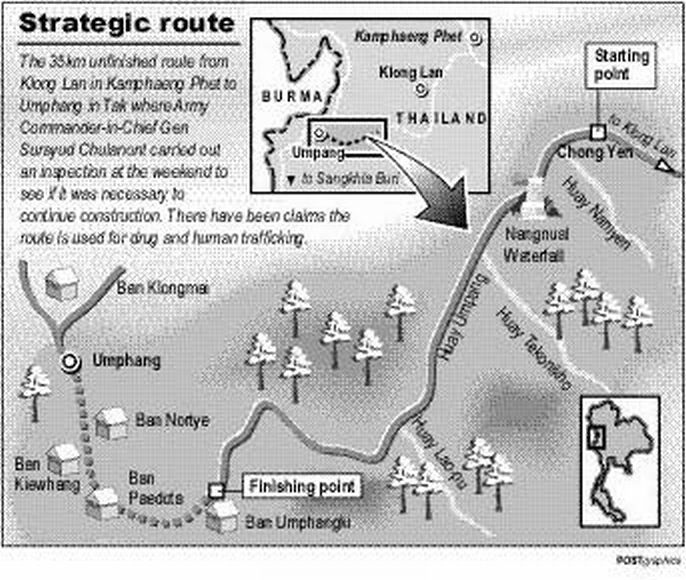 After a weekend survey led by the army chief, it has been decided not to build a security road linking Kamphaeng Phet's Khlong Lan to Tak's Umphang, to protect the environment. After a weekend survey led by the army chief, it has been decided not to build a security road linking Kamphaeng Phet's Khlong Lan to Tak's Umphang, to protect the environment.Army commander-in-chief Gen Surayud Chulanont spent three days and two nights from Friday until noon Sunday trekking 35km across Tanaosri Range's 10 mountains and more than 90 rivers. The National Security Council and Forestry Department asked the army if construction of the unfinished Khlong Lan-Umphang security route should be resumed. Gen Surayud said the army would not support extension of the route, which was not useful for military operations because the road was up to 50km away from the border. Under the current policy, security roads must be no farther than 2-3km from the border. "If we allow the construction of another 33km section of this road, we will lose abundant forests and a lot of rare wild animals. "It's not worth losing forests and wildlife habitat even though it would make travel to Umphang more convenient and support the development of Tak. "The army is against the construction. All forests disappear wherever roads are cut,'' he said. The project began in 1985 and was suspended in 1987 after completion of a 115km section, since the army saw no security benefit and did not want to see deforestation.
Despite no trace of drug smuggling found along this route during this trip, the army chief ordered routine patrolling by the Naresuan task force to combat drug trafficking. "I envy the villagers here who live among pristine nature. Please help protect this. Do not cut down trees and, more importantly, do not fall prey to drug gangs,'' Gen Surayud told Karen villagers at Umphang Kee village in Tak during his trek. Umphang Kee is a self-defence and drug-free village under the army's "strong community project''. |
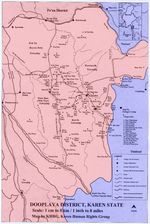 From where Thailand meets the Salween River down to some distance south of the Three Pagodas Pass, Thailand borders with the Karen State which is, within today's international geopolitical context, is regarded as a part of Burma. Ugly military struggles still persist today between the Karen soldiers and Burmese soldiers, and the area is replete with landmines planted by both parties.
| Path | Row | WRS | Sensor | RGB | Date | |
| Image-1 | 130 | 49 | 2 | TM | 732 | Dec 21, 1989 |
| Image-2 | 131 | 48 | 2 | TM | 732 | Feb 3, 1989 |
| Image-3 | 131 | 49 | 2 | TM | 732 | Jan 18, 1989 |
| Path | Row | WRS | Sensor | RGB | Date | |
| Image-4 | 130 | 49 | 2 | TM | 742 | Dec 21, 1989 |
| Image-5 | 131 | 48 | 2 | TM | 742 | Feb 3, 1989 |
| Image-6 | 131 | 49 | 2 | TM | 742 | Jan 18, 1989 |
| Path | Row | WRS | Sensor | RGB | Date | |
| Image-7 | 149 | 48 | 1 | MSS | 231 | Jan 26, 1973 |