��This page is devoted to discussion of tactical issues, especially as they pertain to law-enforcement-oriented airsoft combat. Muz-L-Flash is a Great Lakes area SWAT team member and has graciously volunteered to answer your questions regarding tactics. Questions should be submitted to Muz-L-Flash via SASOT's email, and one question each month will be selected by Muz-L-Flash for discussion on this page. If anyone's got questions, let's hear them!
Note from Muz-L-Flash:
The arena I work in is a very serious, and sometimes deadly one. Tactical superiority is maintained by not divulging information considered sensitive by Law Enforcement professionals. Therefore, the information I relay will only be that which is found in print or media forms accessible to the public already. I will not be passing on "inside information" on movement, approach, intelligence gathering, communications, etc... Look to me as a clearing house for information which you could find, if you had time and the impetus, on your own. Any persons feeling I have passed on anything which may endanger a Police or Federal officer, I solicit your comment and suggestions. The game we are playing, airsoft, is fun, and by watching an episode of "Cops" or "Navy Seals" or "Soldier of Fortune", you would learn more than you will by reading a year's worth of my column. When you read what I write, you will not learn how to defeat an entry team; you will see that they can beat you no matter how good an ambush you think you have laid. This should discourage people, not help bad guys. Again, if you have any questions or suggestions, please pass them on to me. -Muz-L-Flash
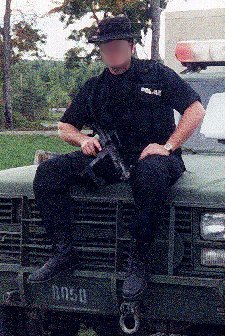
MAR-2000 - What are the advantages to using a 3-point sling? Also, what is the proper way to use a 3-point sling?
��1. Advantages: With a tactical, or three point, sling, you have the advantage of a more secure and ergonomic bracing of the weapon, properly adjusted, you could just about release the weapon and maintain a cheek weld, with a little flexing forward of the strong side shoulder. Second, when you "run dry" you can simply let go of the weapon and it will fall to across your chest, muzzle down (if adjusted appropriately). You can then quickly transition to your secondary sidearm. This works as well if you have to go for a tool, and it leaves the firearm in a quickly accessible position. Also, if you do need room to work, a simple flip back, and the weapon is securely held, butt up, behind the arm and shoulder. This sling is the best thing ever for the multitasking roles an operator serves in CQB. ��2. Wearing properly... Well, people can argue about almost anything, but I believe the only way I could ever wear mine is in the manner that allows the weapon to hang barrel down when you let go (at a 45 degree angle, should rest with butt near strong side pectoral). This will depend on if you are right or left handed.
FEB-2000 - What's the best way to deal with stairways?
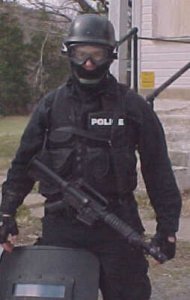
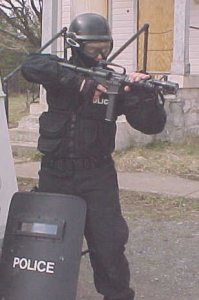
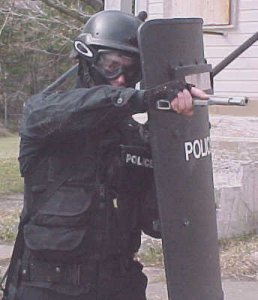
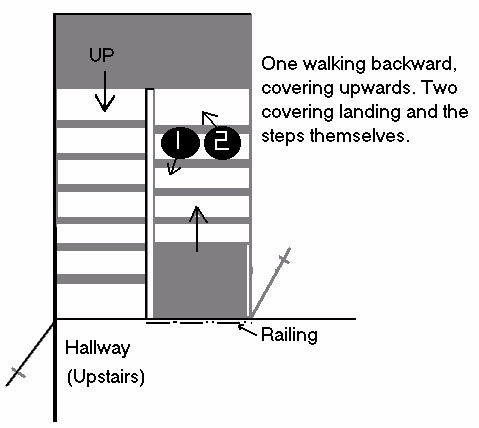
��Answer: Be aware, stairways are one of the most dangerous "fatal funnels" in a building. Move slowly and quietly when possible. First: clear the bottom landing room (door on right). If you can be seen entering this room from above, make a shoulder to shoulder (back to back) entry, with the point man facing into the room, cover shooter providing security up and behind. If you have a three and four, have one cover the stairs themselves, and take one and twos place as you move quickly into the room to avoid exposure from above. Last person remains at door frame covering up the stairwell opening. When number two enters the room, he swivels quickly and takes his place in the room (see last report, room entry). When the bottom room is clear, first person (was last, covering upwards) keeps his eyes up, and is shoulder flanked by number two, who covers the stairs themselves and the next landing. They move up the stairs side by side, with number one walking backwards. Remember, each keeps his eyes on his area of responsibility. Three and four will also walk backwards up the stairs, covering above (since that is primary threat zone). At the top of the first flight, turning 180 degrees, one and two will now be walking forwards, covering up, left and right respectively. When you reach the top of the second flight of stairs, one will break right to clear room, while two will assume low cover position on the hallway. Three will follow one into room and assist with clearing, four will assume high cover over two, watching hallway for threat emergence. It is a complicated and slow procedure, best done stealthily. Once the top room is clear, a base of fire has been established and you may begin clearing the hallway rooms.
FEB-2000�- What's the best method of entering a building with only two team members?
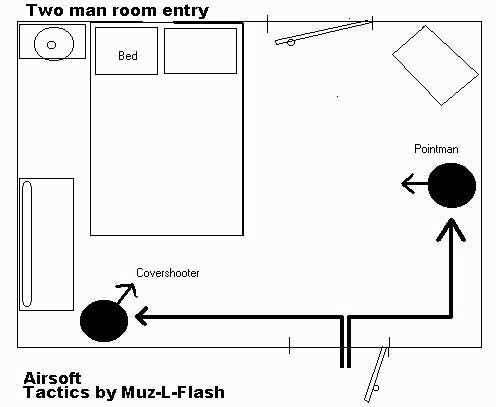
��Answer: The short answer is, there is no best way, it is extremely hazardous, and in the real world simply best not done with less than a four man element (or larger depending on building size, layout, expected resistance etc..), but for our purposes here, let's be realistic, you may have no help and no hope of backup. If this is the case, the best way is as follows: approach your entry point with stealth (surprise), stack to one side of the door and when prepared to enter, give the high sign (usually a one-two-three up and down bounce, commit on three), the first person through the door (window, hole, roof, chimney etc...) breaks right or left (do not precommit to direction, let the person in front choose based on immediate threat presentation). The "point man" (say he chose right) must then swing right, into the room, quickly clearing the fatal funnel doorway for his partner and making sure he makes a complete turn, bringing his muzzle into line with the farthest right corner (danger area). This is called "digging out the corner", because that's where bad guys tend to hide. He then scans, while moving down the right side wall, with his muzzle and eyes (always looks where you are pointing the weapon) up the right side wall, and to the far wall. He continues moving until he reaches the corner and then begins moving up the side wall, stopping no more than 1/2 way up the length of that wall. Meanwhile, the cover shooter (or number two in the stack), moves in and digs the left corner, and sweeps his half of the room as he moves to the left corner and stops, scanning the room. This sets up a basic "L" ambush in the room, allowing you both to direct fire, without creating a crossfire and staying on your walls (actually at least 8 inches off the wall if possible to avoid bouncing bullet phenomenon). In this position, neither of you ever blocks the other.
(Speed)
��The important thing to remember is that if the point man takes someone under fire, the cover shooter must remember his areas of responsibility and trust his partner to eliminate that threat until he has secured his zone of fire. Also, vice versa. If a threat is encountered, shoot fast and shoot well. Remember, Muz-L-Flash's quote of the day "Speed is fine, but accuracy is Final!"
(Violence of action)
��Once clear, signal your partner verbally if noise discipline has been compromised by an incident upon entry, or non-verbally to maintain stealth status. So remember, the keys to a limited sized entry are as follows, "Surprise, Speed and Violence of Action!"