Advantages
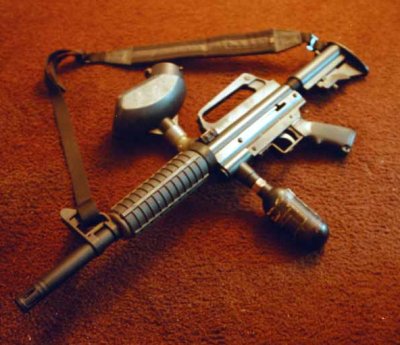
Paintball equipment is generally accessible by a larger number of people and at more locations than Airsoft equipment is, and the inherent qualities of the paintball system itself (the round leaves a definite mark when it hits a target) is a definite advantage during training. Paintball guns typically have a little more range than Airsoft guns do, which makes them better for outdoor training. Paintballs tend to hurt more than Airsoft BBs do on impact because of their mass, which tends to make for more solid tactical thinking when you know how badly it will hurt if you get shot.
Disadvantages
The main disadvantage here is that there are so few paintball guns that adequately simulate the handling characteristics of real weapons. The CAR68 pictured above is one of only a handful of realistic paintball guns on the market, and even so it still differs significantly from the real steel in weight, balance, reloading, and general function. It is also semi-auto only. There are a very small number of select fire paintball guns on the market - two at the time of this writing, both made by ATS. One resembles an H&K MC51, and the other resembles an M4. Both are fairly expensive, and some models are typically for sale only to law enforcement and military agencies. The power of paintball guns makes them ill-suited for indoor CQB training since the number of point-blank encounters would seriously increase the risk of injury. Paintball ammunition is a good deal heavier than airsoft ammo, and it is also a lot more expensive. Compare the average cost of $8 per thousand Airsoft BBs to the same price for around 200 low-grade paintballs. There is also the mess factor: paintball guns can experience bursts in the barrel which take a while to clean out, especially if you're in the field being shot at. The physical setup of a paintball gun is usually such that there's a large gravity-feed hopper on top of the gun throwing the balance way off, adding a pound or two for around 200 rounds (think how little a loaded 200-round mag for a Marui MP5 weighs). Most self-loading paintball guns are of the open bolt variety; that is to say that the bolt is rearward when the gun is cocked and ready to fire. When you pull the trigger, the bolt flies forward, chambering a round and then firing as soon as the chamber is closed, to recoil backward to the cocked position immediately afterward. The problem with this system is that it throws your aim off with the momentum of the bolt going forward before the gun even fires. With paintball guns, most of your shooting won't be so precise that it will make a huge difference, but it does affect the feel of the gun and adds a fraction of a second to your response time when reacting to a target.
One more thing: paintball guns have a tendency to look dumb. The gravity feed hopper on top, the large air tanks, and the fact that most are not designed after real guns all adds up to a big disadvantage in my book, especially with regard to tactical training.
UPDATE: (01-16-00) It was recently brought to my attention that there is a custom paintball gun maker out there who seems to take airsofts and put stock paintball guns in them, which is an excellent idea. Check out Extreme Sports Paintball Guns for more information. From the models available, the MP5 looks the best but it may be a little flimsy since it appears to be made from a spring powered MP5 airsoft. I'll have to get my hands on one and give it a thorough review. In all, they won't handle as realistically as an airsoft will, and they won't offer the degree of realism as far as training goes. But they do offer a much nicer looking paintball gun, in my opinion, than 99% of the other models available. Also, from what I hear the bolt action on my CAR-68 is heavier than on most paintball guns, so the aim being thrown off when the trigger is pulled probably isn't an issue with most normal paintball guns.
Hybrid Systems
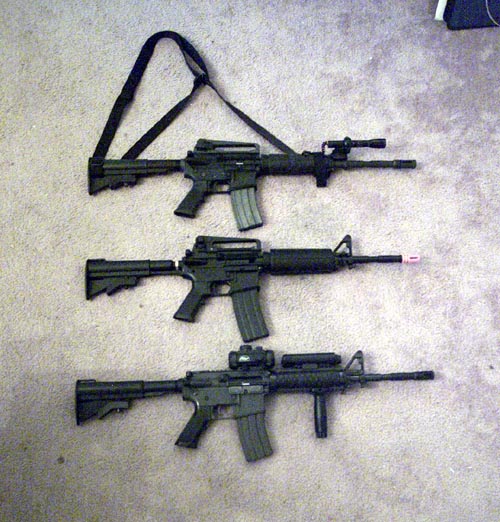
There's a new game in town that combines the best of the airsoft and paintball worlds, and it's called the Real Action Marker. The most prevalent model available is the M4 (though there are several variants available), and there is an MP5 on the way. It's a gas-powered system that fires smaller, .43 caliber paintballs which are fed from a spring-loaded magazine just like an airsoft gun would. How do you keep the paintballs from bursting under spring pressure? Put each one in a small, tubular plastic casing. This casing system also provides another fun benefit - the marker ejects the casings as it fires, much in the manner of a real weapon. The M4 RAM is full auto, which could be fun. So you've got the handling characteristics of an airsoft gun with the advantages of a paintball system. We've just picked up an M4 RAM, and we'll be reviewing it soon. In the meantime, check out the photo below for a comparison. Top: Real steel civilian model M4 carbine. Middle: M4 Real Action Marker. Bottom: Marui M4 RIS airsoft.
Update:
After a preliminary test with a small disposable CO2 cartridge, I have a few things to report. The M4 sounds great when it's being fired - the rate of fire is good and the marker sounds very businesslike. It also doesn't seem to use much gas to fire the small paintballs - the small cartridge lasted for more than a hundred shots (fired in short bursts). I can't imagine how long it would last with the standard air tank. The velocity was adjusted all the way down (which apparently gives a muzzle velocity of around 200 feet per second), and I didn't have a tool to make adjustments. There was a lot of drop, but I could make good hits to 25 yards. Stay tuned for an adjusted-velocity test. The RAM worked reliably; I didn't have a single jam the whole time I was testing it.