��Most Airsoft combat is military or tactical in nature, and calls for practical, out-in-the-open gear. But for those of us who use Airsoft as a law enforcement training tool, concealed carry is often a variable in the scenarios. In this section I will go over some basic concealed carry applications and review some concealed carry holsters as they relate to Airsoft. NOTE:�Never carry your airsoft gun concealed in public. If you are caught, at the very least you could be convicted of carrying a concealed weapon. At most, you could end up getting shot. Do not carry a concealed weapon EVER unless you are licensed or authorized to do so.
��Here are some typical types of concealment holsters, as well as a brief description of each:
Shoulder holster -�This is a popular type of holster that carries the gun beneath the weak-side armpit. There are two basic types of shoulder holsters: vertical and horizontal. The vertical type offers the best concealment because the gun's muzzle is pointed straight down with the grip sticking forward - only the grip of the pistol can protrude and cause "printing" - the telltale bulge of the gun under whatever you're covering it with. The disadvantage of the vertical shoulder holster is that it is not as quick to draw from as a horizontal shoulder holster. With a vertical, you have to maneuver your hand so it's pointing downward to grasp the handgun, undo whatever catch is holding the gun in the holster, and typically pull the gun up and then out. With a horizontal holster, all you have to do is reach straight in, undo the snap, and pull the gun straight out. However, since the barrel of the gun is now horizontal, the odds are greater for printing since not only does the grip stick out in front of your arm, the barrel sticks out behind (except with really small handguns). I have had personal experience with the following shoulder holsters: Galco's "Miami Classic", which is a really nice leather horizontal shoulder holster with a variety of opposite-side accessories (for example, you can have a double magazine pouch on the side opposite the gun, or a handcuff pouch, or both, etc.), the Bianchi M12 military shoulder holster (vertical - which is not a concealment holster, but it would work in a pinch), and a couple different models of Uncle Mike's nylon shoulder holsters (which are generally a lot less expensive than any other brand, but you get what you pay for...).
Crossdraw holster -�This is a belt holster that goes on the weak side of your body and holds the pistol butt-forward. The draw on crossdraw holsters is usually a little quicker than on a typical strong-side holster (at least when they're concealed), but a crossdraw holster is not as concealable in general. The only crossdraw holster I have had personal experience with was a Bianchi leather model, I forget which model number.
Regular strong side belt holster -�This is probably the most common concealment holster. The holster is placed on the belt on the strong side of the body, usually just behind the body's center line. There are two main methods for gun retention (as is the case with most holsters) - either friction, or a strap with a snap holding the gun in place. I personally prefer the thumbsnap arrangement for several reasons - it's better for weapon retention when you're undergoing rigorous physical activity, and it is easier to draw from, meaning you can draw one-handed rather than needing your other hand to steady the holster as you draw from it as is often the situation with friction holsters. This is the main type of holster I have had experience with - I recommend Strong brand pancake holsters, as well as Bianchi and Galco pancake holsters.
Small-of-the-back holster -�This type of holster goes on the belt and places the gun at the small of the back. This is excellent for concealment since about the only way you'll experience printing is if you crouch down and bend over. The main disadvantage to an SOB holster is that it is a slower draw than something that sits farther forward on the waist line. The only small of the back holster I have had experience with is Galco's SOB.
Paddle holster -�This holster is a variant of the regular belt holster. Instead of a one piece construction with slots to run your belt through, it has the holster attached to a paddle which slides inside your pants. This allows more freedom in positioning, and also allows you to wear the holster without a belt. It's also very easy to put the holster on or take it off, which is a nice convenience in some situations. The only downside to paddle holsters is that they tend to be less concealable than regular belt holsters since their construction is necessarily more elaborate. I prefer this type of holster for its convenience, and I have used both Safariland and Galco paddle holsters. The main difference between the two is that the Galco holsters are made from a soft, suede-lined leather, and the Safariland holsters are made from a stiffer laminate material.
Inside the pants holster -�This is a variant of either the small of the back holster, the strong side holster, or the crossdraw holster. Instead of attaching to the belt on the outside of the pants, this type of holster tucks inside the waist of the pants and will usually have some sort of clip to hold it in place. These are excellent for concealment, but your pants need to be a size too big for you in order to wear this type of holster comfortably. Also the draw can be a little slower since the gun is pushed tightly up against your body. Most if not all inside the waistband holsters are generic and will fit a wide variety of handguns. I have had experience with Bianchi and Galco IWB holsters (very reasonably priced), and also a Mitch Rosen holster (super expensive - around $150, but super high quality and custom made).
��There are other holster types, but these are the main, commonly available variants.
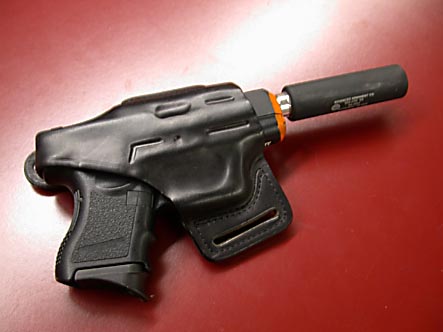
��The belt slide holster is a lightweight and fairly concealable option, and the open-bottom design is essential when carrying suppressed handguns. My only issue with this type of holster is that, because of the open bottom, you have to be extra sure of the clothing that goes over it. With a normal holster, if your jacket rides up a little and shows the bottom of it, people might think it's any number of things like a cell phone case, multi-tool pouch, etc. But when your jacket rides up and people can see the muzzle of your Beretta, there's no mistaking it. This is compounded when using a suppressed handgun, because it protrudes so much farther below the belt line. The model pictured above is made by Old World Leather and is pretty good quality even though it carries a low price tag. The holster above was originally designed for the Sig P226, but the thumbsnap is adjustable and it fits Glocks fairly well too. This type of holster will only work on suppressed handguns when the diameter of the suppressor isn't much larger than the width of the slide. If the suppressor is bigger, you won't be able to draw quickly or smoothly (if at all). The "Scorpion" type mini suppressor shown on Marui's Glock 26 above is well suited for this kind of use.
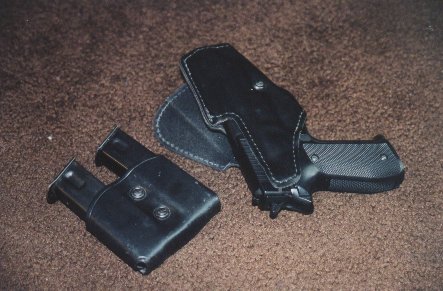
��Although not my favorite holster, this open top rig is convenient. The level of friction holding the gun in place is somewhat adjustable, but even with the tension screw removed, the gun is tight enough where I have to use my non-shooting hand to hold the holster in place while I yank the gun out of it. I much prefer thumbsnap retention, but to each their own. This is a "DEA-style" holster, and supposedly the DEA does indeed use this open top type of paddle holster. Galco's magazine pouch is very nice, and you can unsnap the back of it to slip it over a belt. You don't have to feed your belt through it when you put your belt on. This combo is nice because you can take it off or put it on as you wish without any hassle. The magazine pouch is also tension-adjustable, even more so than the Safariland holster (please note Galco holsters are more tension adjustable then Safariland's - this is probably due to the fact that Galco holsters are made from a softer material while Safariland holsters are fairly rigid). SUPPLEMENTAL: I recently found out the main advantage of an open top friction holster: if you're chasing someone down and have your pistol in hand, and suddenly are confronted with a situation where you need to use both hands such as climbing a fence, you just jam the pistol in the holster and it stays. With a thumbsnap holster you would have to holster the gun and redo the thumbsnap, which would cost valuable seconds. Don't know how often this sort of thing would come up during Airsoft use, but there it is. Advantage of thumbsnap holster - faster draw. Advantage of friction holster - faster reholstering. For what it's worth.
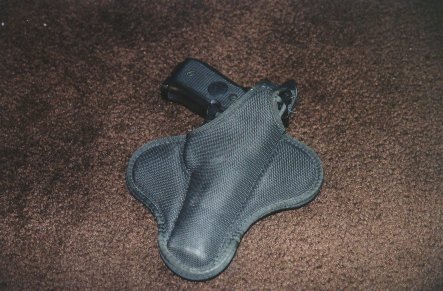
��This is one of the nicer nylon holsters I've ever used. While not as concealable as its leather counterparts, it is super comfortable and lightweight. Not only that, but it's adjustable to fit almost any handgun larger than a PPK and smaller than a SOCOM. You can see that it has a slight forward cant to it to make drawing faster and to make it a little more concealable than a straight vertical holster.
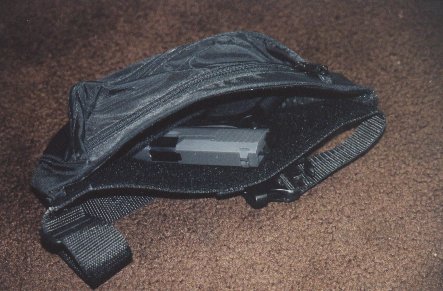
��The belt pack holster is a relatively new innovation. You'll notice most Secret Service agents, when they're out jogging with the President, use this type of holster. It consists of a normal looking belt pack with a secret compartment at the back which is held shut with a long strip of velcro. This holster has several advantages: It allows concealed carry in situations where you might not want to wear a lot of clothing (such as in hot climates), and it's fully adjustable. It will fit just about any handgun smaller than a full size pistol (Beretta 92f, Sig P226, etc.). The main disadvantage is a relatively slow draw since you have to rip the secret compartment open (which makes a lot of noise, too) and then retrieve the handgun. Other companies make belt pack holsters that show more promise than this one, but I've not handled any of them.