 |
|
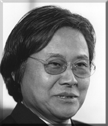
| Kisho Kurokawa's Biography Kisho Kurokawa was born in Aichi Prefecture, Japan in 1934. He graduated from Kyoto University in 1957 and then studied at the Graduate School of Tokyo University under Kenzo Tange. He made his debut into the world of architecture at age 26, as a confounder of the Metabolism Movement. His major works include Hiroshima City Museum of Contemporary Art, National Ethnological Museum, and Nagoya City Art Museum. The Institute of Chicago horored him by designation its architecture gallery the Kisho Kurokawa Gallery of Architecture. Early within his career kurokawa rejected orthodox Modernism and a Western obsession with mechanical analogy. In the 1960s he founded a Japanese avant-grade movement known as the Metabolists to combat this Western Modernism adn to propagate a philosophy of radical change. Despite teh group's intial success at Expo 70 in Osaka, the group disbanded. Many of Kurokawa's buildings explore the notion of engawa, the "in between space" where public realm and private space co-exist in harmony. His recent architecture has achieved considerable international acclaim and has secured a series of prestigious commissions. He abhors traditionalism, but feels that the repective cultures of different countries offer the most appropriate response to contemporary malaise. Kisho Kurokawa is one of the foremost contemporary architects of Japan. Kurokawa's use of geometric figures is in keeping with his strong sense of balance in all his work. Kurokawa employs his concept of "abstract symbolsm" throughout his work. |