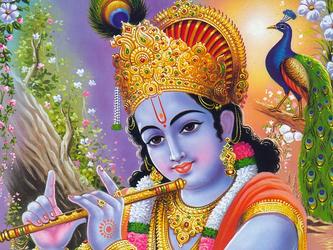
Gopalavimsati
by Vedanta Desika
. Desika has written devotional hymns on all the archaavathaaras the deities of all the vaishnavite shrines but none of the forms of Lord Narayana seems to be so dear to him as His incarnation as Krishna. Gopalavimsati, twenty verses in praise of Krishna is the most exquisite work exuding charm and beauty. Yadhavaabhyudhaya is an epic which seems to be an elongated version of Gopalavimsati as it elaborates on the subtle references to the exploits of Krishna therein but it is rich in poetic skill and intellectual excellence. The most significant fact which points out to the link between the two works is that the opening verse of both the works is the same.
The mangalasloka is
‘vande brindavanacharam vallaveejanavallabham;
jayanteesambhavam DHaama vyjayantheevibhooshanam.’ (Gopalaavimsati-1)
This verse is rich in meaning and brings out fully the glory of Krishna. It means, ‘Salutations to Him, who was born on Krishnaashtami, who used to inhabit the Brindavan, adorned with the garland of forest flowers, self effulgent and loved by gopis. The four adjectives given to the Lord, namely, brindavanacharam, the one who roams around in Brindavan, vallveejanavallabham, the beloved of the gopis, jayantheesambhavam, born on the day of His avatar, vyjayantheevibhooshanam, adorned by the forest flowers are rich in meaning as they denote His vathsaltya, souseelya,soulbhya and svamithva.
His Vaathsalya, love towards His dependents is indicated by Brindhaavanacharam , which is like that of a cow towards its calf. Brindha denotes His devotees, for whose protection, avanaaya, He moves about, charathi. This dispels the fear in the heart of His punishment for the wrong deeds one has committed, svaaparaadha bhaya nivarthakam. Appayya dikshitha, in his commentary says that He, who was dhandakaaranyachara, walked in the dhandaka forest for the protection of the rshis became brindhaavanachara, for the protection of the cows, in Krishnaavathaara true to His promise later, ‘parithraanaaya saadhoonaam vinaasaaya cha dushkrthaam, dharma samsthaapanaarthaaya samhavaami yuge yuge’, I manifest Myself in each epoch in order to protect the good and to punish the wicked.’ The cows represent the good who resort to the Lord for their welfare. Sentiment, rasa, exhibited by this epithet is adbhutha, wonder that the lord assumes the form of a cowherd and showers His love to one and all, man, bird and beast. The same vathsalya as He has shown towards Prahladha so that Hiranya kasipyu could not harm even a hair on his body, towards Jatayu in Ramaavathaara and towards all His dependents in Krishnaavathaara which made Him even to wash and feed the horses during the Mahabhaaratha war.
Valavee jana vallabham, the beloved of the gopis, is the epithet chosen for the purpose of indicating His Souseelyam, benevolence. Souseelyam is defined as ‘mahathah mandhaihi saha neerandhra samslesha svabhaavah, the close friendship shown by the great towards the humble folk. This quality of the Lord dispels the fear that He is beyond comprehension. Appayya dikshitha says that the fact that He who enjoys the uninterrupted union with Mahakakshmi was also able to enjoy the company of the simple cowherd girls is the proof of His souseelya. The term Vallavijana is used to denote their nomad existence as valla means movement. The sentiment expressed here is sringara.
Desika uses the epithet Jayanthee sambhavam to denote the soulabhya of the Lord, in taking birth in the yadhavakula, which removes the fear that the Lord is unapproachable. Soulabhyam is labhdhum susakathvam, easy accessibility. The significance of the word jayanthee sambhava instead of Devakisambhava implies that the Lord manifested Himself as Krishna and was not born, according to His words ‘sambhavaami yuge yuge’ and ‘yadha yadha hi dharmasya glaanirbhavathi -------thadhaathmaanam srjamyaham.’ Jayanthi also means jayam thanothi, victorious in the vinaasa of dushkrtha, indicative of virarasa. It is interesting to observe here that the words jayanthi and janmaashtami are used only to mark Krishnajayanthi, janmaashtami avathaara dhinasya jayantheethi vyavahaarah and all the others are mentioned as Ramanavami , Nrsimhajayanthi and so on.