
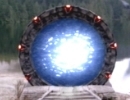
One side of the gate holds nine equally-spaced, V-shaped locking mechanisms, or "chevrons," capable of locking at least seven constelations in place via a freely spinning inner track. The first six gluphs lock down a point in space, while the seventh represents the point of origin. When the seventh chevron locks, and unstable energy vortex emerges from the gate, incinerating everything in its wake. Once the vortex is gone and the event horizon is established, outbound gate travel may commence. Once objects have exited the other side, the Stargate has the capability of shutting itself off.
The Stargate network extends beyond or own galaxy, and includes many thousands of gates. Most gates are paired with a dail-home device (D.H.D), by which a user dials an address to another world. The SGC does not have a DHD, and instead has rigged a computer system to access the gate's systems and dial addresses.
In the Pegasus Galaxy, some Stargates have been placed in space orbit of planets, ranther than on their surfaces. Rather than using a connected DHD, space-based gates are powered by three power nodes, and dialing is accessed by a panel on a ship.
The Stargate is essentially an enormous superconductor, capable of harnessing power from a wide variety of energy sources, especially electricity. The inner track is a safety feature. When the gate has absorbed enough energy this track will unlock, allowing a manual dial in case something dire has occured to the DHD.