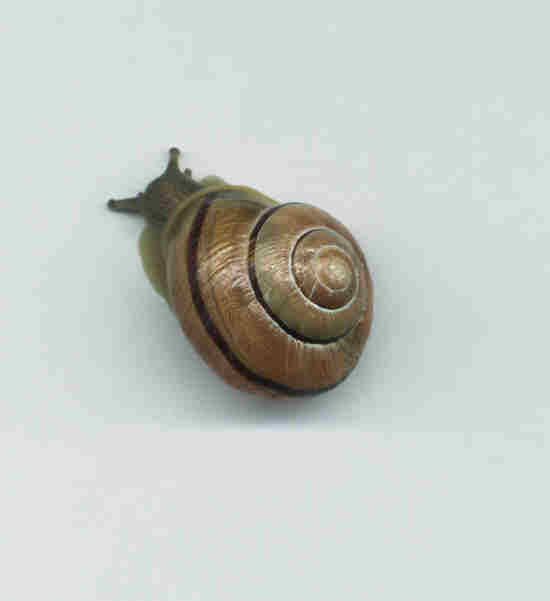
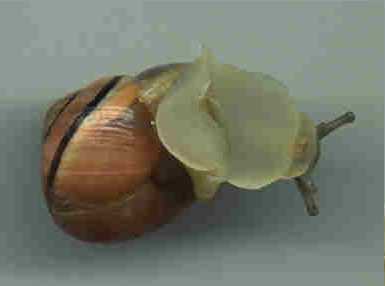
| Capaea Nemoralis and Capaea Hortensis I recently collected some snails from a local meadow. These were Capaea Nemoralis, the brown lipped banded snail, and Capaea Hortensis, the white lipped banded snail. They are native to Britian and also to many other places in the world, having been introduced by various means over the centuries. The distinctive thing about both types of Capaea is the amazing variation in their shells. The shells can be anything from brown through to yellow, pink and orange, and then can also have from 0 - 5 dark bands running around it, which can vary considerably in size and colour and cen even merge to form what looks like one massive band. The Capaea Nemoralis are slightly more adaptable than the Hortensis, and as such are found in many places in Britian, - meadowlands, woodlands, back gardens, sand dunes, and so on and so forth. Capaea Hortensis seem to prefer their environment slightly more regulated, and are more likely to be found in lush, damp meadows, although colonies can also be found in sand dunes and so on. Nemoralis can be distinguished by the dark lip to the shell, which is absent in Hortensis. Capaea Hortensis sometimes has a white or paler coloured lip to the shell but specimins are also found with seemingly no coloured stripe around the lip. The pictures on this page are of a particularly beautiful specimin of Capaea Nemoralis. The scans do not do justice to the shell colour however, which is a vivid orange colour. Sadly this snail died in October 2001. I have kept the shell though. Please check back to this page for more photos which are coming soon. **UPDATE** My Capaea Nemoralis have laid thousands of tiny eggs. Details of the babies, if they hatch, will be here soon!!! THE BABIES ARE HERE!! The eggs have hatched. There are a couple of hundred baby snails, - they're tiny and see through. Interestingly the baby snails have proceeded to cannibalise a second batch of eggs that I put in there with them...maybe I'll try them as population control for the fulicias..... They are not growing very fast but they are eating a lot. I will release nearly all of them to the wild when they are a little bigger. If there are any really pretty ones I may keep those. October 2001: I decided to release all of the baby snails back into the field where I found the adults. Maybe another time I will have the extra space and time to keep some. |
 |
 |
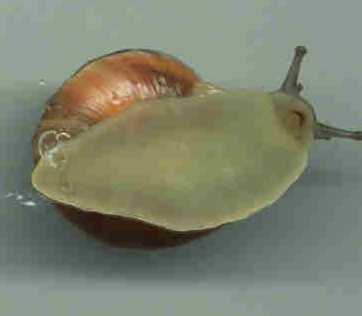 |
| Capaea nemoralis This is a very unusual specimin. Note it's orange colour! Please do not reproduce these photos for any use without first asking for my permission. Email me to get permission. |
| I hope to have some photos of ordinary Capaea nemoralis and hortensis soon. When I get round to it I will put them into the photo gallery. |
| Caring for British common snails in captivity is rally quite easy. They need a similar set up to an African snail, - a secure tank, a source of calcium, somewhere to hide, and fresh vegetables to eat. However I have found that they only need feeding every other day, - when I fed them every day they got really fat and started to stick out of their shells all over and look really gross and blobby. So I took to feeding them only every other day and they seem to thrive on that. As for breeding, they don't lay eggs as often as African snails, though when they do there are hundreds of them! They are tiny, white and spherical. It is very hard to keep track of the babies when they hatch, they are tiny, smaller than African landsnail babies, and they do not grow as fast. It is almost impossible to keep their living environment clean. Therefore I would say it is quite hard to sucessfully breed them. |

|