|
Archachatina puylaepti
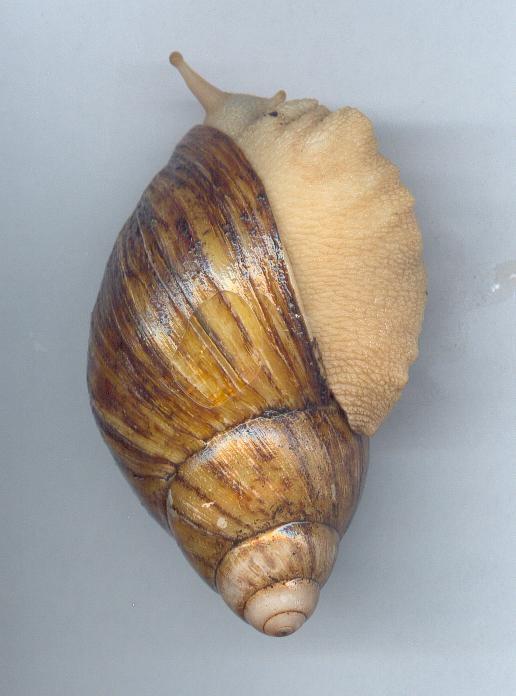
I believe that the two pale-fleshed Archachatina snails I own are probably Archachatina puylaepti although I have a lack of classification information to go on here!
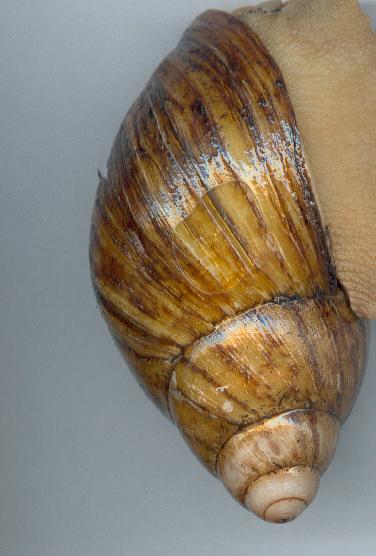
This snail has the same shell shape as Archachatina marginata. It has also got the same striped markings but it's shell is lighter, and can range from a light brown to a yellow-olive colour with fairly thin dark stipes. The tip of the shell has only the slightest hint of pink to it. The snail's flesh light coloured. I have two of these, one of which is more of a dirty yellow colour and one of which has pure white flesh. The snail in the photos here is the "dirty yellow" one. Photos of the pure white one will follow shortly. The snail has the same v-shape along it's tail as Archachatina marginata and Achatina achatina. Towards the snail's head the flesh of the foot is so pale the grey muscle can be seen underneath. I originally thought that this snail might be an albino Archachatina marginata. Albinoism is a genetic variation whereby the snail's genetic makeup lacks the correct genetic information for pigmentation of the flesh and sometimes also the shell. This variation happens randomly and very rarely, although once you have found an albino snail it is possible to breed for this trait. However, I now think that it is far more likely that this snail is Archachatina puylaepti rather than an albino of another species.
This snail is also almost exclusivley nocturnal which makes photographing it very difficult (I'm usually asleep when they are out and about!). It refuses to be tempted out of its shell by warm baths or anything - very single-minded. They spend most of their time buried below the surface of the substrate. They thrive in similar conditions to my margies and, asI have found with all of my snails, prefer the temperature to be that of a really warm room, although they do perfectly well in colder temperatures.
I have so far been unsuccessful in breeding these snails - they have simply not laid any eggs. The variation in colour between the two leads me to wonder if they are in fact different species, but then given the variation that can be observed in, say, Achatina fulica, this may well not be the case. I intend to do a lot of work with my puylaepti in the spring and summer of 2006 in order to find the optimum conditions for them and hopefully persuade them to breed. I have no information avaiable at the moment on incubation, hatching and rearing these snails but if and when I am successful in persuading them to mate and lay eggs, I will be able to begin providing some more information. Please check back during 2006 for updates!
From time to time I may have snails of this species available for sale. Geocities prevents me from operating an online sales centre, so to enquire about the availability of this species of snail please contact me.
|
|
|

