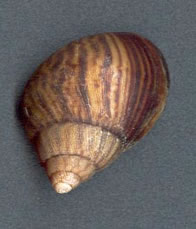
| This is a juvenile immaculata. Note the difference in shell colour and pattern between the adult and juvenile specimens. |
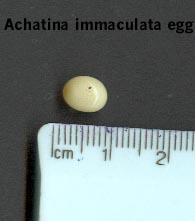
| This is an immaculata egg. |
|
Achatina immaculata
Achatina immaculata are fairly rare and it is illegal to export them out of Africa. They are endangered and the ban on export is there to ensure that the wild population remains undisturbed and able to breed without adult specimins being captured for trade. There are breeding populations in the U.K. and other locations throughout Europe however and so it is still possible to keep these snails as pets.
The immaculata is smaller than it's more common cousin, Achatina fulica. The maximum shell length is around 12cm but the snails usually remain a little smaller than this.
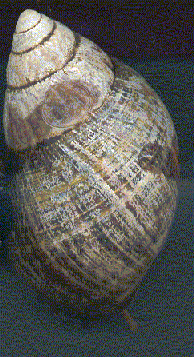
The adult immaculata has, on first impressions, a plain brown shell, which fades to white towards the tip. The fading to white is because immaculata is very susceptible to losing the top layer of the shell over time (this happens even in the tank where there is little wear and tear.) Juvenile specimins have a striped shell, alternating bands of white, yellow and brown. This pattern becomes much darker as the snail matures but on close inspection can still be seen on adult immaculatas, rather as if a child has drawn lots of crayon lines in varying shades of brown across the shell. The snail's body is a dirty orangey-brown, markedly lighter than that of the fulica. The shape of the shell is also different, being slightly more rotund, with a less pointed tip.
The picture to the right is an adult immaculata (not a brilliant picture!) which is worth comparing with the picture of a juvenile immaculata to the left. See the bottom of the page for a comparison picture between fulica and immaculata.
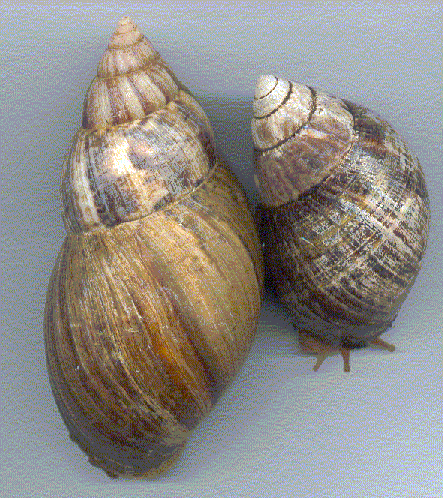 Here the difference between immaculata and fulica can be seen very clearly. Note how the immaculata shell is more streamlined, with each coil being less pronounced than on the fulica, and note the difference in shell tip and overall size.
Breeding Immaculata
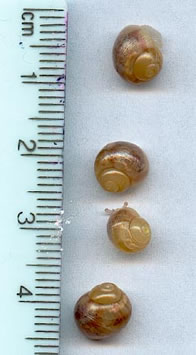
Achatina immaculata are fairly easy to breed although the captive mortality rate for babies is higher than that of fulicas. The eggs are slightly more fragile and so it is reccommended that if you are removing them from the tank to hatch in a seperate container you must be very gentle. My personal experience is that after moving the eggs it is still possible to have more than half of the batch (anything from 20-500 eggs) hatch successfully. Immaculata eggs are slightly larger than fulica eggs and are more decidely oval. They sometimes look like tiny replicas of chicken eggs. They tend to be a creamy, translucent white, though yellow is not unheard of. As the eggs are larger than fulica eggs, so the babies are larger, and also slightly different in appearance. They are not completely transparent on hatching, being a very slightly beige colour, but they are shiny and translucent, and this translucence lasts longer than in fulica babies. They are also much rounder than fulica babies.
|

