|
Achatina achatina
Commonly known as the Giant Ghana Tiger Snail
The tiger snail is perhaps one of the most massive snails you will ever come across. Growing (according to London Zoo) to a maximum of 30cm, they are one of the biggest snails you will find, rivalled only by Metachina krausii and Archachatina marginata species which reach similar proportions. It is true that it is rare to find a tiger snail that really does have a 30cm length shell, but 15 � 20 cm is not unusual. This is considerably bigger than species such as fulica, immaculata etc. In my personal experience, most of my adult tigers are around the same size as my adult Archachatina marginata marginata. However, there are several sub-species of Achatina achatina, and some of them are smaller - I have one which is a similar size to the sub-species Archachatina marginata suturalis (considerably smaller than marginata marginata and marginata ovum) and which has a much more streamlined shell then it's bigger cousins.
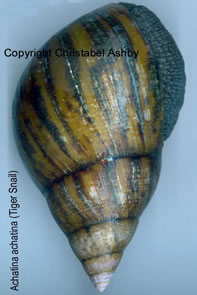
The tiger snail gets its name from its striking shell, which is usually either yellow with black stripes or black with yellow stripes, depending on how you look at it. Often the stripes are more like elongated patches and the snail may occasionally have a pinkish tinge to the very tip of the shell. On the inside rim of the shell you will find a stunning band of pink-purple, visible only when the snail is retracted entirely into it�s shell. Some of the sub species of tiger snail are interesting in that they are in fact a golden colour or even albino, but they are very rarely found in captivity (I have never seen one) and so I will not discuss these variations further here. The snail�s body is also remarkable. The flesh varies in colour from grey (most of mine are grey) to nearly black. The body is very textured, with an almost rough feeling and there is a distinctive v-shape to the tail of the snail�s foot.
These snails do not mess around when it comes to eating and are able to demolish somewhere up to 3 times the amount of food needed by the average fulica. However, they are sensitive to variations such as a drop in the temperature, and will, in my experience, go for long periods of hiding away and eating hardly anything unless they are kept in stable, warm conditions. For this reason, as I have no central heating and the temperature fluctuates quite a lot, I allow my tiger snails to hibernate for up to 2 weeks at a time during the winter, - this does not appear to harm them at all and when I place them on a heat mat and offer fresh food they come out to eat without the need for any extra coaxing.
Tiger snails are reluctant to reproduce in captivity, particularly if they are wild-caught specimins. In the wild they rely on the photoperiod and the seasons (wet or dry) to tell them when to mate. However, they can and do mate in captivity, and the best conditions to encourage this are to keep the tank several degrees warmer than room temperature and fairly moist and damp. Achatina achatina eggs are similar to fulica eggs in that the snail lays hundreds of small spherical whitish eggs below the surface of the substrate. They are relatively easy (but not as easy as fulica) to hatch and gently removing them to another container will not cause them any damage. They should be kept moist and consistently warm. The baby snails are the same size as baby fulicas and look identical to the babies of fulica and many other species for the first few weeks. Distinctive markings only begin to appear after a few months, although you can see the "v" shape on the tail right from birth, if you look very carefully. There is a high mortality rate among the baby snails - it appears to be very difficult to successfully raise the hatchlings in captivity.
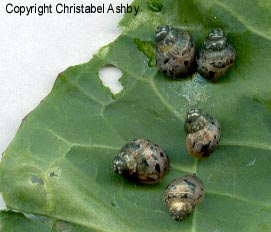
Achatina achatina at a few weeks old
|
|
|

