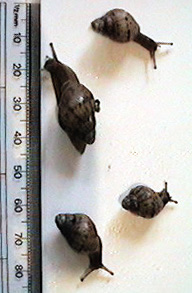
| Here are some baby Achatina fulica. |
|
How to Care for Giant African Landsnails
It is becoming more and more common to find snails being kept as pets. They often require little by way of care and attention and are cheap and easy to keep and breed. In the case of aquatic snails they can also have a useful purpose, in that they keep fish tanks and aquariums free of algae. This page will give you a basic guide to the care of the Giant African landsnail. Please note that there are slight variations on care from species to species, some of which can be found detailed on the individual species pages. I have taken Achatina fulica, the most commonly found captive snail, as the "template" for this page but the general instructions should work for just about any Achatinadae species snail that you keep.
Housing the Snails
Snails are happy in just about any plastic or glass container. An ideal home is a plastic small animal tank with ventilated clip on lid (scroll to bottom of page for suppliers). You could also use an aquarium with a wire or mesh covering on the lid. Other containers I have used include plant propagators, large ice cream tubs and takeaway cartons with holes punched in the lid (though this latter option isn't really recommended for your adult snails, it is useful for keeping baby snails in when they hatch). Questions you should ask when choosing a home for your snail are:
- Is the container well ventilated
- Can the snail get out? (you do not want this to happen )
- Is it clean? (if not, wash it thoroughly with hot water first and allow to dry before using)
- Is it big enough? Although it is hard to tell when a snail is overcrowded, I would recommend that for a pair of fully grown adults the tank should be about a minimum of 15 inches long, 10 inches wide and 10 inches deep. Of course once you have a bit of experience with snails you can judge for yourself and make the appropriate decisions. They don't seem to really mind being overcrowded but given more space they will be bigger, healthier, longer-lived snails.
In the tank you will need a layer of substrate between 2 and 4 inches deep. It is often said that a shallower layer will prevent the snails from laying eggs but in my experience this is not the case. Conversely however a deeper layer might encourage the snails to burrow and lay eggs. Possible substances to use for substrave include fine bark chippings, vermiculite, peat, aquarium pebbles, fine white (soft) sand, organic compost, or a combination. Perhaps the best of these are fine bark chips and organic compost, especially when used mixed together. Cases have been brought against peat (too acidic and using it is harmful to the environment from which it is dug) and sand (it can damage the snails if they are not adapted to a sandy environment and ingest sand particles by accident) You can also add sphagnum moss to the tank as an extra layer over part of your substrate. Whatever you use, check that it is pesticide-free before using it in the tank. You might also consider a plant pot for the snails to hide in (plastic is preferable as they are less likely to damage their shells on it if they take a fall from the roof) and you can also experiment with plastic and fabric plants. Live plants can be used but you must be certain that they are not going to be toxic for the snails. As a general rule avoid houseplants and use instead herbs such as basil and parsley. The snails will eat plants that have been put in their tank so you need to be prepared to replace them at regular intervals.
The substrate and snails then need to be sprayed with tepid water once or twice a day to keep the tank nice and damp. Don't let them sit in a puddle of water though. They can have too much of a good thing. A shallow drinking dish could also be used in the tank, - make sure it is not too deep so the snails can't drown in it and remember to change the water every day.
Snails like to be kept warm, - room temperature is fine and a few degrees above room temp is even better. A heat mat might be useful if your house is not warm or you do not have central heating. A simple mat can be bought at any reptile shop and many pet shops and works best when attached to the side or back of the tank and not put underneath as you would expect. This is because the thich layer of substrate can cause the mat to heat to a higher degree than required thus making the atmosphere in the tank too warm and dry. Affixing the mat to a side of the tank will still afford heat but means that it will not overheat and also means the snail can get away from the heat if it prefers.
Feeding the Snails
Snails are not fussy eaters and will enjoy any green vegetable such as cabbage, greens, lettuce, cucumber and so on. They like fruits too, - apple, banana, peaches etc. Also they will enjoy sweetcorn on the cob, carrots, parsnips (etc. any vegetable really) brown bread, dried tortoise food, baby food, mince meat and the very occasional drop of beer. The majority of their diet should be made up of fresh vegetables and fruit as it provides essential nutrients, and then the other items can be fed occasionally as treats. Snails require a constant supply of calcium in order to grow and maintain their shells, and for this reason there should always be a cuttlebone in the tank for them to rasp at. Simply replace the cuttlebone when they have rasped it all off, or when it gets particularly dirty (I replace mine every three weeks or so, maybe more often in the spring and summer when the snails are growing) Please note that it is very important to wash all the foods you give to your snail very thoroughly (obviously though you can't wash bread or baby food) in order to remove any traces of pesticide on the food. If you can afford it, it might be nice to give them all organic food, as this is less likely to carry toxins that could harm the snail. However I have never had problems with ordinary vegetables, - just make sure they are very well rinsed before you feed them to the snails! The snails should be fed once a day, - remove any leftover food and replace with new, fresh food. If the food is all gone in a short time you aren't feeding them enough. You will soon learn to guage how much they will eat. (and they can eat a lot!!)
Keeping the Snails Clean
Once a month or so the snail tank should be washed out thoroughly and the substrate should be replaced with a new, clean layer. There are many differing opinions as to what one should use to clean the tank (it is quite hard to get all the slime off the sides) but common things to use are washing up liquid, or vinegar, or bleach, and lots of hot water and elbow-work. Cleaning the tank is really the only time consuming part of snail care. Whatever you use to clean the tank, make sure you rinse very very well after cleaning, preferably several times over, with nice, clean, hot water. If any traces of cleaning products remain inside the tank they can be harmful to your snails. Then allow the tank to air-dry before putting in new substrate. As a matter of preference I use washing up liquid to clean my tanks, and if used neat on really stubbon slime it works a treat.As mentioned before though, the keyword is RINSE. If the snail eats any washing up liquid it will die.
When you clean out the tank, the snails can also have a bath. The important things to remember with this are that snails can drown, and that they can be adversely affected by water that is either too hot or too cold. As a guide, the water should be lukewarm. It should feel "not cold" rather than actually "warm" to your hand. You can run the water over the snail's shell and body and also let it sit in a tub with a few millimetres of water in the bottom. Never totally immerse your snail in water, and never leave the snail unattended while it is in it's "bath". You can clean the snail's shell off with a finger tip or with an old, soft-bristled toothbrush. Never use a new toothbrush as the bristles are too strong and can damage the shell, and never scrub at the shell. Very gentle motions where dirt seems to be particulary caked on are all that is needed. Bathing is very useful in ridding the snails of mites, which you might notice occasionally appear in the tanks. Simply cleaning out does not get rid of them as they live actually on the snail's body as well as in the substrate. Motes are basically harmless however and are not a common occurrence in the majority of snail tanks. They are therefore something you do not need to be unduely concerned about.
After the snails have been bathed, simply pop them back into their newly cleaned tank with some fresh food. You may notice that they become particularly active shortly after they have been cleaned out.
Breeding the Snails
Giant African Landsnails are hermaphrodites, which means they are both male and female, but they do need two snails in order to reproduce. The snails mate by doing a sort of courtship dance and injecting each other in the genital opening, which is on the neck just behind the right eye stalk and usually invisible.After mating both snails are able to lay eggs and will bury themselves into the substrate to do this. Achatina fulica can lay well over 100 small eggs at a time, and can lay every 3 or 4 weeks, so breeding them is a doddle really.
Gently remove the eggs from the tank and put them with some substrate into a smaller container, and keep them warm and damp and hey presto, in 10 to 16 days the baby snails begin to emerge. They leave the shell by eating their way out from inside, - for this reason do not remove unhatched eggs or bits of shell because they provide essential nutrition for the baby snails. Give the baby snails some cuttlebone and cucumber and lettuce and watch them grow. Be careful not to chuck any babies out when you remove old food though, - they are easy to miss!! They start out tiny, round and transparent, but they grow fast. Within weeks you will be able to treat them just the same as the adult snails, and within 6 months they will be close to adult size. However they can continue growing slowly for much of their adult lives, so it is not uncommon to see a 3 year old snail with new growth on it's shell. Achatina fulica live on average between 4 and 6 years though can get as old as 7.
For breeding Achatina marginata and some other species you will require more specialised information. Please see the individual species pages.
Links
- Livefood UK
-
For suppliers of tanks, substrate, and so on I recommend these people.
- The Giant African Landsnail Pages
-
For detailed information on breeding and care of Achatina marginata and Achatina achatina this site is great. It's well worth a read anyway as it is known as THE place to go for snail information!
- Cybersnail
- This is an excellent internet group where you can talk to fellow snail enthusiasts, and share advice and information.
Feel free to contact me with any specific questions you may have regarding the care of your snails. I shall do my best to answer your queries!
|

