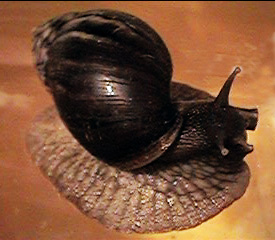
| Achatina fulica This is the most commonly found captive snail in the U.K. It is also, I believe, one of the most common or prevalent species in Africa. It is a voracious breeder, and having been introduced in many parts of the world, sometimes deliberatley, sometimes by accident, it can today be found in many areas of the world. In the U.S.A. it is illegal to even keep giant african snails captive. It is legal to keep them in the U.K. but it is illegal to release them into the wild. This is for a very good reason. Achatina fulica are regarded as pests by agricultural organisations worldwide. With large and unfussy appitites they can quickly destroy a field of crops, and their ability to breed and multiply (at a rate comparable to the proverbial rabbit) means that they can very quickly become a real threat to food supplies and farmers livelihoods. Having said that, it is unlikley that a fulica would survive the winter conditions in the U.K. as the temperature drops lower than the snail can tolerate. A lucky snail might survive by burrowing in a sheltered place, but most would die. Therefore it is not only illegal but also cruel to release African snails into the wild. Characteristic of the fulica is a brown shell which can vary from being marked with many stripes of different brown and yellow shades (sometimes even green shades) to being simply brown. Towards the tip of the shell the brown may be interspersed with lighter bands, which can very from light brown to whitish. The shell usually has 6.5 coils, and the final coil ends with a slightly opened out lip. The shell is moderatley thick, robust and may have small ridges as a result of growth spurts and damage. The snail's body can very from grey through to light and even dark brown in colour. The most common colour I have come across is light brown on the top of the body going to a greyish brown on the underside of the foot. Some mutations in the shell have been observed in my collection, the most remarkable of which involved a snail with eight coils to the shell instead of 6.5. The shell did not have an opened out lip and when the snail grew it simply created new coils over time. This snail was bigger than the average fulica by the age of 1.5 years but unfortunatly could not be observed further as it died prematurely in a rather unfortunate incident. Fulicas lay between 50 and 1000 eggs in a batch and the eggs are usually about 5mm across, slightly oval in shape, and have varible colour from white to yellow. The eggs take approximatley 2 weeks to hatch and the babies are tiny, round and trnaslucent. They begin to look like minature african snails within the first few weeks of life as the shell starts to take on colour and develop the characteristic pointed tip. The babies are very easy to rear, and it is advisable when keeping fulicas to excercise some sort of population control by removing some or all eggs as and when they are laid and either crushing or freezing them. In any case the babies are far easier to rear in a small, see-through container with only minimum substrate and so removing them from the main tank is advisable. If you do find yourself over-run with baby snails you may find a local pet shop or reptile centre is willing to take them, though you will be very lucky if they offer to pay for them!! Fulicas can live for 7 years or so, and so you must be prepared for a pet that may be around for some time. They reach maturity within the first year of life and are fully able to reproduce by the age of about 6 months. They continue to grow slowly throughout most of their life, but the main growing will be done in the first two years. By that time you will have a very good impression of the adult size of the snail, which can be as big 25cm in shell length. After the snail has reached two years of age you will see that it continutes to grow (there will be a band of light coloured, soft new shell around the lip when the snail is growing) but the increase in size will be much slower and less significant. Click here to return to the snail pages, or here to see some pictures of fulicas in the photo album. Click here to return to the main site menu. |
 |
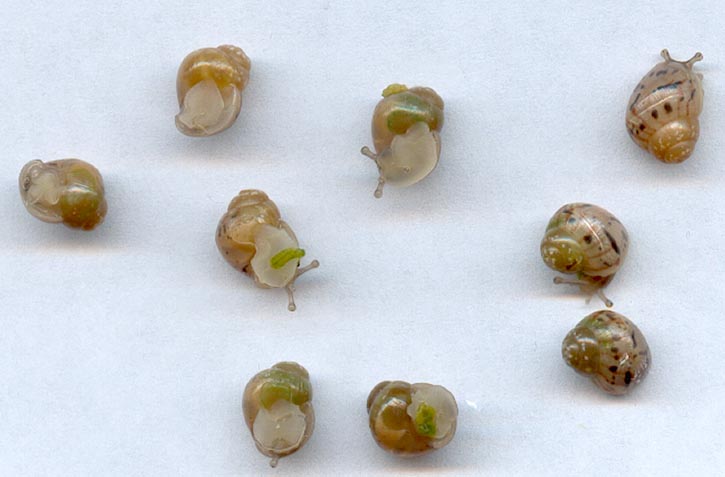 |
| Pictured here are my latest fulica babies, at 2 weeks old. They are less than 1cm long and have only just started to take on colour. Their shells were previously transparent. |

|
| This counter tells how many hits the fulica page has had |