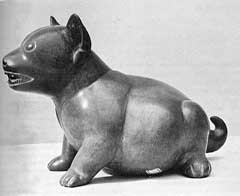
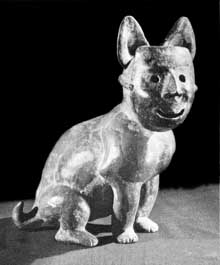
The name Xoloitzcuintli (pronounced show-low-etz-queent-lee) is derived from the name of the Aztec Indian god Xolotl and Itzcuintli, the Aztec word for dog. The Xolo's reputation as ahealer persists to this day. Believed to ward off and cure numerous ailments much of their reputed medicinal powers. These superstitous beliefs remained suprisingly prevalent today. According to legend, sleeping with a hairless dog would bring relief from a variety of ailments within four days. Xolos were recomended for curing toothaches, colic, rheumatism, arthritis, back pain, just about everything from paralysis to broken bones. No doubt, the soothing warmth which radiated from a sleeping Xolo, provided some relief to the sufferer. Jesuit priests who lived among the Indian tribes during 17th and 18th centuries, reported that any good Indian host offered his guests two or three Xolos as bed warmers, which is the basis of the saying "three dog night."
Esteemed as guards and protectors, Xolos were believed to safeguard the home from evil spirits as well as intruders. In ancient times Xolos were often sacrificed and buried with their masters, in order to guide the soul on it's journey to the underworld. Xolos were also used as a food source throughout Mexico, Central, and South America. Many believed that eating the meat of a Xolo would offer a form of spiritual protection. Dogs were considered a great delicacy and consumed for sacrificial rites, marriage ceremonies and funerals. Different colored Xolos were regarded as having special meaning for these rituals and ceremonies.
all three sizes exhibit the typical temperament of a working breed. They are reserved and wary of strangers, but never agressive or timid. although patient with children and other pets, Xolos do not tolerate an outsider in their home. Their reputation as a guard dog is well deserved. A Xolo is extremely affectionate with it's owner, but not overly demostrative with others. They are quick to develop an undying devotion to one person and often pine in their absence. Remarkably easy to housebreak, Xolos are known to be fastidious in their personal habits and will even clean and groom themselves like a cat.
Their are two varieties of Xolos, hairless and coated. The hairless has only a short tuft of coarse hair on it's head, tail and feet. Xolo skin is thick and protective, highly resistent to injury, sunburn and insects (including fleas and ticks), while at the same time, soft, smooth and warm to touch. The coated variety is covered in a short, glossy, dense coat. Darker colors predominate, black, slate and blue, but lighter shades of liver, bronze and red occur regularly. solid colrs predominate, but many have small white markings on the chest and toes. Brindle, spotted and black and tan dogs are rarer but do occur ocasionally.
Although the genetic aspects of the hairless trait are well understood, the inclusion of coated Xolos in breeding programs remains a controversial issue. It is well-established that hairless breeding programs will always produce a percentage of coated puppies. Both FCI and FCM breed standards ignore the existence of this variety. In consideration of the genetics of the Xolo, the XCA has granted full recognition to both varieties. We believe that concurrent efforts to perfect both varieties can only benefit the breed as a whole.