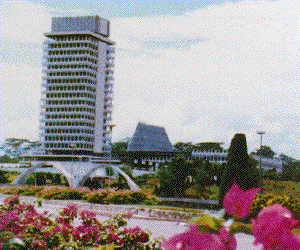
Malaysia is made up by 13 states. Which is Johor, Melaka, Pahang, Penang, Perak, Sabah, Sarawak, Terengganu, Kelantan, Negeri Sembilan, Kedah, Perlis and Selangor.
Kuala Lumpur is the federal government.
Parliament House, the symbol of democracy in Malaysia.

Because of its strategic position between the Indian Ocean and the South China Sea, Malaysia has long been the meeting place for the traders and travelers from west and east. Hence its history is one of continual interaction with foreign powers and influences.
Hindu-Buddhist influence was strong in the centuries before the coming of Islam. By 1400, when the Malacca Sultanate was at the height of its power, Islam had become a major influence. By 1511, however, Malacca had fallen to the Portuguese. Meanwhile the Dutch had been establishing their influence and presence in Jawa. By 1641, The Dutch had also taken over Malacca but they turn lost it to the British who had been slowly consolidating their hold on the Malay states following Francis Light's arrival in Penang in 1786. In 1815 Malacca was in British hands and in 1819, Stamford raffles founded Singapore. Thereafter, through treaties, relentless political pressure and diplomacy, the British slowly extended their control over all the states of the Malay Peninsula.
Sarawak , once part of the Sultan of Brunei's Empire, was ruled by a British adventurer named James Brooke and his descendants since 1841. In 1888, Sarawak and North Borneo (Sabah) become British protectorates. By 1920s, all the states that eventually comprised Malaysia were under British control. The first strings of Malaysian nationalism were felt in 1930s and following the end of World War II, the momentum of nationalism picked up again, culminating in independence for the Federation of Malaya in 1957 and the formation of Malaysia in 1963.
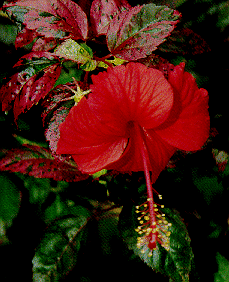
The national flower is the Bunga Raya (hibiscus) (Rosasinesis) which has an interesting history. No one knows when flower was first introduced to Malaysia but undoubtedly it came by trade from its original homeland in China, Japan and the Pacific Islands, probably before the 12th century.
From early times the Bunga Raya has been known to have many uses, mostly medicinal. Its petals were commonly used to darken and enhance women's eyebrows: some people still use the roots of the flower as a cure for fever and other ailments. Skin eruptions and glandular trouble are said to relieved by the application of the juice obtained from its leaves and roots, while a poultice prepared from the leaves is often applied to cure headache.
The Bunga Raya is found abundantly in Malaysia today. It grows in several varieties of color: the red, five-petalled grows in several varieties type was chosen for Malaysia's national flower.
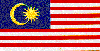
The National flag consists of fourteen red and white stripes (along the fly) of equal width, a union or canton of dark blue, a crescent and a star. The red and white stripes stand for the equal status in the federation of the member states and the federal government.
The union or canton of dark blue in the upper quarter of the flag next to the staff represents the unity of the people of Malaysia. The union contains the crescent which is the symbol of Islam, and the star, the 14 points of which symbolize the unity of the 13 states of the federation with the federal government. The yellow of the crescent and the star is the royal color of the Rulers.
The National Language, Bahasa Malaysia is established as such under Article 152 of the Constitution, which also safeguards other language by stipulating that no person may be prohibited or prevented from using (except for official purposes) or from teaching or learning any other language. As the national language, Bahasa Malaysia must be used for official purposes which includes its use by federal and state governments, and as defined by the constitutional amendment of 1971 by all authorities (including authorities) and statutory bodies. By the same constitutional amendment the status of Bahasa Malaysia may not be questioned, and amendment to Article 152 can only be made with the consent of the Conference of Rules.
An incredible number of exotic fruits are found all year round. Best places to buy fresh fruits are Pasar Tani (Farmers Market) or Pasar Malam (Night Markets). Here are brief about some of the fruits :
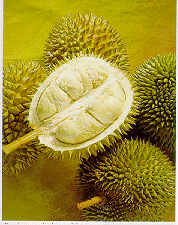
Be adventurous when trying this. The locals call it "The King of Fruits". Controversial for its smell, this thorny football-size fruit fetches a very high price. Its flesh defies all description. You'll just have to taste it!
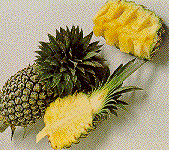
If you are in Johor, don't leave without trying the different varieties of pineapples. Johor, the 'Pineapple State' produced the juiciest pineapples.
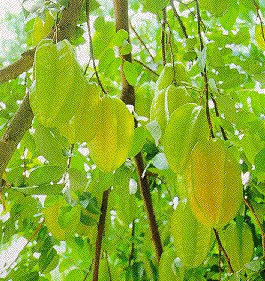
Juicy with hint of sweetness. The most delicious varieties come from Perak. When the fruit is cut across, it reveals an attractive Starshape, hence its name. This fruit is believed to lower blood pressure.
The outstanding characteristic of Malaysia's population today is its highly variegated ethnic mix makers it one of the prime examples of a multi-racial society in the whole world. The multi-ethnic character of Malaysia's population has come into being over the course of the last 150 years. Broadly speaking Malaysia's ethnic groups fall into two main categories: those with culture affinities indigenous to the region and to one on other, who are classified as Bumiputera; and those whose cultural affinities lie outside.
Malaysia is a multi-cultural nation of friendly, warm hearted people. It has population of 17.9 million people. Peninsular Malaysia has 14.6 million people while Sabah and Sarawak have 3.3 million people.
Festival is joyful occasions in Malaysia. It is the time for family re-unions, rejoicing with friends and colleagues and remind them of the religious significance each festival holds.
Festival in this country reflect the roots of the various races who are proud to be called Malaysians. Malaysians festivals are colorful, exciting and portray the spirit of unity and togetherness that the country is proud of despite each race practicing their varied cultures and religions.
Chinese New Year
Hari Raya
Deepavali
Malaysia Fest
Mooncake Festival
Festival of San Pedro, Portuguese Settlement, Malacca
Flora Fest
Malaysia is a nation of diversity in unity where Malays, Chinese, Indians and indigenous people of Sabah and Sarawak live caring culture harmony.
Once you have overcome your jet-lag fatigue, step into the real heart of Malaysia-the citizens of the country. You would be pleasantly surprised at the warmth of Malaysians. For deeply entrenched within each of the different race is the engaging charm and traditional hospitality which the country is renowned for.
Malaysia enjoy meeting from other lands. So, do go right ahead and strike up a conversation. After all, the whole point of traveling is to know other cultures.