Cellular Transport Notes
[Cellular Transport Review]
[Fall Semester]
[Home]
Cellular Transport is the transport of materials across the plasma membrane. It is carried out by all membranes within a cell. You will learn about the parts of the membrane and how its structure is related to the functions of the cell.
Let us first consider:
The Characteristics of Life
- Cellular Organizationall of life is composed of cells.
- Homeostasis - the ability to control internal conditions within an organism. (Internal stability)
Examples in humans:
- Body Temperature
- Blood pH
- Glucose levels in the blood �blood sugar�
- Metabolism � the total sum of all chemical reactions that is carried out by an organism.
- Reproduction � the ability to produce offspring or �recreate itself�.
- Heredity � In reproducing itself, an organism must pass on to the next generation a set of instructions or blueprints for the construction of the organism. These blueprints are called genes.
These characteristics are still up for discussion. For example, viruses are considered by most scientists to be non-living because they have no metabolism and no means of homeostasis. They do, however, have organic material like DNA and/or RNA. But are they really living?
It is important to understand here that the membrane systems in cells �
- protect the DNA, so it protects our genes. (Nuclear Envelope)
- aid in metabolism. Enzymes embedded in membranes control most chemical reactions of the cell.
- maintains homeostasis by controlling what goes in and out of the cell. (Cellular Transport)
Homeostasis in a cell
Cells exist in an aqueous (water) environment that carries dissolved food, oxygen, and wastes to and from the cell. For a cell to function, it must maintain stable internal conditions. The plasma membrane maintains this homeostasis by controlling what goes in and out of the cell. (Selectively Permeable) This characteristic of cells can be related to the structure of the membrane:
Parts of the Plasma Membrane:
- The lipid bilayer is made up of two layers of phospholipid molecules. It is considered a �fluid�, which means these molecules can flow around each other. Phospholipids are not bonded together.
- A phospholipid is a lipid that has a polar head and a non-polar tail.
- This lipid bilayer has a nonpolar region in the middle of its layers:
- Very small polar molecules (water), and dissolved gases (carbon dioxide, nitrogen, and oxygen) can diffuse through the lipid bilayer.
- The nonpolar region repels / does not allow ions (Na+, Cl-, Ca+, K+), large polar molecules (glucose), and large lipid molecules to diffuse through the lipid bilayer.
- Cholesterol keeps the phospholipid membrane rigid and flexible.
- Transport Proteins are proteins that provide a passageway for larger particles and ions to pass.
These proteins extend through the membrane and are classified by their shapes:
- Pumps and gates: transport proteins that use energy to change their shape, controlling when and how many particles can pass through the membrane.
- Tunnels/Pores: do not change shape, but have polar/nonpolar regions that allow only certain particles to pass.
Cellular Transport: The Movement of Particles through a Plasma Membrane.
Passive Vs. Active Transport
| Passive Transport |
Active Transport |
| No energy is needed to move particles through the membrane |
Energy is needed to move particles through the membrane |
| Random movement (Diffusion) |
Energy moves particles to where they are needed. |
| From high to low concentration |
From low to high concentration |
Passive Transport: The random movement of particles from an area of high concentration to an area of low concentration.
There are three types of passive transport: (1)Diffusion, (2)Osmosis, and (3)Facilitated Diffusion.
- Diffusion is the random movement of particles from an area of high concentration to an area of low concentration to establish equilibrium.
- Equilibrium is the state of balance where the same concentration of solutes is found throughout the solution. In the case of cells, equilibrium means that the concentrations of solutes on both sides of the plasma membrane are equal.
- Facilitated Diffusion (Facilitated - helped or aided). is passive transport that uses transport proteins to diffuse polar molecules like glucose and amino acids, charged ions, and very large molecules ions and larger particles across the membrane. (These particles can not pass through the lipid bilayer.)
- Osmosis is the diffusion of water through a selectively permeable membrane. Water diffuses faster than any other particles through the membrane. Thus, water tries to establish equilibrium across the membrane. Water will always diffuse across a membrane to where there is a higher concentration of solutes. Water attempts to dissolve them and establish equilibrium on both sides of the membrane.
- Cells cannot stop the diffusion of water through membranes. As a result, the osmotic pressure puts stress on the membranes of the cell. This pressure on cell membranes can have disastrous effects.
Let us assume that a red blood cell is 80% water and 20% dissolved substances.
If this cell is placed in a hypertonic solution, then this will mean that the concentration of dissolved particles is higher outside the cell than inside the cell.(DS= Dissolved Substances/solutes)
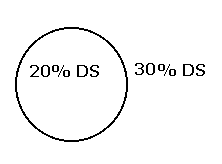 |
The environment is Hypertonic to the cell.
|
If the red blood cell is placed in a hypotonic solution, then this will mean that the concentration of dissolved particles is lower outside the cell than inside the cell.
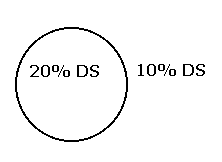 |
The environment is Hypotonic to the cell.
|
If the cell is placed in an isotonic solution (iso- equal), then this will mean that the concentration of dissolved particles is the same both inside and outside the same.
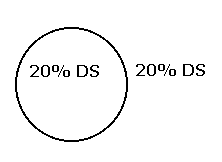 |
The environment is Isotonic to the cell
|
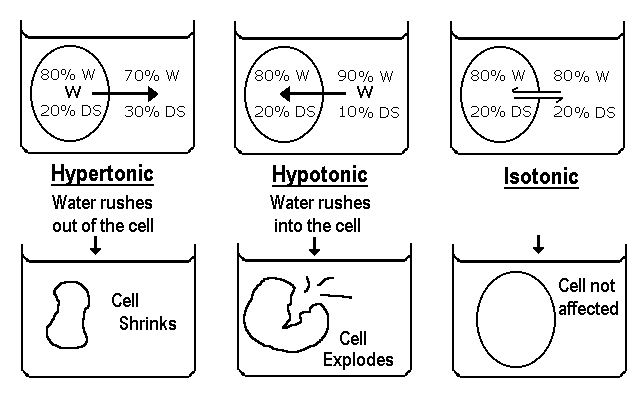
So what happens to the cell in hypertonic, hypotonic, and isotonic solutions?
Remember: Water diffuses faster than dissolved substances, thus water will move to where there is a higher concentration of dissolved substances / solutes.
DS= % concentration of Dissolved Substances/solutes
W= % concentration of Water
Dealing with Osmotic Pressure:
- Homeostasis in Animals:
- Animals use kidneys to balance blood volume/pressure.
- In some fresh-water organisms like paramecium, contractile vacuoles are used to collect and pump out water that is constantly diffusion into the cell due to osmosis. These vacuoles can aid in cell movement.
- Marine fish have gills that actively pump salt out of their bodies.
- Homeostasis in Plants:
Plants use osmotic pressure to their advantage. A plant cell has one large water-filled vacuole that supports the cell by putting pressure on the cell walls. This pressure inside the plant cell is called tugor pressure. Thankfully, the cell wall prevents the pressure from reaching the bursting point of the plasma membrane. Decreasing tugor pressure (decreasing water content) can cause a plant to wilt.
Active Transport is the process of moving particles across a selectively permeable membrane from an area of low concentration to an area of high concentration. This is like pushing a bolder up-hill; it takes a lot of energy. It usually requires transport proteins to pump needed particles across the membrane.
Taking in large bulky material using Active Transport:
- Endocytosis � is the process of taking in bulk materials by bulging the membrane inward enclosing the particles into a pocket or bubble. These membrane bubbles break off and float around inside the cell. � Ex. An amoeba ingesting food.
- Exocytosis � is the process of removing large particles from the cell. Pockets or bubbles of material fuse with the plasma membrane releasing the particles out of the cell. The left over particles from the amoeba�s dinner are released in this way. This is also how hormones are released from gland cells.
Back to Top