Organic Chemistry Notes
[ Enzyme Notes]
[Organic Chemistry Review]
[Fall Semester]
[Home]
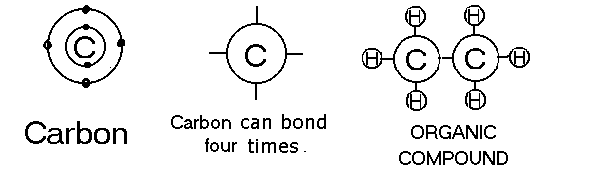
- 99% of all organisms are made up of carbon, hydrogen, oxygen, and nitrogen.
- Because the carbon atom bonds four times, it is used as the central building block to build the complex rings, chains, and branched chains seen in organic molecules.
- Organic compounds are compounds created by living organisms that contain carbon-to-carbon bonds.
- There are four main classes of organic compounds: Carbohydrates, lipids, proteins, and nucleic acids.
- These giant molecules are referred to as macromolecules.
- Most macromolecules are polymers. Polymers are made up of repeating subunits or �building blocks� called monomers. Polymers are built and destroyed by the following two reactions:
- Condensation reactions join monomers to build polymers. It is called "condensation" because in bonding two monomers a water molecule is lost.
- Hydrolysis reactions break polymers down using water. (Hydro -means water Lysis -means to break).
- Carbohydrates are starches and sugars that provides our main source of energy.
- Made up of carbon, hydrogen, and oxygen atoms bonded in a ratio of 1carbon: 2 hydrogen: 1 oxygen.
- Monosaccharides (simple sugars)
- These simple sugars are the monomers of carbohydrates.
- C6H12O6 is the chemical formula for all monosaccharides. They differ only in three dimensional shape, making them isomers to each other.
- Isomers are molecules that have the same chemical formula but different structural shapes.
- Examples of monosaccharides:
- Glucose is a simple sugar produced by plants that serves as the primary energy source for plants and animals alike. Glucose is referred to as our "blood sugar".
- Fructose is fruit sugar. It is the sweetest sugar.
- Galactose is milk sugar.
- Disaccharides(double sugar) are formed from the bonding of two monosaccarides.
- Sucrose or �table sugar� is made up of one glucose molecule bonded to one fructose molecule. Sugar cane and sugar beets have high amounts of sucrose. Plants create disaccharides as a means to transport food within the plant. (Sap)
- Lactose or �milk sugar� is made of one unit of glucose and one unit of galactose. People who are lactose intolerant lack the enzymes that break the bond between the glucose and lactose.
- Polysaccharides (many sugars) are formed when many glucose molecules are bonded together forming long chains.(glucose storage molecules)
- Starch: glucose storage molecule in plants. Potatoes, corn, and wheat store large amounts of starch.
- Glycogen: glucose storage molecule in animal liver and muscle. (branching chain of glucose)
- Cellulose: compact chains that form the cell walls of plants. Cellulose can not be digested by humans. It is a source of "dietary fiber" that helps clean our digestive system.
- Lipids are energy storage molecules that include fats, oils, and waxes.
- The basic unit of a lipid is a fatty acid. A fatty acid is made up two parts. The �fatty� part is made up a very long carbon and hydrogen chain. The �acid� part is a carboxylic acid (�COOH group). A typical fatty acid chain is made up of at least 20 carbon atoms.
- Triglycerides are the common form of fats. It is made up of three fatty acids bonded together by a glycerol. (forms an "E" shape) Triglycerides are nonpolar meaning they do not dissolve in water.
- Function of lipids:
- Long-term storage (1 gram fat=9 calories, 1 gram of carbohydrate=4 calories) Lipids store more energy than carbohydrates, but are not our preferred energy source. (Glucose is smaller and easer to burn.)
- Insulation
- Major part of cell membranes
- Types of Lipids:
- Saturated fats are animal fats and waxes that are solid at room temperature. Some exceptions include coconut and palm oils (liquid). These fats should be limited in your diet. They are triglycerides that have fatty acid chains that are �saturated� with hydrogen. Each carbon is bonded with two hydrogen atoms each.
- Unsaturated fats are liquid oils at room temperature.(Most vegetable oils) They are triglycerides that have fatty acid chains, which are not "saturated" with hydrogen. Some carbon atoms are double bonded to each other creating kinks.
- Steroids are smaller lipids, which include cholesterol and hormones.
- Phospholipids are lipids found in the membranes of cells.
- Nucleic Acids store genetic information in long strands of repeating subunits called nucleotides.
A nucleotide is made up of three parts: A phosphate group, a five-carbon sugar, and nitrogen base. There are four different types of nucleotides (different nitrogen bases.)
Nucleotides are strung together to make large polymers:
- A DNA molecule consists two twisting strands of nucleotides, which uses deoxyribose as its 5-carbon sugar. These molecules are found in the nucleus of a cell and are involved in heredity.
- A RNA molecule consists of one strand of nucleotides, which uses ribose as its 5-carbon sugar. Its function is to carry out the instructions found in DNA to create proteins.
- Proteins are polymers made up of subunits called amino acids.
An amino acid is made up of a central carbon atom bonded to a carboxyl group (-COOH), an amino group, (-NH2), a hydrogen atom, and a fourth variable group that is represented by an "R". Changing the "R" group, changes the amino acid.
There are 20 common amino acids in humans that are strung together in various ways to form long chains. An amino acid chain then bends and folds on itself forming a protein.
- Protein rich foods: fish, eggs, legumes(beans), and meats.
- The protein's shape determines a it's function.
- Structural Proteins are used to create important structures in our bodies like skin, muscles, hair, cartilage, tendons, and fingernails.
- Enzymes are proteins that help control chemical reactions.
- Enzymes are referred to as catalyst meaning they speed up chemical reactions by decreasing the amount of activation energy needed.
- Enzymes are very sensitive to their environment. Chemicals, temperature changes, and pH changes can affect a protein's shape. The destruction of a protein's shape is called denaturation.
Enzyme Notes
The Four major Macromolecules:
- Carbohydrates:
- Subunits: Monosaccharides.
- Classes:
- Monosaccharides: Glucose, Fructose, and Galactose
- Disaccharides: Sucrose and Lactose
- Polysaccharides: Starches, Glycogen, and Cellulose
- Lipids:
- Subunits: Fatty Acids
- Classes:
- Saturated Fats: Animal Fat and Waxes(solid)
- Unsaturated Fats: Vegetable Oils (liquid)
- Proteins:
- Subunits: Amino Acids
- Classes:
- Structural Proteins
- Enzymes
- Nucleic Acids:
- Subunits: Nucleotides
- Classes:
Back to Top