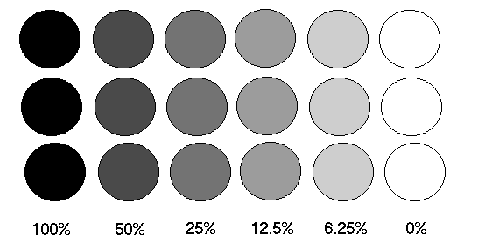
The mud test is used to test the toxicity of used oilfield drilling muds (offshore drilling). EPA (The Environmental Protection Agency) states that if 50% or more of the fish live in the bowls with the 12.5% mud concentration, then the mud passed the test. This regulation stands even if all of the fish die at the 100% concentration.
Variables:
"C"-constants,"I"-Independent variable, "D"-Dependent variable
C-18 bowls and nets
I-Mud sample in the above concentrations
D-20 live fish per bowl
C-Salt water with a controlled salinity (salt content)
C-Constant oxygen supply
C-Feedings: twice a day
C-Duration of test: 98 hours
Which is the independent variable?
The variable being tested is the mud. We are testing to see how toxic it is.
Which is the dependent variable?
The variable that "depends" on the mud is the fish. We will measure the number of fish that live at the end of the experiment.
What are the constants in this experiment?
All other variables are called constants. This is because they must remain the same throughout the experiment so is not to interfer with the results.
Why are there three replicas (bowls) for each concentration?
We only really need one bowl for each concentration for this experiment. By having three bowls for each, we are running the same experiment three times. By comparing the results in these bowls we can tell if the data is valid or not.
Which bowls make up the control group? Why is the control group needed?
The control group consists of the bowls with zero percent concentration of mud. By having a bowl without mud (O%), we can check for any problems that might exist with the dependent variable or constants. For example, what if we happened to use a bad batch of fish? We would not be able to tell if we did not have that "control" bowl without mud.
Which bowls make up the experimental group?
All bowls with the mud (indep. var.) are part of the experimental group.
Why is this mud test a controlled experiment?
We are isolating one variable (indep.) and changing it in a controlled way and monitoring its effect if any on a second variable (dependent).
Mud A- passed. More than 50% of the fish lived in the 12.5% concentration. Problems: No fish lived in the first bowl in the 12.5% conc. This might have been do to problems with the air supply to that bowl. (This is why we have replicas.)
Mud B- Failed. Less than 50% of the fish lived in the 12.5% concentration.
Mud C- Passed. At least 50% of the fish lived in the 12.5% concentration.
Mud D- Invalid results. This data can not be used because fish died in the control group (zero%).